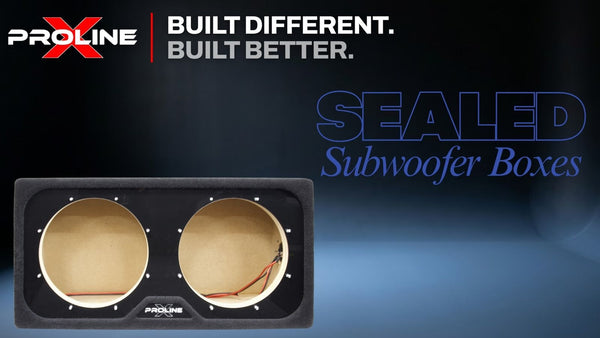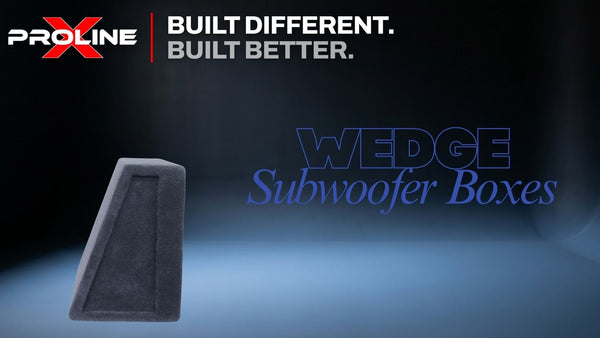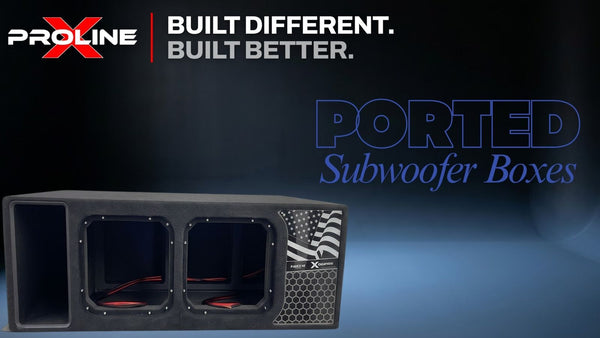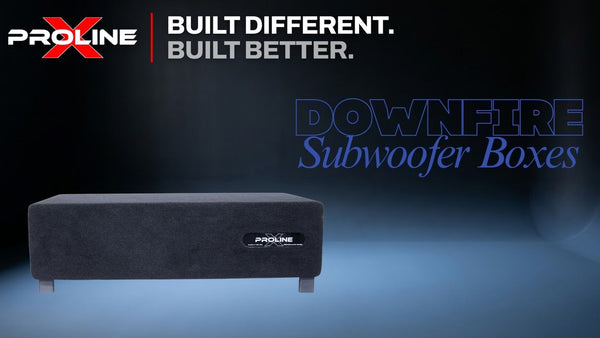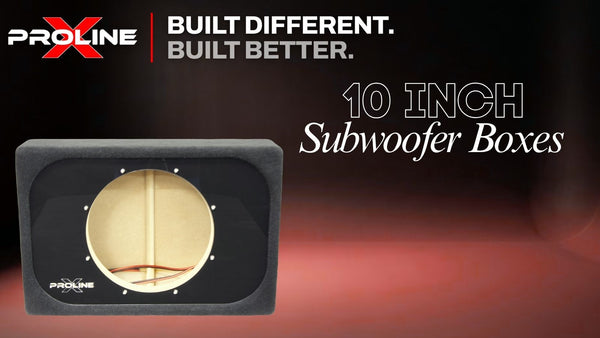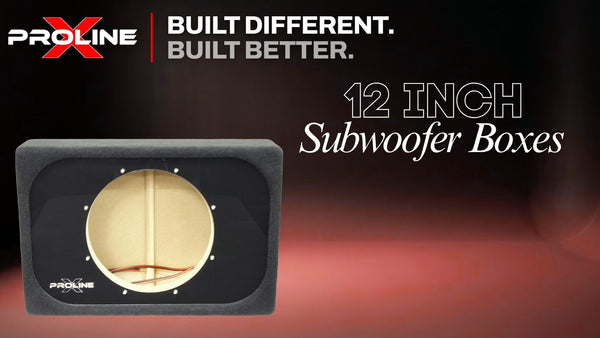

Performance Optimized Wedge Sealed Dual 8" Enclosure | PowerBass XL-844
$ 249.99
In stock and ready to ship!
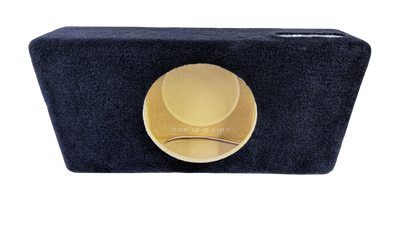
DetailsSealed and ported enclosures cut for PowerBass subwoofers in wedge and down-fire, CNC-machined in Tullahoma, Tennessee.

Sealed and Ported, Wedge and Down Fire, 8 to 15 Inch
Sealed and ported PowerBass enclosures from 8 to 15 inch, single and dual, in rear-firing wedge and down-fire, all Performance Optimized on a 1.5 inch double baffle.




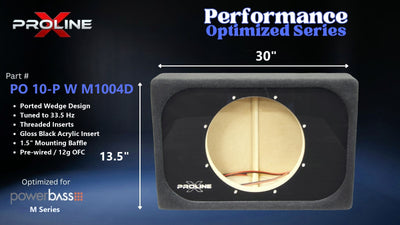
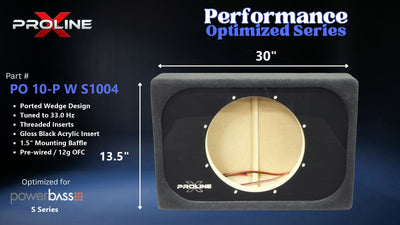
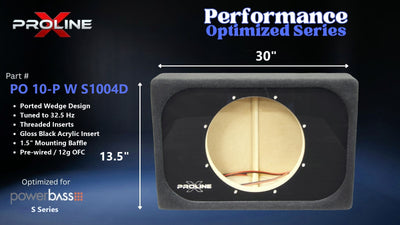
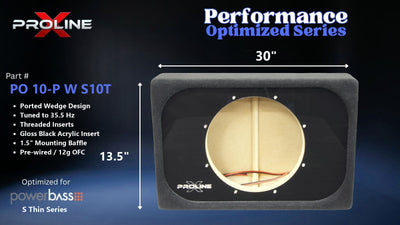
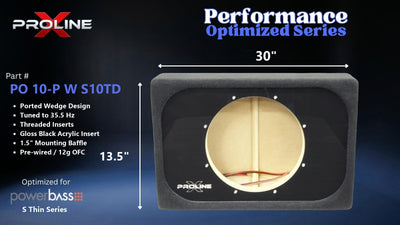
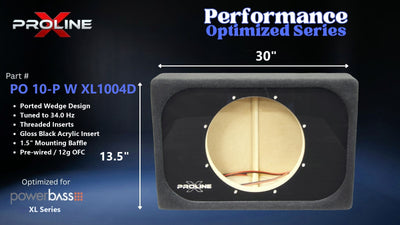
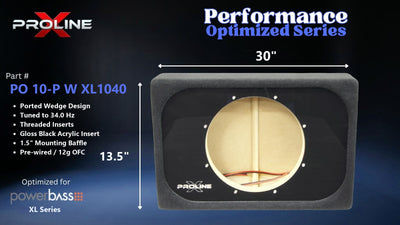
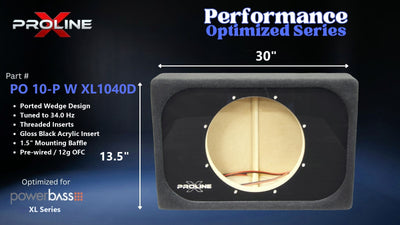
Every enclosure here is cut for a specific PowerBass driver, sealed or ported. The first decision is not the subwoofer, it is where the cabinet has to live.
| Down Fire | Wedge | |
|---|---|---|
| Goes where | Under or behind a seat | Trunk or cargo area |
| Constraint it solves | Vertical height | Floor space |
| Installed height | 6.65 to 9.03 in including the 1.75 in standoff | 11 to 18 in, sits against the seat back |
| Driver | XL-T shallow mount only | XL, 2XL and 3XL conventional depth sealed; L, M, S, XL, 2XL and 3XL ported |
| Sizes | 10 and 12 inch, single or dual | 8, 10, 12 and 15 inch |
| Net airspace | 0.30 to 0.40 cu ft per driver | 0.50 to 2.25 cu ft per driver |
| Alignment | Qtc 0.91 to 1.15, firm by necessity in that little air | Sealed Qtc 0.60 to 0.71, well damped; ported tuning per driver |
| Price from | $239.99 | $229.99 |
This is where the range differs most, and it is worth reading before you shop on diameter. Half power lands anywhere from 46 to 62 Hz depending on the driver, and the two sealed 12 inch wedges are 16 Hz apart from each other. A bigger cone does not mean a lower cabinet.
| Driver | Offered as | Qtc | F3 | Character |
|---|---|---|---|---|
| XL-1244 | 12 inch, single or dual | 0.714 | 46.2 Hz | The deepest sealed reach in the range and a textbook Butterworth alignment. |
| 3XL-1510D | 15 inch, single | 0.680 | 46.1 Hz | Same reach as the XL-1244 with far more cone and a 1500 watt RMS rating. |
| 2XL-1040D | 10 inch, single or dual | 0.630 | 51.2 Hz | Long-throw 10 with 11.5 mm of travel, in the smallest cabinet of the 10s. |
| XL-1044 | 10 inch, single or dual | 0.637 | 55.0 Hz | The value 10. Efficient, easy to drive, modest excursion. |
| XL-844 | 8 inch, dual only | 0.610 | 59.8 Hz | For builds with no room for a 10. Very stiff suspension, dry and quick. |
| 2XL-1240D | 12 inch, single or dual | 0.601 | 62.3 Hz | A Qts of 0.334 puts it past the knee for sealed loading. Big cone, big travel, but it gives up the low end a sealed 12 can otherwise reach. |
For more output than a sealed cabinet gives, ported wedges are cut for six PowerBass lines from 8 to 15 inch. Each carries a triangular corner slot port solved from that driver's published parameters, with the tuning frequency and net volume stated on the listing, and each ships without polyfill because fill would move the tuning.
| Line | Models | Sizes | Net volume | Tuning |
|---|---|---|---|---|
| S | S-84, S-1004, S-1004D, S-10T, S-10TD, S-1204, S-1204D, S-12T, S-12TD | 8, 10, 12 | 0.69 to 1.73 cu ft | 32.5 to 35.5 Hz |
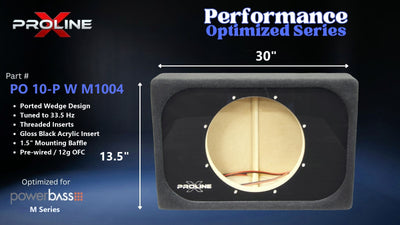
| M | M-1004, M-1004D, M-1204, M-1204D, M-1504, M-1504D | 10, 12, 15 | 1.15 to 2.22 cu ft | 28 to 33.5 Hz |
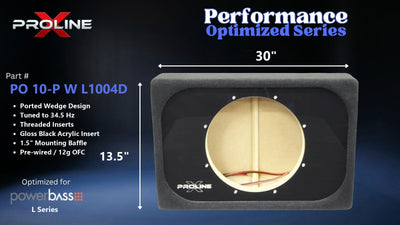
| L | L-1004D, L-1204D, L-1504D | 10, 12, 15 | 1.13 to 2.02 cu ft | 31 to 34.5 Hz |
| XL | XL-1004D, XL-1040, XL-1040D, XL-1040T, XL-1044, XL-104MF, XL-1204D, XL-1240, XL-1240D, XL-1240T, XL-1244, XL-124MF | 10, 12 | 0.82 to 2.23 cu ft | 32.5 to 37 Hz |
| 2XL | 2XL-1204D, 2XL-1240D | 12 | 1.08 to 1.45 cu ft | 32.5 to 35 Hz |
| 3XL | 3XL-1501D, 3XL-1502D | 15 | 2.33 to 2.36 cu ft | 32 to 32.5 Hz |
Shared across every cabinet: Langboard Elite MDF cut on ShopSabre routers in Tullahoma, Tennessee. A 1.5 inch double front baffle. Plush black carpet. A Proline X ABS and carbon fibre composite terminal cup with stainless hardware, pre-wired in 12-gauge OFC. Threaded inserts at every mounting location. Polyfill installed in the sealed builds.
Half power across the sealed cabinets runs from 46.1 Hz to 62.3 Hz, and the two sealed 12 inch wedges sit at opposite ends of that. The XL-1244 reaches 46.2. The 2XL-1240D reaches 62.3, because its Qts of 0.334 is past the knee for sealed loading. Both are correct for their driver. Read the alignment on the listing before you shop on diameter.
Airspace comes from the recommended enclosure tables in PowerBass owner's manuals. Cutout, mounting depth and frame diameter come from their cutout templates. Alignment is computed from their published Thiele-Small parameters, and on every 2XL and 3XL model our figures land within 0.02 on Qtc of what PowerBass prints themselves.
Every cabinet is Performance Optimized. The sealed builds use the airspace PowerBass publishes for the driver, and each product page states its net volume, alignment and external dimensions.
Each cabinet is cut for one specific model, and the product title names it. The sealed wedges cover the XL-844, XL-1044, XL-1244, 2XL-1040D, 2XL-1240D and 3XL-1510D, and the sealed down-fire boxes the shallow mount XL-1040T and XL-1240T. The ported wedges cover the S, M, L, XL, 2XL and 3XL lines from 8 to 15 inch, with the model on every listing. Match the model, not the diameter: a shallow mount 10 and a conventional 10 share neither cutout nor mounting depth nor recommended volume.
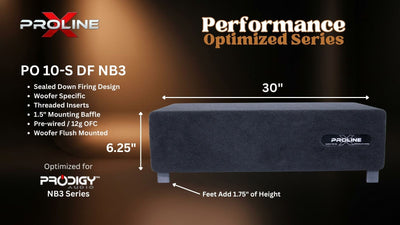
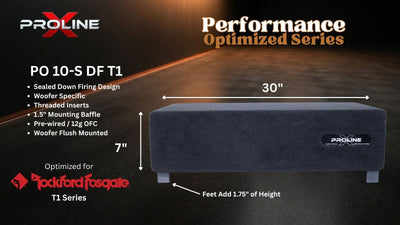
The vehicle decides. A down-fire cabinet fires at the floor and stands 1.75 inches off it, so installed height runs 6.65 to 9.03 inches and it goes under or behind a seat. A wedge leans against the rear seat back and fires into the trunk, so it needs floor space rather than headroom. If a conventional box fits your trunk, the wedges use better drivers and reach lower.
Because the drivers are different. The XL-1244 reaches 46.2 Hz and the 2XL-1240D reaches 62.3 Hz, both anechoic, both in the airspace PowerBass specifies. The 2XL-1240D has a Qts of 0.334, which puts it past the knee for sealed loading, and no sealed cabinet takes it much below 61 Hz. It is the better driver on paper and the worse one in a sealed box. If low extension is the goal, the XL-1244 is the 12 to buy.
Not by choice. A shallow mount driver exists for installs with no room, and PowerBass specifies 0.30 to 0.40 cubic feet for the XL-T models. That little air produces a firm alignment, Qtc 0.91 on the ten and 1.15 on the twelve. Firing down at a hard floor close to a boundary is what recovers some of the low end in the vehicle.
No. We build the enclosure and you source the driver. The sealed cabinets are cut to the airspace PowerBass publishes for its own model and the ported ones to its published parameters, so they suit a subwoofer you already own or buy elsewhere.
It depends on the driver. The XL-844, XL-1044 and XL-1244 are single 4 ohm voice coils, so a single is 4 ohms and a pair is 2 ohms in parallel. The 2XL models are dual 4 ohm. The 3XL-1510D is dual 1 ohm, which parallels to 0.5 ohms, so series 2 ohm wiring is the default answer on that one. Each product page states its own options.
Both. The sealed wedges and down-fire cabinets ship with polyfill already installed as a light lining; it damps the inside of the box and is part of how each cabinet was specified, so do not add or remove it. The ported wedges are solved from each driver's published parameters with a triangular corner slot port and the tuning stated on the listing, and they ship without polyfill because fill would move the tuning.
Related Collections
Browse curated picks that work with the products above.
Proline X
$ 159.99 $ 179.99
Proline X
$ 169.99 $ 179.99
Proline X
$ 229.99
Proline X
$ 229.99
Related Collections
Browse curated picks that work with the products above.
Proline X
$ 169.99
Proline X
$ 179.99
Proline X
$ 249.99
Proline X
$ 249.99
Amplifiers for the System
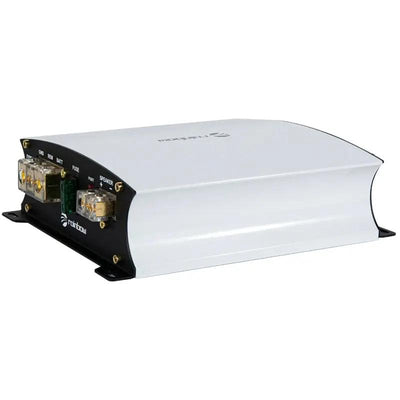
Monoblock amplifiers matched to the power requirements of the drivers these enclosures are built for. Buy the enclosure, match the driver, pick the right amplifier.
Rainbow
$ 89.99 $ 399.99
Rainbow
$ 98.99 $ 549.99
US Acoustics
$ 159.99
US Acoustics
$ 159.99
Last updated September 5, 2026