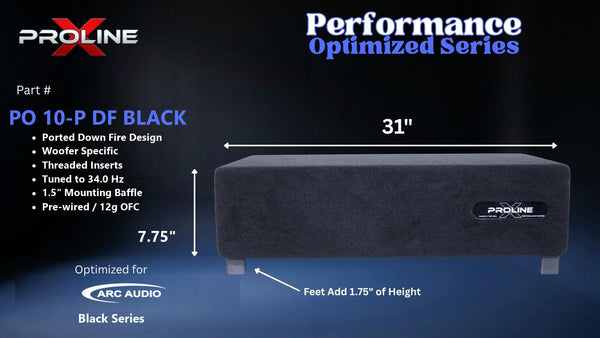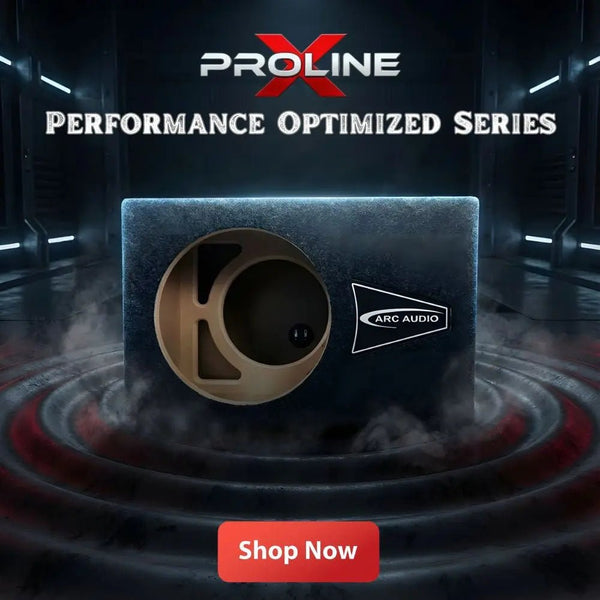
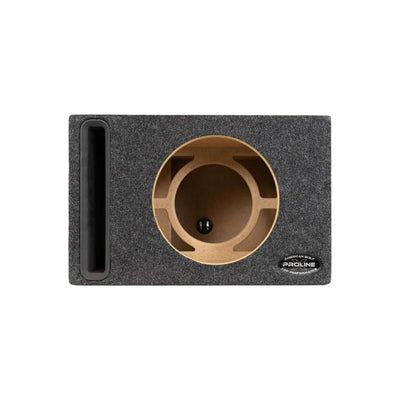
Proline X P10-P | Single 10" Ported Subwoofer Enclosure | V3
$ 199.99
In stock and ready to ship!
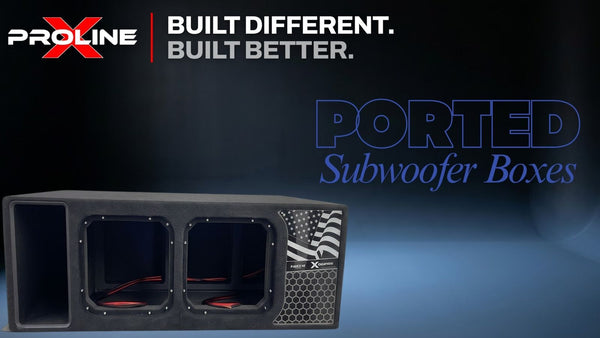
DetailsPorted cabinets for 10 inch drivers with the tuning frequency on every card, standard, down-fire and wedge. CNC-cut in Tullahoma.

Ported, 10 Inch
Ported 10 inch cabinets in stock today | single and dual | standard, down-fire and wedge | Performance, Performance Optimized and Professional | tuning stated per cabinet
Decision Shortcut
Curated picks matched to common build goals
Best Value
Proline X
P10-P Single 10" Ported Subwoofer Enclosure. The lowest-priced ported 10 inch cabinet on the page, standard orientation, 1.2 cubic feet net.
$ 199.99
View DetailsBest for Trucks
Proline X
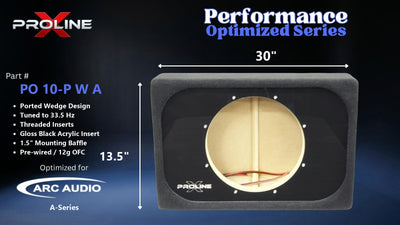
Arc Audio A-Series 10. A wedge cabinet tapered to sit flush against a seat back, tuned to 33.5 Hz.
$ 349.99
View DetailsShallowest Cabinet
Proline X
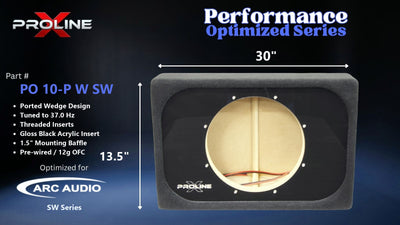
Arc Audio SW 10. 11.3 inches deep, the shallowest ported 10 inch cabinet in stock, for openings a standard box will not take.
$ 349.99
View DetailsLowest Tuning
Proline X
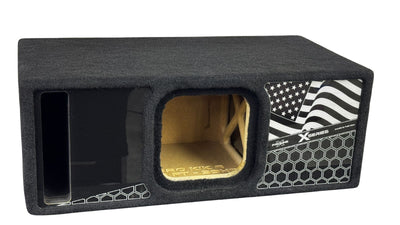
X Series cabinet that fits Kicker Solo X 10" Subwoofer. Tuned to 31 Hz, the lowest on the page, for a driver whose free-air resonance earns it.
$ 484.99
View Details


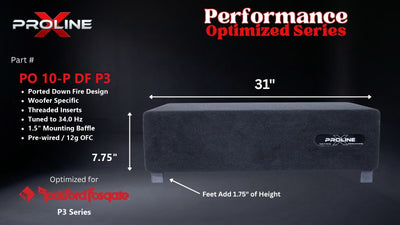
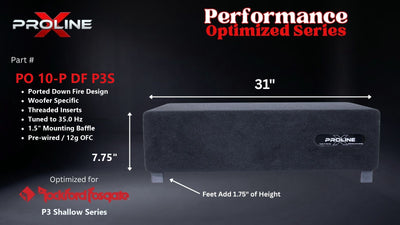
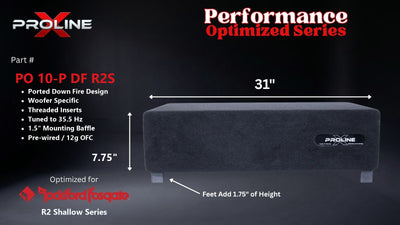
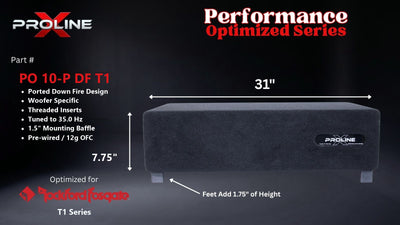
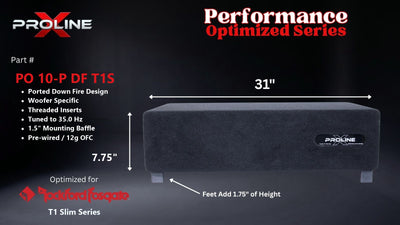
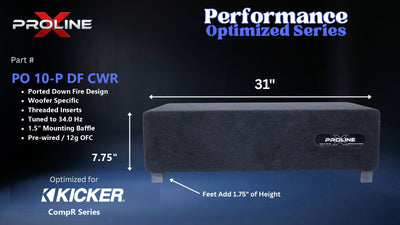
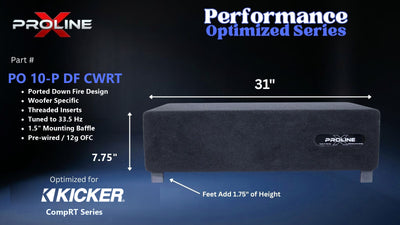
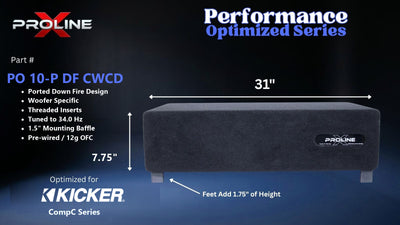
Same driver size, same shop, same materials. The alignment changes the cabinet, what the listing has to tell you and what you do at the amplifier. This page is the ported half; the sealed 10 inch page is the other.
| Sealed 10 inch | Ported 10 inch | |
|---|---|---|
| Net volume | Smaller for the same driver | Larger, with the port's own volume added |
| Polyfill | Installed on every build | None. Ships dry so the tuning holds |
| Tuning stated | No, a sealed box has none | Yes, on every listing |
| Output | Flat passband, gentle 12 dB per octave roll-off | More output around tuning for the same power |
| Subsonic filter | An improvement | A requirement, set just under tuning |
| Pick it when | Space is tight, music is wide, or you want a dual | The space is there and output per watt matters |
Shared across both: Langboard Elite MDF at 48.5 lbs per cubic foot, 200 psi internal bond and 410,000 psi MOE, cut on ShopSabre routers in Tullahoma and carpeted in house.
Fires forward, stands on its base. The shape for a trunk with height or a cargo floor with room behind the seat.
Warranty 1 or 2 years by series
Driver on the bottom baffle, on feet that set the clearance. The floor loads the cone and protects it from cargo.
1 year limited warranty on Performance Optimized
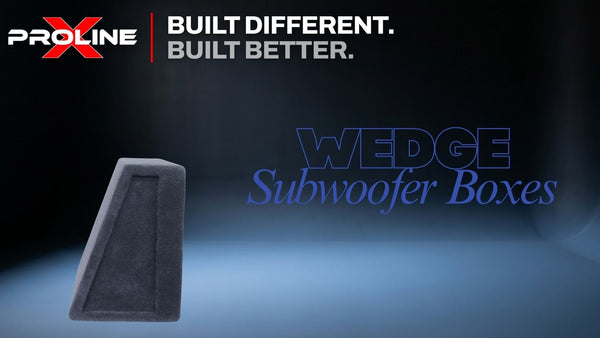
Tapered on the rear panel to sit flush against a seat. The truck cabinet, and the shape that leads at the larger sizes.
1 year limited warranty on Performance Optimized
Prices are the lowest in stock for each shape today. Depth, net volume and, on ported builds, tuning are what change from card to card.
Supporting guides to help you design, build, and tune your system.
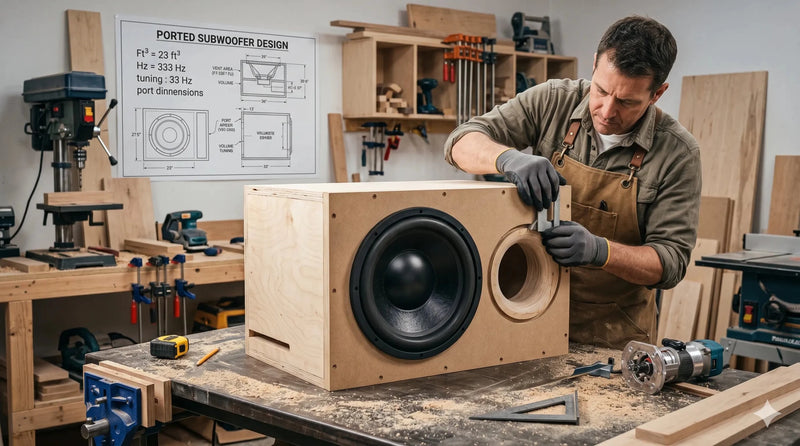 Explainer
How net volume, port area and tuning frequency are set from the driver, and what goes wrong when they are not.
Read the guideSee what a given volume and port do to tuning, and why the listing's number is the one to trust.
Read the guide Application
Every ported cabinet needs one. Where to set it relative to the tuning frequency, and why.
Read the guide Decision
What each alignment actually does, with measurements. The sealed 10 inch page is the other half of this decision.
Read the guideHow much vent a high-excursion driver needs before the port chuffs, which is the constraint these ports are sized to.
Read the guide Decision
What changes when the port is folded into a down-fire cabinet, the shape a large share of this page takes.
Read the guideEach listing states its own, and across this page tuning runs 31 to 40 Hz. That is deliberate: a vehicle adds roughly 12 dB per octave below about 45 Hz, so tuning near the driver's own resonance keeps the cone quiet where the port is doing the work instead of doubling up on what the cabin already does.
Net volume on this page runs 0.8 to 2 cubic feet for a single-driver cabinet, quoted for the box, and every listing states its own. A ported cabinet is larger than a sealed one for the same driver because the port needs volume of its own and the alignment wants more air behind the cone.
No, and do not add any. Every sealed cabinet we build ships with polyfill, but damping material changes the volume a port is tuned against. Stuff a ported box and you move the tuning without shortening the port, which gives you a mistuned enclosure rather than a bigger-sounding one.
Yes. Below its tuning frequency a ported box stops loading the cone and excursion runs away toward the driver's limits. Set the amplifier's subsonic filter just under the tuning stated on the listing. On a sealed build the same filter is an improvement; on a ported one it is a requirement.
Yes. This page carries dual cabinets alongside the singles. A ported dual shares one tuned chamber, so the stated tuning applies to both drivers.
Limited warranty runs by series from the original date of purchase: one year on Performance and Performance Optimized; two years on Professional. It covers structural failure and manufacturing defects for the original purchaser.
For hip-hop, trap and bass-heavy electronic music, the lowest-tuned 10s here, 31 to 33 Hz, reach furthest into the 808 range, in the larger cabinets. For rock, metal and country, the 36 to 40 Hz cabinets keep kick drum punch and are the most compact. For a mixed playlist, 34 to 36 Hz is the safe middle and where most of this page sits. If the music is mostly sub-bass and the space allows, a ported 12 reaches deeper at the same output.
Every box is cut to one driver's published specs. Pick the brand your subwoofer comes from.
Drivers Built to Match
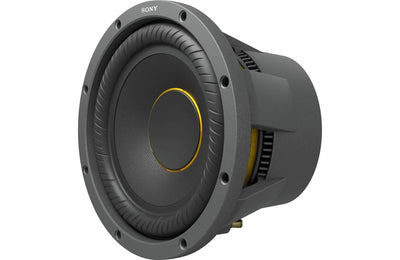
The drivers below are matched to the enclosures above by Thiele-Small parameters. Buying together guarantees the alignment, port tuning, and damping work the way the engineering intended.

Prodigy Audio
$ 138.99 $ 145.99

Image Dynamics
$ 139.99

Prodigy Audio
$ 148.99 $ 165.99
Sony
$ 198.00 $ 299.99
Amplifiers for the System
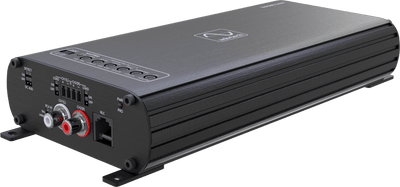
Monoblock amplifiers matched to the power requirements of the drivers these enclosures are built for. Buy the enclosure, match the driver, pick the right amplifier.
Amplifiers for the System
Monoblock amplifiers matched to the power requirements of the drivers these enclosures are built for. Buy the enclosure, match the driver, pick the right amplifier.
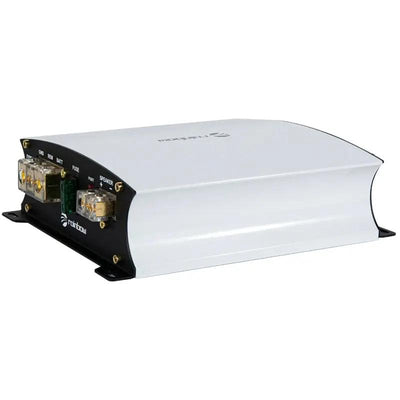
Rainbow
$ 89.99 $ 399.99
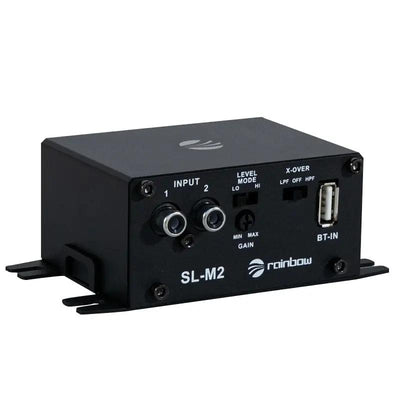
Rainbow
$ 98.99 $ 549.99
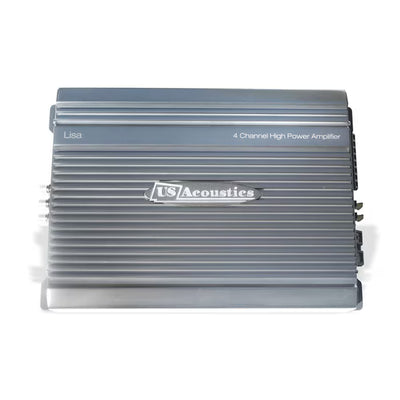
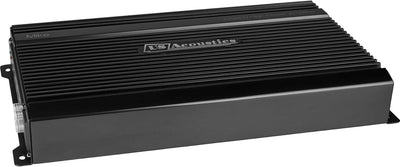
US Acoustics
$ 159.99
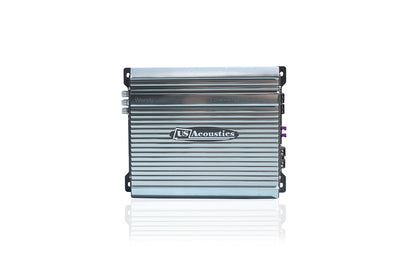
US Acoustics
$ 159.99
Last updated September 5, 2026