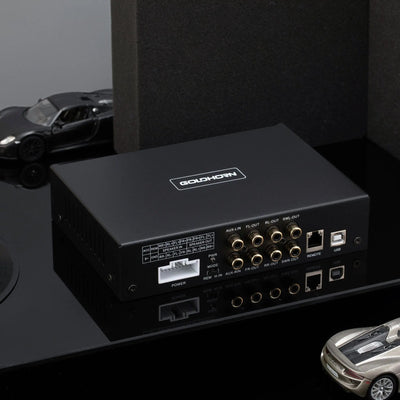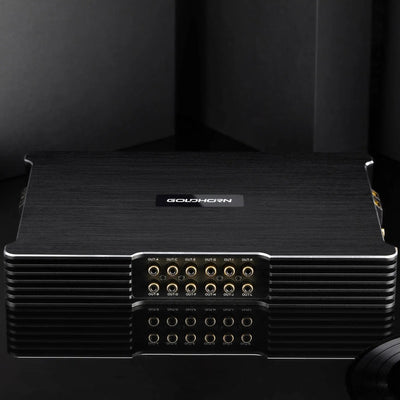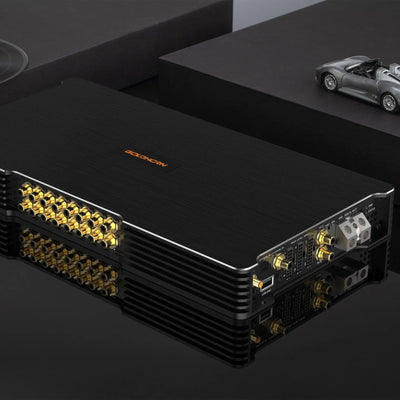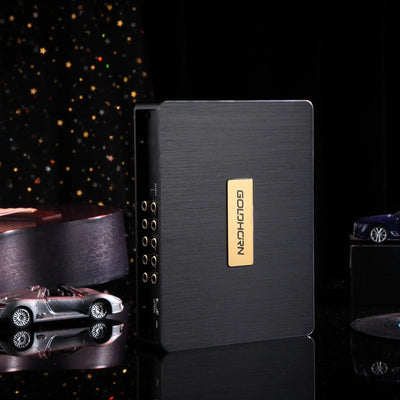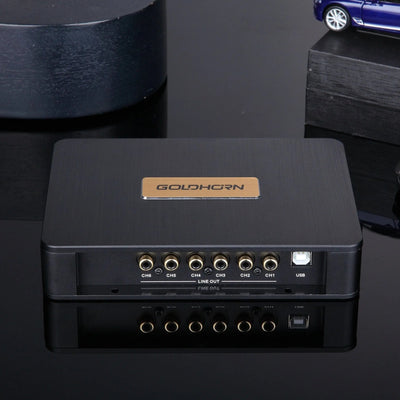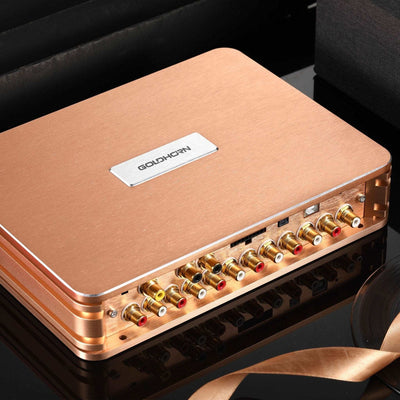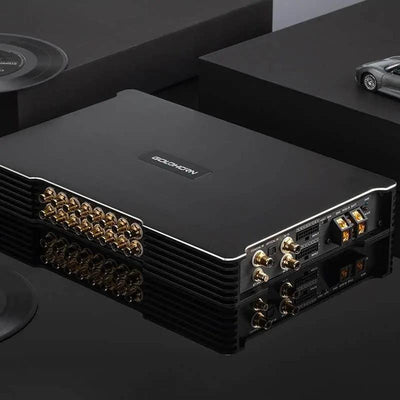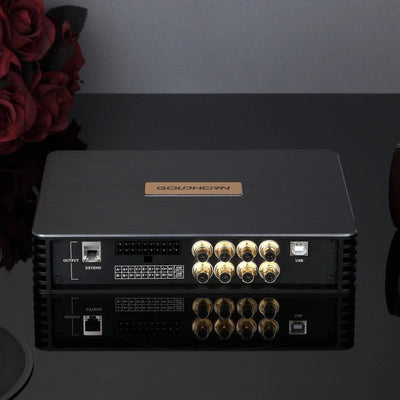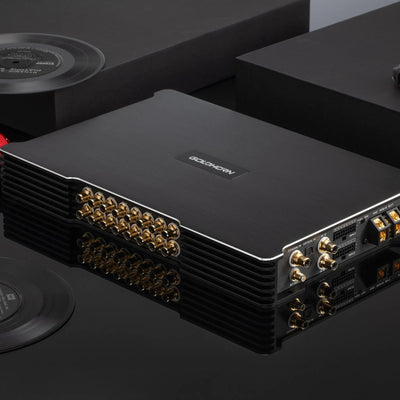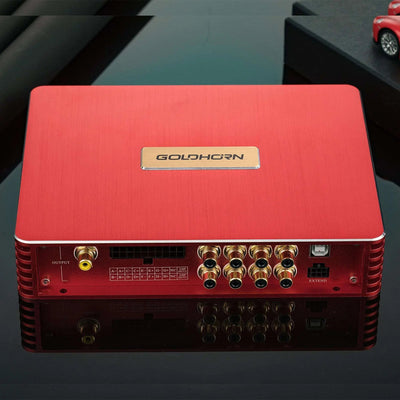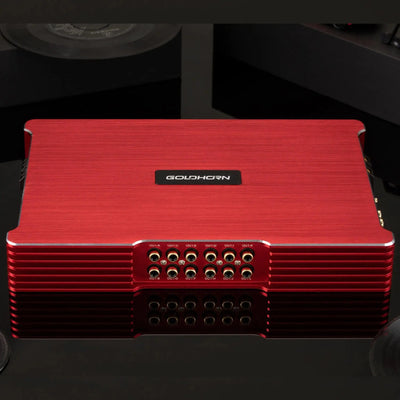
Goldhorn DSPA 810 Pro: 10-Channel DSP & Amplifier v1.1

Unmatched Audio Performance for Car Enthusiasts

Goldhorn DSPA 810 Pro: 10 - Channel DSP & Amplifier|Goldhorn|Audio Intensity
Flexible Audio System Configuration
EPS Protection System
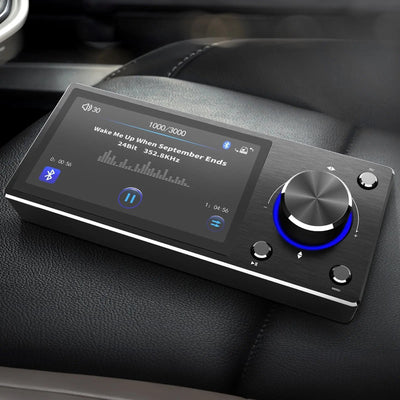
High-Fidelity Streaming
Exceptional DSP Performance
10 Channel DSP10 Preamp Outputs8 x 65W Internal Amplifier
Regular price $ 699.99
Sale price $ 699.99 Regular price $ 799.99
Unit price
Sale
Share Compare Get help

Ask a Question

* Required fields

Size guide
4 people are viewing this right now
Goldhorn DSPA 810 Pro: 10 - Channel DSP & Amplifier|Goldhorn|Audio Intensity

Goldhorn DSPA 810 Pro: 10-Channel DSP & Amplifier v1.1

Regular price $ 699.99
Sale price $ 699.99 Regular price $ 799.99
Unit price

Goldhorn DSPA 810 Pro v1.1 - Flagship 10-Channel DSP Amplifier

⚡ CLOSEOUT: Brand New | Version 2.0 Coming Soon

Goldhorn DSPA 810 Pro v1.1 | 10-Channel DSP & 8×65W Amplifier

Flagship Closeout: 699.99

⚡ FINAL INVENTORY ALERT: Version 1.1 Clearance Before V2 Launch

Why This Matters: Goldhorn is phasing out the DSPA 810 Pro v1.1 to prepare for Version 2.0 with enhanced features. This isn't a discontinued product being dumped—it's a field-tested, professional-grade flagship being cleared to make warehouse space.

The Opportunity: The DSPA 810 Pro v1.1 competes directly with units like the Helix DSP Pro Mk3 ($1,200+), Mosconi Pro 8/30 ($1,100+), and AudioControl D-4.800 ($999+). At $699.99 closeout pricing, you're getting flagship DSP processing and 8-channel amplification for mid-tier money.

What You're Getting: Brand new units with full manufacturer warranty, mature software (no beta bugs), proven reliability from 2+ years in the field, and complete accessory packages. The ADAU1450 DSP chip, Class AB amplification topology, and 31-band EQ architecture remain unchanged—this is the same unit that earned "Best Overall DSP" recognition.

Stock Status: Limited final inventory. Once v1.1 units are depleted, the DSPA 810 Pro V2 will launch with enhanced features. This is your last opportunity to secure flagship-tier DSP/Amp technology at this price point.

The Goldhorn DSPA 810 Pro v1.1 combines professional-grade 10-channel ADAU1450 DSP (1.2 BIPS) with 8×65W Class AB amplification in a single chassis. With 31-band parametric EQ per channel, 48 dB/octave crossovers, 17ms time alignment, optical input, and 8 preset memory, it delivers flagship processing and amplification at closeout pricing.

Who Benefits Most from the DSPA 810 Pro v1.1?

🎯 Advanced Enthusiasts & Competitors

If you're building a 3-way or 4-way active system with dedicated amplification for tweeters, midrange, midbass, and subwoofers, the 10-channel DSP provides the routing flexibility to run complex crossover networks. Use 8 amplified channels for front stage + rear fill, then send 2 RCA outputs to subwoofer amplifiers.

🔧 Professional Installers

The 8-preset memory system allows you to save customer-specific tuning configurations for rapid recall during service appointments. Optical input enables bit-perfect digital signal extraction from OEM head units, while EPS (Error Protection System) prevents thermal shutdown during demanding installations in high-temperature environments.

🚗 OEM Integration Specialists

8 high-level inputs accommodate complex factory amplified systems (like Bose, Harman Kardon, Mark Levinson), allowing you to tap speaker-level signals before OEM amplification degrades them. The 17ms time alignment window corrects for factory speaker placement issues, and Navigation Mix mode prevents GPS interruptions from disrupting your tuning.

💰 Value-Focused System Builders

At $699.99 closeout pricing, you're paying $200-500 less than standalone DSP processors (Helix DSP Pro Mk3, AudioControl DM-810) while getting 520W of integrated amplification. This eliminates the need to purchase a separate 8-channel amp ($400-800), delivering exceptional value for your system.

Critical Insight: The DSPA 810 Pro v1.1 competes in the $1,200+ flagship DSP category while providing integrated amplification that eliminates the need for additional 4-channel or 8-channel amps. At closeout pricing, you're essentially getting a 500 amplifier package for $699.99—a $1,100+ savings compared to buying separate components.

ADAU1450 DSP Architecture: Flagship Processing Power

The ADAU1450 represents Analog Devices' automotive-grade SigmaDSP platform, designed specifically for the thermal extremes (-40°C to +105°C) and electrical noise environments found in vehicle audio systems. This isn't a consumer-grade audio chip—it's the same silicon found in premium processors from Helix, Mosconi, and AudioControl.

Processing Specifications: Why 1.2 BIPS Matters

The ADAU1450's 1.2 billion instructions per second (BIPS) processing capacity enables the DSPA 810 Pro v1.1 to execute complex DSP algorithms in real-time without latency or audible artifacts:

31-Band Parametric EQ (All 10 Channels)

Each of the 10 DSP channels gets a full 31-band parametric equalizer with adjustable frequency (20Hz-20kHz), gain (±12dB), and Q factor (0.5-16). This level of granularity allows you to target specific resonances, correct for speaker response irregularities, and shape tonal balance without affecting adjacent frequencies.

Practical Application: If your midbass driver exhibits a 4dB peak at 180Hz (common with door-mounted woofers), you can create a narrow -4dB cut at 180Hz with Q=8 without attenuating bass response at 120Hz or 240Hz.

Variable Crossover Slopes: 6-48 dB/Octave

The DSPA 810 Pro v1.1 offers 8 slope options across three filter types: Butterworth (6/12/18/24/30/36/42/48 dB), Bessel (6/12/18/24/30/36/42/48 dB), and Linkwitz-Riley (12/24/36 dB). Steeper slopes (36-48 dB) provide better driver protection and reduce overlap between frequency bands, while gentler slopes (6-12 dB) create more natural phase relationships.

Why This Matters: When running a 3-way front stage (tweeter/midrange/midbass), you can use 24 dB/octave Linkwitz-Riley crossovers at 3.5kHz (tweeter/midrange) and 400Hz (midrange/midbass) to minimize phase interaction while protecting tweeters from midrange content.

17ms Time Alignment (Per Channel)

The extended 0-17ms delay range translates to 19 feet of acoustic path length correction (assuming 1,125 ft/s speed of sound). This allows you to time-align speakers mounted in factory locations (like rear deck subwoofers 15 feet behind the listening position) without running out of delay range.

Comparison Context: Entry-level DSPs typically offer 5-10ms (5.5-11 feet), which limits your ability to correct for extreme speaker placement. The DSPA 810 Pro v1.1's 17ms headroom accommodates nearly any vehicle configuration.

Variable Phase Rotation (0-359°)

Full phase control allows you to correct for polarity issues caused by asymmetric crossover slopes, driver mounting depth, or acoustic reflections. This is particularly valuable when integrating aftermarket speakers with OEM subwoofers, where phase misalignment creates a "hole" in bass response around the crossover point.

Real-World Scenario: If your aftermarket component set exhibits weak midbass output (80-120Hz) due to phase cancellation with OEM door speakers, you can rotate phase on the DSP output feeding those channels to restore in-phase summation.

Key Takeaway: The ADAU1450 in the DSPA 810 Pro v1.1 delivers the same processing capability as DSP-only units costing $800-1,200, while the integrated 8×65W amplifier eliminates the need for a separate $400-800 multi-channel amp. At $699.99 closeout pricing, you're getting flagship DSP + amplification for less than competitors charge for DSP alone.

8×65W Class AB Amplification: Voltage Build-Up Technology

The DSPA 810 Pro v1.1's amplifier section represents a critical differentiator from DSP-only processors and Class D-equipped competitors. Voltage Build-Up Technology allows the Class AB output stage to deliver a true 65 watts RMS per channel @ 4Ω from a 12-14.4V electrical system—power levels typically requiring 16-18V rails in conventional Class AB designs.

Class AB vs. Class D Advantages: The DSPA 810 Pro v1.1's Class AB topology delivers flatter frequency response (20Hz-20kHz ±0.5dB), lower THD+N (<0.05%), higher damping factor (>200), and no PWM switching noise compared to Class D designs. This results in tighter bass control, cleaner high-frequency reproduction, and zero radio interference.

Installer Note: The DSPA 810 Pro v1.1 is designed for 4Ω nominal loads (component speakers, coaxials, midrange drivers). While it will drive 8Ω loads safely, power output drops to ~35W per channel. For maximum power delivery, ensure speakers are rated at 4Ω nominal impedance. Do NOT parallel speakers to create 2Ω loads—this exceeds thermal design limits and will trigger protection circuits.

Comprehensive I/O: Optical, High-Level, RCA, Bluetooth

The DSPA 810 Pro v1.1's connectivity options accommodate virtually any source configuration, from bone-stock OEM head units to high-end aftermarket processors.

Input Options: Maximum Flexibility

🔊 8 High-Level Inputs

Voltage Range: 0.3V - 30V RMS
Use Case: Tap speaker-level signals from OEM amplified systems (Bose, Harman Kardon, JBL) before factory amplification colors the signal. The wide 30V tolerance accommodates even high-power factory amps without input clipping.

Installation Tip: Use high-level inputs when integrating with factory head units that lack RCA outputs. Connect at the head unit harness (not speaker terminals) to avoid picking up noise from speaker wire runs.

🎵 2 RCA Inputs

Input Sensitivity: 0.3V - 8V RMS
Use Case: Connect aftermarket head units, source processors, or media players with low-level RCA outputs. The adjustable input sensitivity (0.3-8V) ensures proper gain staging regardless of source output voltage.

Best Practice: Use RCA inputs when available for lowest noise floor. If your source has both front and rear RCA outputs, connect front to RCA inputs and use high-level for rear channels.

💿 1 Optical Input (SPDIF)

Sample Rate: Up to 96kHz / 24-bit
Use Case: Extract bit-perfect digital audio from OEM head units with optical outputs (common in Toyota, Lexus, BMW, Mercedes). Optical transmission eliminates ground loop noise and prevents signal degradation from electrical interference.

Advantage: Many factory head units downsample analog outputs to 16-bit/44.1kHz but preserve 24-bit/48kHz resolution over optical. This input unlocks the full dynamic range of OEM digital sources.

📱 Bluetooth 5.0 (aptX HD)

Codec Support: SBC, AAC, aptX, aptX HD
Use Case: Stream music directly from smartphones without head unit involvement. aptX HD codec supports 48kHz/24-bit wireless transmission (576 kbps bitrate), approaching CD quality over Bluetooth.

Limitation: aptX HD requires compatible source device (Android phones with aptX HD support). iPhones default to AAC codec (256 kbps), which still provides acceptable quality for casual listening.

Output Architecture: 10 DSP Channels

The DSPA 810 Pro v1.1 routes 10 independent DSP channels to a combination of amplified speaker outputs and RCA pre-outs:

Output Type Channel Count Specifications Typical Use Case
Amplified Speaker Outputs 8 Channels 65W RMS @ 4Ω per channel Front/rear component speakers, full-range coaxials, dedicated midbass drivers
RCA Pre-Outs 10 Channels 6V pre-amp output Route to external subwoofer amps, additional speaker amps, or active crossover networks
High-Level Speaker Outputs 8 Channels Mirrors amplified outputs Drive factory speakers in parallel with amplified channels (rarely used)
Routing Strategy: Use the 8 amplified channels for front/rear speakers (tweeters, midrange, midbass, coaxials), then route DSP channels 9-10 via RCA pre-outs to external subwoofer amplifiers. This configuration provides complete system control from a single DSP while leveraging dedicated subwoofer amplification for low-frequency content.

Complete Technical Specifications

DSP Processing

  • DSP Chip: ADAU1450 (1.2 BIPS)
  • Channels: 10-channel independent processing
  • EQ: 31-band parametric (all channels)
  • Crossover: 6-48 dB/octave (8 slopes)
  • Time Alignment: 0-17ms per channel
  • Phase Control: 0-359° rotation
  • Presets: 8 memory slots

Amplifier Specifications

  • Channels: 8 × 65W @ 4Ω
  • Topology: Class AB (Voltage Build-Up)
  • Total Power: 520W RMS
  • THD+N: <0.05% @ 1kHz
  • Frequency Response: 20Hz-20kHz (±0.5dB)
  • Damping Factor: >200 @ 1kHz
  • SNR: >95dB (A-weighted)

DAC/ADC Performance

  • DAC: PCM1690 (113dB DNR) + PCM1754
  • ADC: 2× PCM1862 (106dB DNR)
  • Sample Rate: Up to 96kHz/24-bit
  • THD+N: <0.0004% (DAC)
  • Dynamic Range: 113dB (DAC), 106dB (ADC)

Inputs

  • High-Level: 8 channels (0.3-30V)
  • RCA: 2 channels (0.3-8V)
  • Optical: 1 channel (SPDIF, 96kHz/24-bit)
  • Bluetooth: 5.0 (aptX HD, AAC, SBC)

Outputs

  • Amplified: 8 channels (speaker-level)
  • RCA Pre-Out: 10 channels (6V)
  • High-Level Out: 8 channels (mirrors amp)

Control & Software

  • Software: Windows PC (included)
  • Connection: USB (tuning/firmware updates)
  • Auto Turn-On: Signal sensing or 12V trigger
  • Protection: EPS (Error Protection System)
  • Clipping Indicators: Front-panel LEDs

Power & Dimensions

  • Input Voltage: 10.5-15.5V DC
  • Current Draw: 42A @ full power (13.8V)
  • Fuse Rating: 2× 30A
  • Dimensions: 217 × 170 × 43 mm (8.5" × 6.7" × 1.7")
  • Weight: 1.8 kg (4.0 lbs)
  • Start-Stop Ready: Yes (voltage fluctuation tolerance)

Special Features

  • Navigation Mix: Auto-ducking for GPS audio
  • Voltage Build-Up: Enhanced Class AB power
  • Master Volume: Bluetooth app control
  • Firmware Updates: USB flash support

Competitive Analysis: Flagship DSP/Amplifiers Under $1,000

The DSPA 810 Pro v1.1's closeout pricing at $699.99 positions it uniquely in the market. Competing with units in the $1,100-1,400 range, the closeout price undercuts even mid-tier DSP/Amp combos while maintaining flagship specifications. Here's how it compares to alternatives in the sub-$1,000 category:

Model Price DSP Channels Amp Channels / Power Optical Input Key Differentiator
Goldhorn DSPA 810 Pro v1.1 $699.99 10 (ADAU1450) 8 × 65W @ 4Ω (Class AB) ✓ Yes Flagship DSP + 520W @ closeout price
AudioControl D-4.800 $999.95 8 (proprietary DSP) 4 × 80W @ 4Ω (Class D) ✗ No AccuBASS processing, OEM integration focus
Ground Zero GZDSP6-10SQ $699.99 10 (ADAU1451) 6 × 100W @ 4Ω (Class D) ✓ Yes 600W total power, Class D efficiency
Match UP 10DSP $899.00 10 (ADAU1450) 6 × 85W @ 4Ω (Class D) ✓ Yes Audiotec Fischer engineering, compact size
Hertz H8 DSP $649.00 8 (ADAU1451) 8 × 10⁵W @ 2Ω (Class D) ✗ No High power output, budget-friendly
Goldhorn DSPA 406 $399.99 (closeout) 6 (ADAU1450) 4 × 65W @ 4Ω (Class AB) ✗ No Budget option, same DSP chip, fewer channels
Dayton Audio DSP-408 $299.00 8 (ADAU1701) 4 × 50W @ 4Ω (Class D) ✗ No Entry-level DSP, older chip, budget price
JL Audio VXi800/8i $999.99 12 (proprietary DSP) 8 × 100W @ 2Ω (Class D) ✗ No 800W total power, JL Audio pedigree
Mosconi Gladen ONE 80.6 DSP $949.00 8 (proprietary DSP) 6 × 80W @ 4Ω (Class AB) ✓ Yes Italian engineering, Class AB topology
Quick Competitive Summary:
vs. AudioControl D-4.800 ($999): DSPA 810 Pro offers 10 channels vs. 8, 8 amplified outputs vs. 4, optical input, and saves $300
vs. Ground Zero GZDSP6-10SQ ($699): DSPA 810 Pro provides 8 amplified channels vs. 6, Class AB vs. Class D, 31-band EQ vs. 10-band
vs. DSPA 406 ($399): DSPA 810 Pro adds 4 DSP channels, 4 amplified channels, optical input, 8 presets for $300 premium
vs. DSP-Only Units ($800-1,200): DSPA 810 Pro saves $750-1,800 by eliminating need for separate 8-channel amplifier
Competitive Summary: At $699.99 closeout pricing, the DSPA 810 Pro v1.1 undercuts the AudioControl D-4.800 by $300 while providing more channels and optical input. It matches the Ground Zero GZDSP6-10SQ on price but offers Class AB amplification and 8 amplified channels. Compared to DSP-only processors, it delivers exceptional value by eliminating the need for separate amplification. This is a flagship-tier DSP/Amp at mid-tier pricing.

Real-World Installation Scenarios

Scenario 1: 3-Way Active Front Stage + Rear Fill + Subwoofer

System Configuration:

  • Front Stage: Morel Elate Ti 903 (3-way component set: tweeters, 3" midrange, 6.5" midbass)
  • Rear Fill: JBL Stadium GTO620 (6.5" coaxials)
  • Subwoofer: JL Audio 12W6v3 (powered by external JL Audio MX500/1 amplifier)

DSPA 810 Pro Channel Allocation:

DSP Channel Speaker Assignment Crossover Settings Output Type
1-2 (Amplified) Front Tweeters (Morel Elate Ti) HPF: 3.5kHz @ 24 dB/oct (LR) Speaker-level output
3-4 (Amplified) Front Midrange (Morel 3") BPF: 400Hz - 3.5kHz @ 24 dB/oct (LR) Speaker-level output
5-6 (Amplified) Front Midbass (Morel 6.5") LPF: 400Hz @ 24 dB/oct (LR) Speaker-level output
7-8 (Amplified) Rear Fill (JBL GTO620) HPF: 80Hz @ 12 dB/oct, -6dB level Speaker-level output
9 (RCA Pre-Out) Subwoofer Left (JL 12W6v3) LPF: 80Hz @ 24 dB/oct (LR) 6V RCA to MX500/1
10 (RCA Pre-Out) Subwoofer Right (JL 12W6v3) LPF: 80Hz @ 24 dB/oct (LR) 6V RCA to MX500/1

Tuning Strategy:

  • Use 31-band EQ on channels 3-4 (midrange) to flatten Morel's slight 2kHz emphasis
  • Apply 15ms delay to front tweeters (channels 1-2) to time-align with deeper-mounted midbass drivers
  • Reduce rear fill level by 6dB and apply HPF @ 80Hz to prevent bass buildup in rear seat area
  • Use phase rotation on subwoofer channels (9-10) to align with front midbass output around 80Hz crossover point

Limitations & When to Upgrade Beyond the DSPA 810 Pro v1.1

⚠️ Limitations to Consider

  • Power Output Ceiling: 65W @ 4Ω per channel is adequate for 85-90% of car audio applications, but power-hungry speakers (e.g., Focal Utopia, Morel Supremo) with 83dB sensitivity may lack headroom at high volumes. If you're driving speakers requiring 100W+ per channel, budget for external amplification.
  • No Mobile App Tuning: Unlike newer DSPs (Helix DSP.3, AudioControl DM-RLC), the DSPA 810 Pro v1.1 requires Windows PC connection for tuning adjustments. You cannot make real-time EQ changes from your smartphone while sitting in the driver's seat. Bluetooth connectivity is audio streaming only, not control.
  • Single Subwoofer Output: While the DSP provides 10 channels, only 2 channels (9-10) are available as RCA pre-outs after using 8 for speaker amplification. If you're running multiple subwoofer amplifiers (e.g., separate amps for front-firing and rear-firing subs), you'll need Y-splitters or additional signal distribution.
  • No Automatic EQ (RTA/Microphone): Tuning is 100% manual—the DSPA 810 Pro v1.1 doesn't include automatic room correction like Audison Bit Tune or AudioControl's DM-RTA. You'll need an external RTA (Real-Time Analyzer) or measurement microphone to optimize EQ curves scientifically.
  • Fixed Amplifier Allocation: You cannot reassign amplified channels in software. Channels 1-8 are hard-wired to the internal amplifier; channels 9-10 are RCA-only. If you want more than 2 channels of pre-out (e.g., for bi-amping), you must use external amplification for some speakers.
  • V1.1 Closeout Status: As a closeout product, long-term software support is uncertain. Goldhorn will likely shift development resources to V2, meaning firmware updates for v1.1 may become infrequent or cease entirely. The current firmware is mature and stable, but expect limited future feature additions.

✅ When DSPA 810 Pro v1.1 is the RIGHT Choice

  • 3-Way Active Systems: If you're running tweeters, midrange, and midbass in the front stage (6 channels) plus rear fill (2 channels) and external subwoofer amp (2 RCA pre-outs), the 8 amplified + 2 pre-out configuration is perfect.
  • OEM Integration Projects: The combination of 8 high-level inputs (0.3-30V tolerance), optical input, and comprehensive DSP processing makes this ideal for upgrading factory systems without replacing the head unit.
  • Class AB Sound Quality Priority: If you're sensitive to the "digital" character of Class D amplifiers and prefer the linear response of Class AB topology, the DSPA 810 Pro v1.1 is one of the few DSP/Amps offering Class AB amplification at this price point.
  • Budget-Conscious Flagship Builds: At $699.99, you're getting 800-1,000 on a standalone DSP and another $400-600 on an 8-channel amp, the DSPA 810 Pro v1.1 saves $500-900.
  • Professional Installation: The 8-preset memory is invaluable for installers managing multiple customer vehicles. Save each customer's tuning profile and recall it instantly during service appointments without re-tuning from scratch.

Upgrade Path: When to Move Beyond the DSPA 810 Pro v1.1

Bottom Line: The DSPA 810 Pro v1.1 at $699.99 closeout pricing represents exceptional value for 90% of car audio enthusiasts. Upgrade only if you specifically need features it lacks (mobile app tuning, higher power, more RCA outputs) or if you're competing at the highest levels of Sound Quality competition. For everyone else, this is flagship performance at mid-tier pricing.

Final Verdict: Flagship Performance, Closeout Pricing

⚡ Why This Closeout Matters: Final Inventory of a 3>

The Goldhorn DSPA 810 Pro v1.1 competes directly with units like the Helix DSP Pro Mk3, Mosconi Pro 8/30, and AudioControl D-4.800—all priced between $999-1,400. At $699.99 closeout pricing, you're getting flagship DSP processing and 8-channel amplification at exceptional value:

  • 10-channel ADAU1450 DSP (same chip as $1,200+ processors)
  • 8×65W Class AB amplification (520W total system power)
  • 31-band parametric EQ on all channels (flagship-level tuning)
  • Optical input (bit-perfect digital extraction from OEM head units)
  • 17ms time alignment per channel (19 feet of correction range)
  • 8 preset memory slots (professional installer feature)

V2 Launch Impact: Goldhorn is clearing v1.1 inventory to prepare for the DSPA 810 Pro V2 with enhanced features (rumored mobile app control, increased power output). This means:

  • V1.1 units are limited final stock—once depleted, this closeout pricing disappears
  • V1.1 is a mature, proven platform with 2+ years of field testing (no beta bugs)
  • Full manufacturer warranty still applies (brand new units, not refurbished)
  • Same ADAU1450 DSP and Class AB amplification as competitors costing $1,000+

The Strategic Opportunity: If you were planning to spend $800-1,000 on a standalone DSP (Helix, AudioControl, Audison) and another $400-600 on an 8-channel amplifier, the DSPA 810 Pro v1.1 closeout saves you $500-900 while providing integrated DSP/Amp convenience in a single chassis.

Who Should Act Now: This closeout is ideal for enthusiasts building 3-way active systems, installers needing multi-preset functionality, OEM integration specialists requiring optical input, and value-focused system builders who want flagship DSP performance. If you don't specifically need mobile app tuning or 100W+ per channel power, the v1.1 delivers everything required for world-class sound quality.

Limited Time: Closeout inventory is finite. Once v1.1 stock is depleted, the only option will be the V2 at MSRP. Secure your DSPA 810 Pro v1.1 while this pricing lasts.

The Goldhorn DSPA 810 Pro v1.1 represents a rare convergence of flagship specifications and mid-tier pricing. With the ADAU1450 automotive DSP (1.2 BIPS processing power), 8×65W Class AB amplification, 10-channel processing flexibility, and comprehensive I/O including optical input, this unit delivers the performance of processors costing $1,200+ while integrating 520W of amplification that would require an additional $400-800 external amp.

At $699.99 closeout pricing, the DSPA 810 Pro v1.1 undercuts every competitor in the flagship DSP/Amp category. The AudioControl D-4.800 ($999.95) offers fewer channels and no optical input. The Ground Zero GZDSP6-10SQ ($699.99) provides more power but fewer amplified channels and Class D topology. Standalone DSP processors (Helix DSP Pro Mk3 at $1,199) require separate amplification, pushing total system cost to $1,600-2,000.

The v1.1's limitations—no mobile app tuning, 65W per channel output, PC-only software—are acceptable trade-offs at this price. For 90% of car audio enthusiasts who prioritize sound quality over convenience features, the DSPA 810 Pro v1.1 delivers flagship DSP processing, Class AB amplification, and professional I/O at mid-tier pricing. You're getting 699.99—a exceptional value). Once v1.1 inventory is depleted, this opportunity disappears.

⚡ Final Inventory: Secure Your DSPA 810 Pro v1.1 Before V2 Launch

Flagship DSP + 520W Amplification | ADAU1450 Processing | Optical Input

$699.99 Closeout (Originally

Limited Stock Remaining — V2 Expected at MSRP

Specification Details
DSP Chip ADAU1450
DAC Chip PCM1690 + PCM1754
ADC Chip 2 x PCM1840
Opamp MC33078
Capacitors High Temperature for High Reliability to 105°C electrolytics and WIMA film Caps
PC Connection USB B
Processing Functions Crossover Frequency: 20Hz ~ 20kHz @ 1dB steps / Master Gain: 0 ~ 60dB / Channel gains: -20dB ~ +5dB, Polarity: Phase Reversal 0 or 180 / EQ filters Q 0.5 ~ 15 @ 0.1 steps / Input Mixer, Three Linking Functions: Volume Linking- Absolute or Relative, EQ Linking - Relative or Absolute, Crossover Linking - With EQ link on, Freq Link button will link crossovers
Output EQ EQ bands: All Channels 31 @ ± 15dB in 0.1dB Steps, Filter Functions: Peak / High Shelf / Low Shelf / 1st order All Pass/ 2nd Order All Pass
Crossover Butterworth & Bessel: 6,12,18,24,30,36,42,48dB / Linkwitz: 12, 24, 36dB
Delay 0 ~ 17ms / 0.02ms Steps
Inputs 8 x Hi / 2 x RCA / 1 x Opt / BT
XO Phase Rotation Variable Phase shift at HP and LP filters from 0° ~ 359°
Input EQ EQ bands: All Channels 5 bands @ ± 15dB in 0.1dB Steps, Filter Functions: Peak / High Shelf / Low Shelf / 1st order All Pass/ 2nd Order All Pass, Input Delay: 0 ~ 10ms in 0.02 Steps
Frequency Resp 20Hz ~ 40kHz
Operating Voltage 10V ~ 16V
Input Sens (V) RCA 3V Max
Input Sens (V) Hi 12V
RCA Out Voltage 10 x 6V
RCA Out Specs THD+Noise < 0.003, S/N ⧁108
Amp Outputs | THD+Noise <0.03 S/N >100dB 65W x 8 Class AB
Dimensions (mm) 217 x 170 x 43
Start-Stop ready Yes
EPS Error Protection System Yes
Finish Black anodized Aluminum
Auto Turn On via DC Offset or Signal Sensing Yes
Remote Turn on Output Yes
Clipping LED’s Yes
Built in Bluetooth Yes
THD+Noise Amplifier 0.03%
S/N ratio Amplifier >100dB
THD+Noise RCA out <0.002%
S/N ratio RCA out 105dB
Fuse Rating 20A
Input impedance 6 Ohms
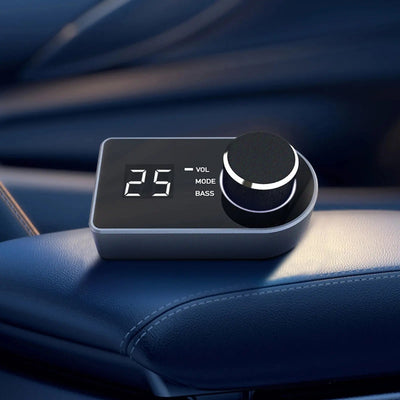
Controller Optional
Input Mixer Yes
Presets 8
Software Interface 64 bit Windows 8, Windows 8.1 or Windows 10/11
Navigation Mode Yes
Power off Delay Yes Variable
Noise Gate (analog Input) Yes
Automatic Switching Config. Yes
Input EQ 5 Bands / Chan
Input All Pass Filters 1st and 2nd Order
Input Delay 0 ~ 10ms / Chan
Variable Phase 0~360 at crossover filters Yes
Output EQ 31 All Channels
Hi-Shelf, Low-Shelf Yes
Output All Pass filters 31 per channel
Output Delay 0 ~ 17ms @ 0.02ms steps

What's in the Box?

  • Goldhorn DSPA 810 Pro: 10-Channel DSP & Amplifier v1.1 Goldhorn DSPA 810 Pro: 10-Channel DSP & Amplifier v1.1
  • Goldhorn BT / WiFi Antenna Goldhorn BT / WiFi Antenna
  • Goldhorn Owners Manual Goldhorn Owners Manual
  • Goldhorn Power and Speaker Harness Goldhorn Power and Speaker Harness

No Related Videos currently available

Goldhorn USA Software

Software can be downloaded from the Goldhorn-USA download page.

Goldhorn DSPA 810 Pro: 10-Channel DSP & Amplifier v1.1

Frequently Asked Questions

What is the power output of the Goldhorn DSPA 810 Pro?

Can I use DSPA 810 Pro internal amplifier and preamp outputs at the same time?

Does the DSPA 810 Pro support Bluetooth streaming?

Can I connect multiple amplifiers to the DSPA 810 Pro?

What kind of audio customization does the DSPA 810 Pro offer?

Does the DSPA 810 Pro have protection features?

Can I use the DSPA 810 Pro for a 3-way active crossover setup?

How many audio profiles (presets) can I save on the DSPA 810 Pro?

Recommended for You