




Amplifier Subsonic Filter: Everything You Need to Know
Subsonic filters are an essential component in audio, protecting speakers from damage caused by l...
Read Article →

Monoblock, 2-channel, 4-channel, and multi-channel amplification from seven brands.
Authorized Dealer
Every amplifier is brand new with the full manufacturer warranty.
Power Matching
Send us your subwoofer or speaker specs. We'll recommend the right amplifier at the right impedance before you buy.
Hands-On Expertise
Direct support from staff who designs, builds, and competes with these systems. Honest recommendations, not upsells.
Fast Shipping from TN
In-stock orders ship within 1-2 business days from our Tullahoma, Tennessee warehouse.
Decision Shortcut
Curated picks matched to common build goals
Best Monoblock Value

Prodigy Audio
1200W mono Class D monoblock at accessible price. The right entry point for serious subwoofer amplification.
$ 272.99 $ 326.99
View DetailsBest Compact Monoblock

Wavtech
1000W mono in a compact footprint. The shallow-amp choice for tight-install builds.
$ 399.99
View DetailsBest 2-Channel for SQ

Audio Wave
Reference Class A 2-channel for the ultimate front-stage SQ build.
$ 3,499.99
View DetailsBest Reference Tier

Tru Technology
Hand-built 2-channel Class A reference. The absolute top of the catalog.
$ 8,500.00
View Details


All products loaded
Amplifier selection is where most car audio builds go wrong. Buyers focus on the wattage number on the box rather than the class of amplifier, the channel configuration, or whether the rated power is actually delivered at a usable impedance. Getting this decision right the first time is what separates a system that sounds the way you intended from one that underperforms or damages components.
This is the first decision. A monoblock puts its full rated output into one channel for a subwoofer. A multichannel amp splits output across two or more channels for speakers, and can bridge a pair to drive a sub if the channel count allows.
| Monoblock | Multichannel | |
|---|---|---|
| What it drives | One subwoofer | Speakers, or speakers plus a bridged sub |
| Channels | 1 | 2, 4, 5, 6 or 8 |
| Typical class | Class D | Class AB or Class D |
| Impedance stability | Usually stable to 1 or 2 ohms | Usually 2 or 4 ohms per channel |
| Bridging | Already mono, no bridging | Bridge a channel pair for sub duty, at the cost of separate tuning |
| Pick it when | The sub gets its own dedicated amp | You want one chassis running the system |
Once you know which side you are on, the channel count should match what it's powering.
Monoblock (1-channel): Built for powering a single subwoofer with full rated output into one channel. The standard choice for subwoofer amplification in any car audio system. Most monoblock amps are stable at 1 or 2 ohms, which provides flexibility in wiring configurations. Match the amplifier's RMS power at your subwoofer's wired impedance to the driver's RMS rating.
2-channel: Built for powering a front stage component speaker system, with one channel per side driving the woofer and tweeter through a passive crossover. For listeners focused on sound quality and front stage imaging, a dedicated 2-channel amplifier for the front speakers paired with a separate monoblock for the subwoofer is the cleanest system topology.
4-channel: Powers front and rear speakers from a single unit, or can be bridged to mono on two channels to drive a subwoofer while the remaining channels handle the front stage. Practical for builds where space and budget favor a single amplifier over multiple dedicated units. Modern 4-channel designs from Crescendo and Image Dynamics deliver performance that makes the compromise worthwhile.
5 and 6+ channel: For complex systems including active crossover builds, OEM integration projects, and competition-level setups that need more channels than a 4-channel amplifier provides. Many 5+ channel amplifiers include integrated DSP, which gives you channel count, processing power, and physical consolidation in a single unit. See DSP amplifiers for the units that combine both.
Class D: The dominant technology in modern car audio. Operates at 80-90% efficiency, which means less heat, smaller physical footprints, and less electrical draw on your vehicle's charging system. Class D designs have improved dramatically over the past decade. Modern Class D from quality manufacturers (Wavtech Link series, Image Dynamics SQ, US Acoustics monoblocks) is sonically transparent and appropriate for any application including critical listening.
Class AB: Operates at 50-65% efficiency with more heat and larger physical size for equivalent power output. The tradeoff is a bias current that keeps the output transistors partially on at all times, eliminating the crossover distortion that early Class D designs suffered from. This is the largest part of our amplifier catalog. For critical listening applications where absolute sonic transparency is the goal, a high-bias Class AB design (Tru Technology Billet, Audio Wave Excel, Crescendo Revolution, US Acoustics multichannel) remains the reference standard.
Class A: The audiophile reference. Operates with the output transistors continuously on, which produces the cleanest possible signal at the cost of significantly higher heat dissipation and current draw. Class A amplifiers are physically large, run hot, and require electrical system upgrades to power. The Audio Wave Excel CA, Audio Wave Aspire Pro V2, and TRU Technology Billet B22-A V2.5 are the reference Class A designs in this collection.
Match the amplifier's RMS output at your wired impedance to the speaker or subwoofer's RMS rating. RMS is continuous power; peak ratings are marketing numbers and should be ignored. Underpowering and clipping is more dangerous than slight overpowering with a clean signal, because a clipped signal contains DC voltage that overheats voice coils.
For subwoofers, a monoblock amplifier at the driver's RMS rating at the final wired impedance is the standard approach. For component speakers, the 2-channel or 4-channel amplifier's RMS at typical 4 ohm load should match or slightly exceed the speaker's RMS rating. For full-range systems, plan amplifier power for each frequency range (sub, midrange, tweeter) independently to ensure clean headroom in each.
Every amplifier draws current from your vehicle's electrical system, and high-powered amplifiers draw a lot of it. A 1000W RMS monoblock at 50% efficiency draws roughly 100 amps from a 12V system at full output, more than most factory alternators can sustain alongside the vehicle's other electrical loads. For builds over 1000W RMS total system power, alternator capacity and battery reserve should be part of the system design, not an afterthought.
Big 3 wiring upgrades (replacing the ground cable from battery to chassis, the ground cable from engine block to chassis, and the positive cable from alternator to battery with heavier gauge wire) are the baseline electrical upgrade for any amplified system over 500W. For serious builds, a high-output alternator and supplemental lithium or AGM battery is the right foundation.
Audio Intensity carries amplifiers from seven brands, each filling a specific use case in the catalog.
Crescendo: Competition-proven Class AB amplification. The Revolution line covers monoblock and 4-channel configurations for SQ and SPL-focused builds, with the 3A1 monoblock running Class D where efficiency matters more than bias. The right pick for buyers who want Class AB refinement matched to demanding driver lineups.
Wavtech: Compact Class D amplifiers engineered for high power density. The Link series (Link5001Mini, Link1000.1mini, Link1500.1plus) is the standard for tight-install behind-seat builds where amplifier footprint matters. Wavtech amplifiers pair naturally with the Wavtech thinPRO subwoofer line.
Tru Technology: Audiophile-grade Class AB and Class A reference amplifiers. The Billet series represents the top tier of car audio amplification, with hand-built construction and competition-proven performance. The right choice for buyers building reference-level SQ systems where sound quality is the absolute priority.
Audio Wave: Reference Class A and Class AB amplification. The Excel CA, Aspire Pro V2, and CR-30X monoblock are Class A. The Excel, Excel Monoblock, CR 401 dual mono, and Active 250 are Class AB. Between them they cover 2-channel front stage duty and full-range monoblock work at the high end of the catalog.
US Acoustics: Class D monoblocks and Class AB multichannel. The monoblock line (Mike, Nick, Big Ben) is built for SPL-focused builds where headroom is the priority. The Class AB multichannel line is the SQ side of the brand: Lanna at 6 x 150w, Andrea at 2 x 150w, Barbara Ann at 4 x 100w, Wendy at 2 x 75w, and Lisa at 4 x 50w, all with the bias-current refinement that front stage duty asks for.
Image Dynamics: The SQ series of full-range and monoblock amplifiers (SQ600.1D, SQ800.4, SQ1200.1D). Built with International Rectifier circuitry for clean power in a compact form factor. Pairs naturally with Image Dynamics IDQ and IDMAX subwoofers.
Arc Audio: Audiophile-grade amplification with a focus on musical accuracy. The Arc and X2 series cover SQ-focused builds with Arc Audio's signature sound character.
Yes, and it is the largest single change most systems can make. A factory head unit puts out roughly 15 to 22 watts RMS per channel and clips well before you reach listening volume. A dedicated amplifier delivers clean, stable power with headroom, which is what lets a speaker reproduce dynamics instead of compressing them. The difference is most obvious on midbass and at volume, where factory power runs out first.
In this collection, from $272.99 for a 1200W Class D monoblock up to $8,500 for a hand-built Class A reference 2-channel. Most builds land between $300 and $700, which covers a quality monoblock for the sub and a 4-channel for the speakers. Price tracks class, build quality and power delivery, not the wattage number on the box.
Match the amplifier's RMS output at your wired impedance to your subwoofer or speaker's RMS rating. Don't focus on peak power numbers. A 1000W RMS subwoofer needs a monoblock amp delivering 1000W RMS at the driver's final wired impedance. A typical 4-ohm component speaker rated 75W RMS needs about 75-100W RMS per channel from the amplifier. Underpowering and clipping is the most common cause of voice coil failure; match RMS to RMS at the wired impedance.
The classes describe the output stage design. Class D is the most efficient (80-90%), with small physical size and low heat. Modern Class D is sonically transparent and appropriate for any application. Class AB is less efficient (50-65%) but uses bias current to eliminate crossover distortion, making it the reference for critical listening. Class A is the audiophile reference, with continuous output transistor operation producing the cleanest signal but with significant heat dissipation. Choose Class D for most builds, Class AB or A for reference SQ builds.
A monoblock amplifier is the standard and best choice for subwoofer power. The full rated output goes into a single channel, optimized for the low impedance and high current demands of subwoofer drivers. A bridged 4-channel amplifier can power a sub if the channel count is constrained, but a dedicated monoblock is the right approach when system topology allows.
Depends on the system topology. For a system with front speakers and a subwoofer, a 4-channel amp can power the front speakers on two channels and bridge the other two channels to power the sub. This works for entry to mid-tier builds. For SQ-focused builds with rear speakers, an active crossover, or higher-power requirements, a 4-channel amp paired with a dedicated monoblock is the better approach.
Yes. Every amplifier in this collection is brand new, sold by an authorized dealer, and carries the full manufacturer warranty. Demo and display units are clearly labeled as such on the product page.
Subwoofers That Pair Well
These subwoofers match the power and impedance characteristics of the amplifiers in this collection. Pick the driver, match the wiring, get a system that performs as designed.
Speakers Worth Amping
Speaker systems that respond to clean amplifier power. The amplifiers above have the headroom; these components have the resolution to use it.
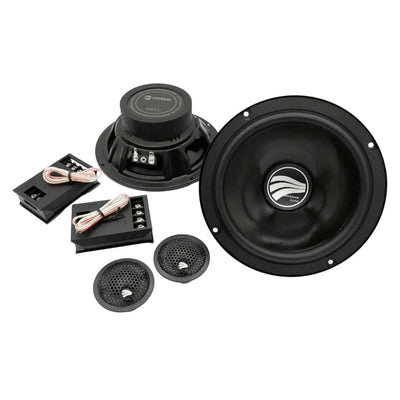
Rainbow
$ 139.99 $ 189.99
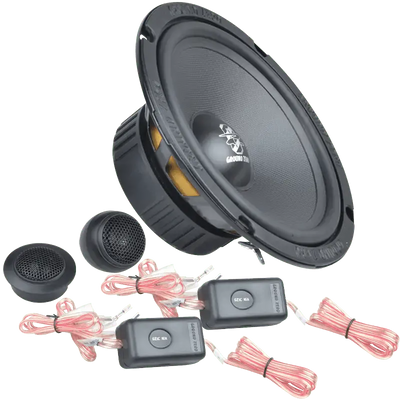
Ground Zero
$ 149.99 $ 199.99
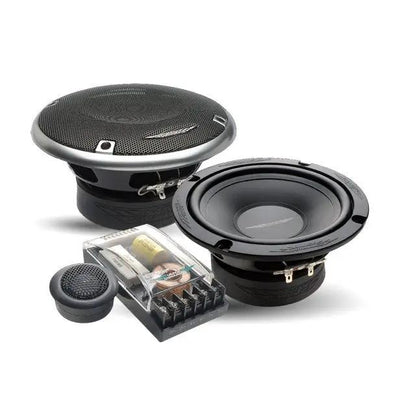
Image Dynamics
$ 159.99
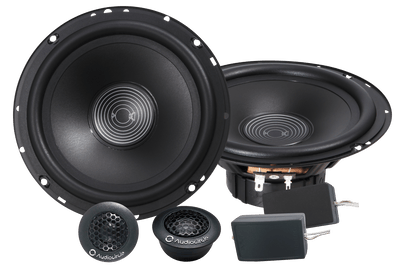
Audiocircle
$ 199.99 $ 229.99
DSP for Tuning Control
A DSP gives you crossovers, EQ, time alignment, and signal routing in a single unit. The amplifier delivers the power; the DSP makes the system actually sound right.
Subwoofers That Pair Well
These subwoofers match the power and impedance characteristics of the amplifiers in this collection. Pick the driver, match the wiring, get a system that performs as designed.


