

Key Takeaways
- Down-firing works. Below roughly 70 to 90 Hz the whole cabin pressurizes, and cabin gain adds about 12 dB per octave whichever way the cone points (CarAudioHelp).
- The floor adds no free output. A 1.75 inch gap moves the floor's cancellation notch to about 1,929 Hz, far above the sub band (our calculation).
- The gap is the front air path. By our math, a 10 needs about 1.2 inches and a long-throw 12 about 1.5 inches before gap air speed passes 10 m/s.
- Pick down-firing when cargo stacks on the box or the cargo area opens into the cabin. Pick rear-firing for a closed sedan trunk. Never just flip a front-firing box.
Yes, down-firing subwoofer boxes work. In a car, a down-firing box plays the same bass as a rear-firing box in the same spot, because the cabin pressurizes as one space below its transfer frequency. The floor doesn't add free output. What down-firing buys you is a reflection notch moved out of the bass band, a protected cone, a flat top you can load, and stealth, as long as you give it at least 1.25 to 1.75 inches of open gap.
Here's the number that settles most of the argument. At 40 Hz a bass wave is about 28 feet long, and the average car interior, trunk included, runs about 12 feet (CarAudioHelp). Bass can't tell which way the cone points. So why do some down-firing boxes sound great while others sound choked and buzz around the cargo floor?
Forums have argued it both ways for years, and most boxes list their height but never the gap they need. We cut enclosures in every orientation, so we've got no reason to push one. Here's the physics, the gap math, how the orientations compare, and which box fits.
What is a down-firing subwoofer, and does it actually work?
A down-firing subwoofer sits in a box with the baffle on the bottom, so the cone faces the floor from a fixed height. And yes, it works. Below the cabin's transfer frequency the whole interior pressurizes together, and cabin gain adds about 12 dB per octave below roughly 70 to 90 Hz, whichever way the cone points (CarAudioHelp).
The reason is size. Sound travels at 343 m/s at room temperature, and wavelength is speed divided by frequency (LibreTexts). A 40 Hz wave is more than twice as long as the cabin, so cone direction doesn't decide much down there. The exact transfer frequency moves with the vehicle, and bigger cabins start lower; see cabin gain and the transfer frequency.
Home audio lands in the same place. Klipsch calls bass omnidirectional and puts the difference between down- and front-firing at "next to none" (Klipsch, 2021). What changes is everything around the bass: the nearest boundary, whether the cone is exposed, whether the top can carry cargo, and whether anyone can tell there's a sub in the vehicle.

Does the floor make a down-firing sub louder?
Not in a car. A nearby boundary adds up to 6 dB in open space because it halves the space the sound radiates into (Struck, audioXpress). But a car sub already sits next to the floor, seats and walls in every orientation. Pointing it down adds no new boundary, so it adds no new gain.
Boundary gain itself is real: +6 dB against one wall, up to +12 dB in a corner (Genelec). But a rear-firing box on the same trunk floor already has that floor beside it. You can't spend the same boundary twice.
The quarter-wave notch is the real story
What the floor does change is the reflection. Near a boundary, the reflected wave cancels the direct sound where the distance equals a quarter wavelength, and Genelec says that first notch "can be between 6 dB and 20 dB deep." By our math at 343 m/s, our 1.75 inch feet put it near 1,929 Hz. A cone 24 inches from a tailgate puts it near 141 Hz, and 36 inches near 94 Hz, right beside the sub band.
That's the honest argument for down-firing: not free output, but a reflection notch kept out of the frequencies the sub plays. Seats and cabin modes add their own reflections, so treat these as near-boundary numbers, not a full in-car response. And the floor pan doesn't radiate bass. A floor that moves is resonating, which is a rattle, not output.
How much gap does a down-firing subwoofer need?
About 1.25 inches for a shallow 10 and about 1.5 inches for a long-throw 12 at full stroke, by our calculation from Rockford Fosgate's published specs. Our feet set 1.75 inches. The gap is the front air path. Squeeze it and it acts like an undersized port: air speed rises, output compresses, and it can start to chuff.
How we worked out the gap
Every bit of air the cone moves on its front side escapes through a ring-shaped curtain under the baffle, with an area of roughly π × cone diameter × gap height. Divide the cone's peak air flow by that area and you get peak air speed, the same number port designers watch. We ran it for the T1 Slim 10 (Sd 356 cm², Xmax 15 mm) and T1 Slim 12 (Sd 560 cm², Xmax 15 mm) at full excursion and 60 Hz (Rockford Fosgate T1S1-10; T1S1-12). It's a simplified model that assumes even flow around the ring, so read it as a guide, not a measurement.
Now the limits. A port-design paper by engineers from JBL Professional and Infinity puts the onset of "serious sonic detriment" in a plain port at about 10 m/s (Salvatti, Button and Devantier, AES). Our ported down-fire line is designed to stay under 17 m/s at tuning. At 1.75 inches, the T1 Slim 10 runs about 6.8 m/s and the 12 about 8.5 m/s, both under the stricter line.
Shrink the gap and it turns fast. The 10 crosses 10 m/s at about 1.18 inches and the 12 at about 1.49 inches. At 0.75 inch, the 12 pushes nearly 20 m/s. Big, long-throw cones feel this most, so a large 15 needs its gap worked out, not assumed.
The strictest rule of thumb, a gap of a quarter of the cone diameter (about 2.1 inches for a 10, 2.6 for a 12), is more than you need, since ports routinely run smaller than the cone area they serve. Also remember that 15 mm of Xmax is about 0.6 inch of travel toward the floor. We haven't run an in-car A/B of a choked gap, so these are calculations, not measurements.
What closes the gap in real life?
Usually not factory carpet. It's a folded blanket, a duffel shoved against the edge, or a spare tire cover bowing up under the box. Measure with the box loaded, keep the opening clear, and land all four feet on something solid and level. Carpet, buzz and strap detail is in why a down-fire box buzzes on carpet.
Can I just flip my current box upside down?
No. Four things have to change for a cabinet to work down-firing, and flipping a front-firing box fixes none of them. On our universal single 12, those changes hold the baffle 1.75 inches off the floor with the terminal cup on a side wall, where the speaker wire can't get crushed.
The baffle has to sit on the bottom face. The terminal cup has to move to a side wall. The internal wiring has to route to match. And the cabinet needs feet to hold the cone clear of the floor.
Flip a standard box and you get the opposite of all four. The terminal cup ends up face down against the carpet with your speaker wire crushed under it. The cone sits flat on the floor with zero clearance, which means zero air path. The box will play, badly, until something gives.
Orientation isn't a mounting decision you make in the driveway. It's a design decision made on the router, and you can see it on the baffle: a solid mounting flange with the wiring already run to it.

Down-firing vs front-firing subwoofer: how do the orientations compare?
Pick down-firing when cargo sits on the box or the cargo area opens into the cabin, rear-firing for a closed sedan trunk, and up-firing only when nothing else fits. The deciding detail is the nearest boundary: 1.75 inches under a down-firing cone, often 24 to 36 inches in front of a rear-firing one, which puts its notch at 94 to 141 Hz (our calculation).
| Orientation | Cone faces | Nearest-boundary notch | Cone protected | Best fit | Main failure |
|---|---|---|---|---|---|
| Down | Floor, 1.75 in away | About 1,929 Hz | Yes, flat top loads cargo | SUVs, trucks, Jeeps, Broncos, hatchbacks | Blocked gap or uneven footing |
| Rear | Trunk lid or tailgate | About 94 to 281 Hz at 36 to 12 in | No | Closed sedan trunk | In-band notch, cargo hitting the cone |
| Front | Toward the cabin or seat backs | Varies with seat distance | No | Behind-seat truck boxes | Cone exposed to feet and gear |
| Side | Wheel well or quarter panel | Varies by vehicle | Partly | Where nothing else fits | Packaging compromise |
| Up | Headliner, far and variable | Varies by vehicle | No | Rare in cars | Anything dropped lands on the cone |
Notch frequencies are our quarter-wave calculation at 343 m/s, using the Genelec rule. They describe the nearest boundary only.
Front-firing is the usual layout behind a truck's rear seat. It works, but the cone is exposed to boots and bags. Our universal P10-S DF and P12-S DF ship with the feet uninstalled and undrilled, so either cabinet can also run forward-firing. Rear-firing is still the right default in a sealed sedan trunk.
Side-firing mostly exists because it fits where nothing else will. Up-firing is rare in cars, because the headliner is far away and inconsistent. An angled baffle is the same idea in a smaller dose, and it isn't a wedge; wedge versus angled-baffle explains the difference.
When does a down-firing box make the most sense?
In trucks and SUVs, which is most of what Americans now buy. In model year 2024, 66% of new vehicles were trucks under NHTSA's definitions, and truck SUVs alone made up about half of all production (U.S. EPA). Flat cargo floors and open cabins are down-fire territory.
Nobody publishes a count of flat cargo floors, so treat that share as a proxy. Five situations cover most builds.
| Your situation | Orientation |
|---|---|
| Cargo stacks on top of the box | Down fire |
| Cargo area opens straight into the cabin (Jeep, Bronco, older SUV) | Down fire |
| Closed sedan trunk | Rear-firing sealed |
| Behind the seat, no floor space | Vehicle specific |
| You want it to arrive assembled | Loaded |
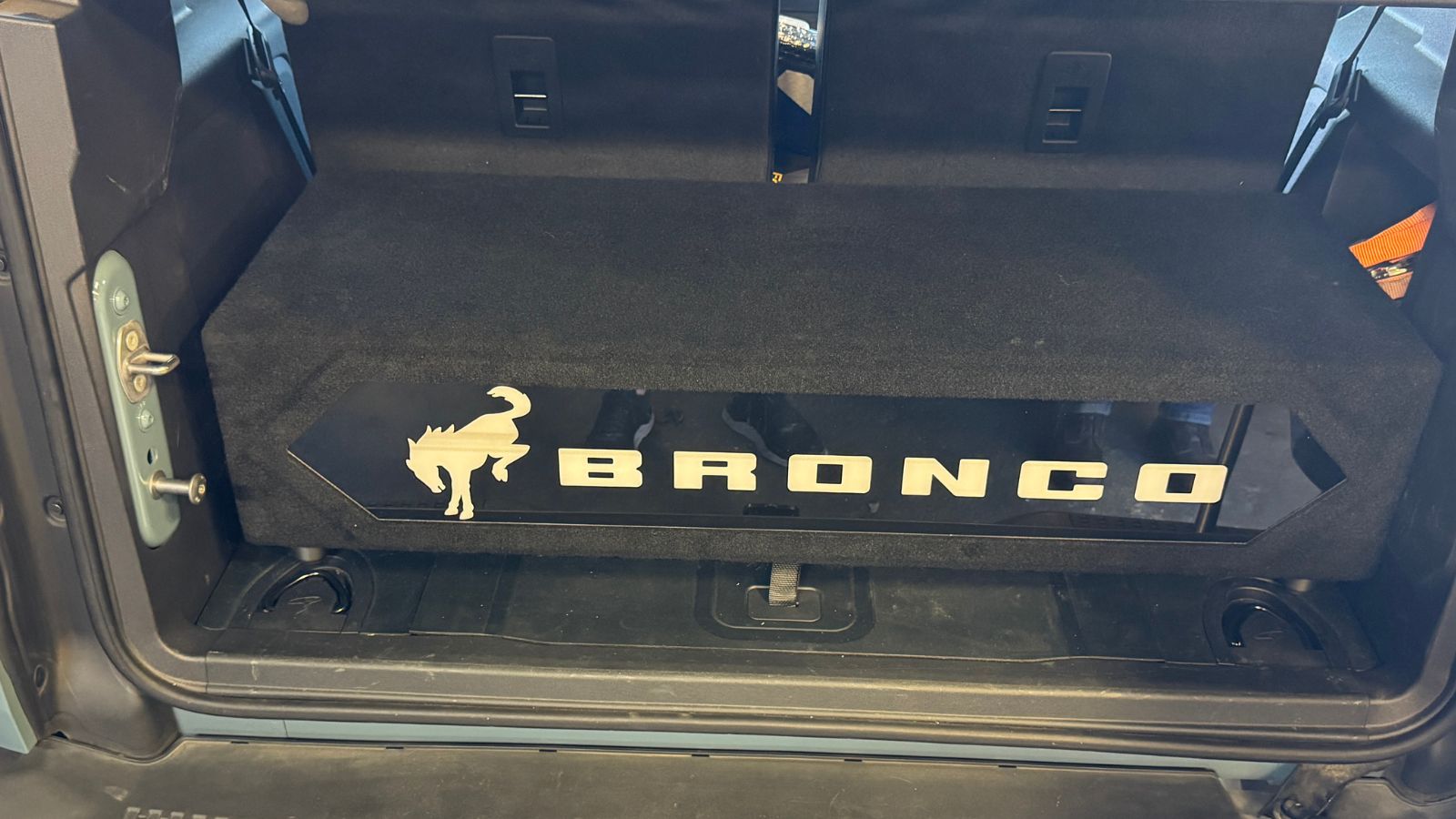
In a Jeep or Bronco there's no trunk lid, so a rear-firing cone sits exposed, aimed at a tailgate a couple of feet away. Down-firing gives you a close, fixed boundary, a cone nobody can step on, and a box that reads as a flat carpeted bench. In our experience it also gives away its location less than a rear-firing sub in a hatchback.
Skip it in a closed sedan trunk, on a ribbed plastic tray, or where the floor steps across a folded seat back, which turns the cabinet into a lever. Want the floor kept clear? Use the spare well instead.
Check your height budget too. The P10-S DF stands 7.25 inches on its feet and the P12-S DF 8.5 inches. Kicker's down-firing 48TRTP122 loaded enclosure is 6-1/8 inches tall (KICKER). If that's still too tall, start with our shallow-mount enclosure guide and our list of shallow-mount subwoofers by size.
Sealed or ported down-fire: does it change the answer?
No. Orientation and alignment are separate choices. Sealed down-fire is shorter and handles duals in isolated chambers. Ported down-fire plays louder near tuning: our Performance Optimized JL Audio 12TW3 box is 1.52 ft³ net, tuned to 34.5 Hz, with a 23.4 in² slot port (our listing). Vented down-fire isn't just our idea either.
Kicker's 48TRTP122 uses a passive radiator tuned to 35 Hz (KICKER). Our sealed down-fire builds use one chamber per driver, volume quoted per chamber, with polyfill sized to the cabinet. A ported down-fire box is one common chamber and ships dry, because polyfill would damp the resonance the vent uses. Keep the port opening as clear as the gap.
We build sealed boxes throughout the range and ported down-fire cabinets for eight to thirteen inch drivers.
Settle the alignment first, then the orientation. The details are in what changes in a ported down-fire box, our guide to sealed, ported, and bandpass enclosures, and with measurements in sealed vs ported: the data that decides it.
Which down-firing box should you buy?
Start from your driver and your height budget. Our universal P12-S DF, for example, measures 29.5 × 14.5 × 6.75 inches, stands 8.5 inches on its feet, and takes drivers up to 6 inches deep (our listing). Pick a universal cabinet for a sub you already own, or a Performance Optimized box cut for one exact driver.
- Proline X P12-S DF: 1.00 ft³ physical net, which behaves like about 1.10 to 1.15 ft³ with polyfill. 11.13 inch cutout, 6 inch max mounting depth, 1.75 inch baffle-to-floor clearance. The box weighs 27 lb (37 lb shipped), cut from Langboard Elite MDF, with a 1-year warranty.
- Proline X P10-S DF: 0.60 ft³ net, 5.5 inch cabinet, 7.25 inches on feet, 4.75 inch max mounting depth.
- Performance Optimized Down Fire Sealed 10" for the Rockford Fosgate T1 Slim: the driver from our gap math, 0.99 ft³ net, Qtc 1.151, F3 37.9 Hz.
- Performance Optimized Down Fire Ported 12" for the JL Audio 12TW3: 1.52 ft³, tuned to 34.5 Hz.
- Proline X Bronco Edition Dual 12" Down-Firing Sealed: built for the 2021 to 2025 Bronco, 2- and 4-door.
On paper, Rockford's T1 Slim 12 is rated for 1.1 ft³ sealed at 3.01 inches deep (Rockford Fosgate), which lines up with the P12-S DF's volume and depth. Confirm the cutout in our driver fitment and volume table before you order. Still deciding on size or count? Read single or dual, 10 or 12. Running duals at a low final load means you'll want an amp that is 1-ohm stable.
Our down-fire line runs from universal-cutout cabinets for a driver you already own through to driver-matched enclosures across 12 subwoofer brands and four build series. Every cabinet is cut on ShopSabre routers in Tullahoma, Tennessee from Langboard Elite MDF at 48.5 pounds per cubic foot. Browse every down firing subwoofer box we cut, or start with the car subwoofers we stock if you don't have a driver yet.
Frequently Asked Questions
Is a down-firing subwoofer better than a front-firing one in a car?
How much space does a down-firing subwoofer need underneath?
Can any subwoofer be down-firing?
Can a down-firing sub sit on carpet?
Do down-firing subs rattle more?
Where should I place a down-firing subwoofer?
Is a down-firing box worth it for your vehicle?
If cargo stacks on your box or your cargo area opens into the cabin, yes. Most new U.S. vehicles are trucks and SUVs (U.S. EPA), and that's where down-firing earns its place. If you have a closed sedan trunk and nothing lands on the enclosure, a rear-firing sealed box is doing its job.
- Down-firing works, because bass below the transfer frequency fills the whole cabin.
- The floor isn't free output. The wins are notch placement, a protected cone, a load-bearing top and stealth.
- Give it at least 1.25 to 1.75 inches of open gap, measured with the box loaded.
- Choose orientation by vehicle and alignment by music, and never flip a front-firing box.
Not sure which orientation your vehicle wants? Contact us or call 931-563-5151 and talk to an SQ-judge tech. We'll confirm whether down-firing suits your install location and match the enclosure to your driver and height.
About the Author
Scott Welch is a Multi Time IASCA National and MECA World Sound Quality Champion, an active SQ judge since 2019, and the owner of Audio Intensity in Tullahoma, Tennessee. He cuts every Proline X enclosure on the shop's CNCs and tunes every customer system before it leaves. Audio Intensity is the original US importer for Goldhorn DSP and an authorized dealer for Prodigy, Crescendo, Image Dynamics, Wavtech, Tru Technology, and more.


