Class A Car Amplifiers: The Gold Standard in Sound Quality
Class A amplifiers are known for excellent sound quality, providing clear and detailed audio. The...
Read Article →Class A car amplifiers from Audio Wave and Tru Technology. The audiophile reference topology for SQ-focused builds.
Authorized Dealer
Every amplifier is brand new with the full manufacturer warranty.
Power Matching
Send us your subwoofer or speaker specs. We'll recommend the right amplifier at the right impedance before you buy.
Hands-On Expertise
Direct support from staff who designs, builds, and competes with these systems. Honest recommendations, not upsells.
Fast Shipping from TN
In-stock orders ship within 1-2 business days from our Tullahoma, Tennessee warehouse.
Decision Shortcut
Curated picks matched to common build goals
Best Class A Entry

Audio Wave
2-channel Class A at $3,499.99. The accessible entry point for Class A front-stage amplification.
$ 3,499.99
View DetailsBest Class A Demo Deal
Audio Wave
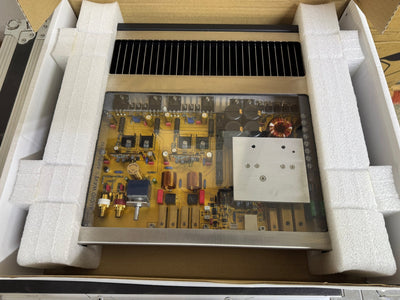
Demo unit Aspire Pro V2 at $6,999.99 (regularly $11,999.99). 41% off, last one available.
$ 6,999.99 $ 11,999.99
View DetailsBest US-Built Class A

Tru Technology
US-built billet aluminum Class A 2-channel at $8,500. Reference circuit topology with audiophile-grade components.
$ 8,500.00
View DetailsBest Class A Flagship
Audio Wave
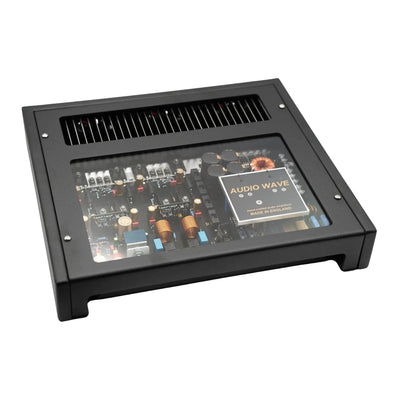
Aspire Pro V2 2-channel Class A at $10,999.99. Audio Wave audiophile flagship with no compromise.
$ 10,999.99
View DetailsBest Class A Monoblock
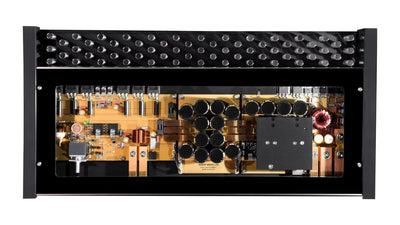
Audio Wave
Class A monoblock for subwoofer duty at $18,500. The only Class A sub amplifier option in car audio at this caliber.
$ 18,500.00
View DetailsAll products loaded
In a Class A amplifier the output devices are biased to conduct continuously across the whole waveform. They never stop conducting, so the signal never crosses a handoff point, so there is no crossover distortion to eliminate in the first place. That is the entire argument for the topology, and it is a real one.
What it sounds like is less coloration on complex material, most audibly through the midrange where the ear is least forgiving. Vocal texture, the decay on an instrument, the character of the room a recording was made in: those are the things that survive better here.
The costs are not theoretical. Efficiency runs roughly 20% to 25%, so three quarters of what the amp draws leaves as heat, and it draws that current continuously whether the music is loud, quiet, or paused. The chassis is bigger. The alternator works harder. None of that is a drawback if you have already decided Class A is what you want. It is a set of things the install has to accommodate.
This is the only real question on this page, and the honest answer for most people is Class AB.
| Class A | Class AB | |
|---|---|---|
| Output devices | Conduct continuously, signal or not | Bias holds both stages partly on |
| Efficiency | Roughly 20% to 25% | Roughly 50% to 65% |
| Heat | Constant, even at idle | Scales with output |
| Current draw | Continuous and high regardless of volume | Rises with output |
| Electrical system | High-output alternator and battery, effectively required | Big 3 over about 500W RMS |
| Pick it when | The listening session is the point of the car | You want the linearity and still drive it every day |
Class AB gets most of the way there and lives in a car without an argument. If that is the trade you want, see Class AB amplifiers. If efficiency and space are what decide it, Class D amplifiers. Everything is in the full amplifier lineup.
A reference front stage. A 2-channel Class A on the front pair is the canonical build. The front stage sets the imaging, the stage depth and the tonal accuracy that everything else is judged against, and this is the topology that gives up least getting there. Pair it with component sets worth the amplifier.
Competition. We judge IASCA and MECA. The formats reward low distortion and low coloration across the listening window, and Class A on the critical drivers is a common choice in the cars that score.
An active three-way, no compromises. Three pairs of Class A, one per driver tier, is the ceiling for a front stage. The power draw and the cost are both serious. Nothing is given up at any amplification stage.
The subwoofer, if you mean it. Class A is rare on bass because the efficiency penalty compounds at the power a sub wants. The CR-30X is one of the very few Class A monoblocks in car audio, and it exists for people who want one topology end to end. See monoblock amplifiers.
Audio Wave's entry into Class A, and the accessible end of a range that does not have one. Full Class A topology, 2-channel, for a front stage. Currently out of stock. Contact us about the next run.
The Aspire Pro V2 in 2-channel Class A, as a previous display unit against a $11,999.99 compare price. Last one. It is a display unit, so ask us about its condition before you buy.
US-built 2-channel Class A from the Billet line. Hand-built billet aluminum chassis and the component selection to match. Last one. See Tru Technology.
The same amplifier at full retail rather than display condition. Audio Wave's flagship 2-channel with nothing traded away on topology or parts. Currently out of stock. See Audio Wave amplifiers and the rest of the 2-channel lineup.
Class A on the subwoofer, full range, and the only way to run one topology from the tweeters to the bass. In stock and ready to ship. Pair it with the drivers in car subwoofers.
Class A rewards a signal chain worth its capability. A DSP is what routes the right band to the right driver, and gain is what protects all of it: how we set amplifier gain.
Class A conducts continuously across the whole waveform, so there is no handoff and no crossover distortion, at roughly 20% to 25% efficiency. Class AB uses two stages that hand off between the positive and negative halves, with a bias current holding both partly conducting so the handoff does not produce distortion either, at roughly 50% to 65% efficiency. Class AB sounds excellent and lives in a car easily. Class A is the reference tier, where the last increment justifies the efficiency penalty to you.
Almost certainly. Class A draws high current continuously regardless of what the music is doing, which is a sustained load on the charging system rather than a peak one. Plan on a high-output alternator and real battery capacity for any serious Class A install, and treat the Big 3 as mandatory rather than optional. Budget the electrical work alongside the amplifier, not after it.
A lot, and constantly. At 20% to 25% efficiency, roughly 75% to 80% of the current draw becomes heat, and it does that whether or not music is playing. Mount it somewhere with real ventilation and keep it out of sealed spaces. Some Class A installs add fans, particularly in hot climates or where install volume is tight.
Usually not, and we would rather say so. Class A suits a build where the listening session is the point, the electrical system has been upgraded to feed it, and you are willing to work around the heat and the current draw. If the car is mainly transportation, Class AB or a modern Class D at the same money gives you excellent sound with far fewer install complications.
Drivers good enough to hear the difference. High-resolution tweeters, low-distortion midrange, and midbass with real transient response are what reward this topology. Putting a $5,000 Class A amp on entry-tier coaxials wastes the amplifier. Start with component sets and midbass at the tier the amp deserves.
Strongly recommended. Crossover slopes, time alignment and per-channel level control are what let the amplifier deliver what it is capable of into each driver. Reference SQ builds are built on the combination, not on the amplifier alone.
The new units (Audio Wave Excel CA, Aspire Pro V2 Class A, TRU Technology Billet B22-A v2.5, Audio Wave CR-30X) are sold as an authorized dealer and carry the full manufacturer warranty. The Aspire Pro V2 Class A Previous Display is a display unit at closeout pricing. Contact us for its warranty specifics before you buy.
Related Collections
Browse curated picks that work with the products above.
US Acoustics
$ 159.99

US Acoustics
$ 159.99

Rainbow
$ 197.50 $ 399.99

Rainbow
$ 199.99 $ 549.99
Related Collections
Browse curated picks that work with the products above.

US Acoustics
$ 159.99

Rainbow
$ 199.99 $ 549.99

US Acoustics
$ 289.99

Arc Audio
$ 699.99 $ 749.99
Related Collections
Browse curated picks that work with the products above.
DSP for Tuning Control
A DSP gives you crossovers, EQ, time alignment, and signal routing in a single unit. The amplifier delivers the power; the DSP makes the system actually sound right.