


Proline X
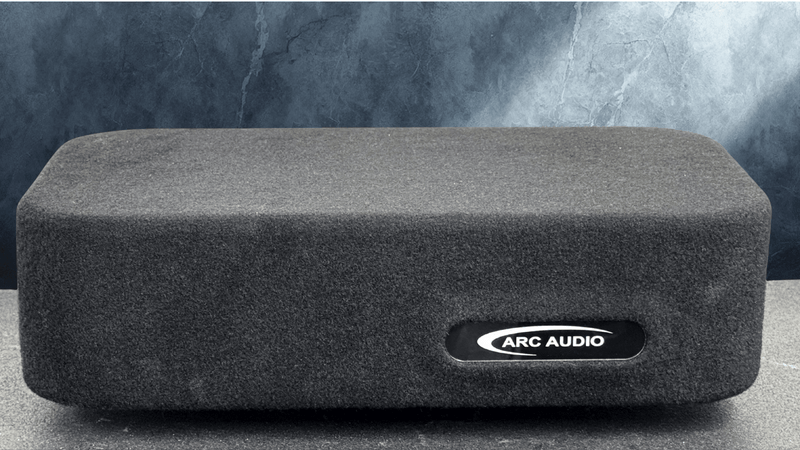
Arc Audio A10 Box: Sealed 10" Shallow Micro Series Enclosure
SKU: M10-S ARC A
- Best For: Daily-driver installs. Under-seat, behind-seat truck, and tight trunk builds where 3.77" mounting depth is required.
- Power: Rated for up to 250W RMS (Arc Audio A10)
- Topology/Class: Sealed / Double-Layer Stack Fab / Dowel Reinforced / Front-Fire or Downfire
- Sonic Character: Warm, impactful daily-driver bass. Mid-Qts driver delivers strong upper-bass presence in Arc's published optimum 0.60 cu ft airspace.


 Financing available. Choose Shop Pay Installments at checkout.

Arc Audio A10 Box: Sealed 10" Shallow Micro Series Enclosure
More enclosures cut for Arc Audio subwoofers: Arc Audio Subwoofer Boxes
Built for the Arc Audio A10.
Precision Airspace in a 6-Inch-Deep Cabinet.
The Arc Audio A10 has been a reliable shallow-mount 10" for daily-driver installs since it launched: 250 watts RMS, 15.2mm published one-way Xmax, a 3.77-inch mounting depth, and Arc's progressive-taper poly-injected pulp cone with a Nomex-blend spider. Arc Audio publishes a 0.60 cubic foot optimum sealed enclosure for the A10. The Proline X Micro Series enclosure delivers exactly that airspace in a double-layer stack-fab build that is 6 inches deep.
0.60 cu ft: Arc Audio's Published Optimum
Arc Audio publishes a sealed enclosure range of 0.40 to 0.90 cubic feet for the A10, with 0.60 cubic feet identified as the optimum. This enclosure delivers exactly 0.60 cubic feet of net acoustic airspace. At this volume the A10's system Qtc lands in the elevated range, producing a warm, upper-bass-forward response that suits daily-driver installs where impact and efficiency at listening volumes matter more than deep anechoic extension.
The A10 has a mid-range Qts of approximately 0.51 and an Fs near 27 Hz. In the 0.60 cubic foot enclosure the system produces a naturally elevated Qtc, which translates to strong output in the 50 to 80 Hz range where most bass energy in music actually lives. This is the acoustic signature Arc Audio designed the A10 for. It is not an SQ competition driver, and it does not require DSP to sound good. It is a straightforward, honest shallow-mount 10" that plays well when installed correctly.
"If I Do the Math on the External Dimensions, the Volume Looks Too Big"
This is the most common question we get on every Micro Series enclosure. The math customers run looks like this: external dimensions of 24" × 14" × 6" subtract 3/4" walls on all six sides, leaving an assumed internal cavity of 22.5" × 12.5" × 4.5". That works out to 1,266 cubic inches, or roughly 0.73 cubic feet. The listed net volume is 0.60 cubic feet, a difference of about 0.13 cu ft, which looks like the enclosure must be oversized by about 22%.
That math assumes four things that are not true on a Proline X stack-fab enclosure:
1. The walls are not 3/4" on every side. The front baffle is a double-layer stack-fab build at 1.5 inches thick, twice the assumed wall thickness. That alone removes more internal depth than a 3/4" calculation accounts for.
2. The enclosure is not a perfect rectangle. Viewed from above, all four corners are radiused at 3 inches. This is a deliberate design choice for two reasons: the rounded corners break up the parallel-wall geometry that creates internal standing waves, and they produce a finished shape that fits cleanly against vehicle interior surfaces without sharp corners catching on trim or upholstery. The 3" radii remove measurable internal volume that an external-minus-walls calculation assumes is open airspace.
3. The area directly behind the driver's magnet is precision-milled. This is a deliberate engineering step that serves two purposes. First, it allows us to make fine volume adjustments to hit the target airspace exactly. Second, and more importantly, it increases the open area immediately behind the driver's rear vent. The A10's pole vent is part of the driver's voice coil cooling system. Air flows through the vent during cone movement, carrying heat away from the voice coil former. If the area immediately behind the vent is restricted, backpressure builds against that airflow and voice coil cooling is compromised. Most enclosure manufacturers do not understand this airflow dynamic, and even fewer engineer around it. We do.
4. The driver itself displaces internal airspace once installed. The basket, motor, and pole structure occupy roughly 60 to 70 cubic inches inside the chamber. This is not subtracted from a back-of-napkin external calculation, but it is subtracted from what the driver acoustically loads into.
How we actually calculate volume. Our engineering approach is built on precision, and it is different from how most enclosure manufacturers calculate airspace and different from the math any customer can do from external dimensions. A Proline X stack-fab enclosure is built from individually CNC-cut layers, each with its own machined opening. We calculate the precise internal volume of every layer's opening, then sum those layer-by-layer volumes to arrive at the actual net airspace inside the assembled enclosure. No one else in this industry calculates net volume this way. It is the only method that produces a genuinely accurate account of the airspace a driver sees once the enclosure is built. The 0.60 cubic foot figure is exact, not approximate.
The A10 in a 0.60 cu ft Sealed Box: What It Sounds Like
The Arc Audio A10 is a daily-driver shallow subwoofer. It is not marketed as an SQ competition driver, and it is not engineered to compete in that category. Its Qts of approximately 0.51 sits between the low-Qts SQ drivers (like the ResoNix GUS series) and the high-Qts warm-bass drivers (like the Alpine RS-W10D4). In a 0.60 cubic foot sealed box the A10 produces the tonal balance most listeners recognize as "good bass" in a daily driver: strong output in the upper bass range, moderate extension into the low bass, and no need for a DSP to produce a pleasing in-cabin response.
Arc Audio has been building the A-Series since 2020, and it has developed a reputation as one of the more musical shallow-mount 10" drivers available at its price point. In the correct enclosure, running clean unclipped power in the 200 to 250 watt RMS range, it delivers exactly the daily-driver experience it was designed for. This enclosure is the correct enclosure.
1.5" Double-Layer Baffle. Stack Fab. Dowel Reinforced.
The front baffle is a double-layer stack-fab build: two CNC-cut Langboard Elite MDF panels bonded to 1.5 inches total. The stack-fab assembly is further reinforced with dowels throughout, adding between-layer tension reinforcement that locks the panel stack against shear movement under sustained operation. At 250 watts RMS the mechanical load is moderate, but the construction standard is the same across the entire Micro Series lineup because the goal is to build an enclosure that holds its acoustic seal for the life of the vehicle, not just the first year.
The stack-fab construction itself does the joining: every CNC-cut layer interlocks with the layers above and below it, eliminating single-layer butt joints entirely. The 6-inch total depth gives the enclosure side walls adequate geometric rigidity for the load, and Langboard Elite MDF at 200 psi internal bond and 410,000 psi MOE is the correct panel spec for a driver in this power class.
0.60 cu ft, Exactly Arc's Published Optimum
Arc Audio publishes 0.60 cu ft as the optimum sealed volume for the A10. This enclosure delivers exactly that, calculated by summing every CNC-cut layer's individual opening. Precision volume, not approximation.
6" Total Enclosure, 3.77" Driver Clearance
The A10 requires 3.77" of mounting depth. The 6" total enclosure provides sufficient clearance for the driver's rear motor structure with the precision-milled magnet relief area maintaining voice coil cooling airflow.
1.5" Double-Layer Dowel-Reinforced Stack Fab
Two bonded layers of Langboard Elite 3/4" MDF at 1.5 inches total, reinforced with dowels throughout the stack-fab assembly. Baffle resonance at the panel level adds coloration. Double-layer construction eliminates it.
8/32 Threaded Inserts with Machine Screws Included
The baffle is fitted with 8/32 threaded inserts on the back face. Stainless machine screws are included. The A10 mounts to steel, not MDF. Consistent clamping force at all mounting points and clean reinstallation at any service interval.
Proline X Terminal Cup, Pre-Wired with 12g OFC
The Proline X ABS/carbon fiber terminal cup with stainless hardware and copper ring terminals is installed and pre-wired with 12-gauge OFC to the driver position. Connect your amplifier run and wiring is complete.
Direct-Fit A10 Geometry with Standard Round Flange
The A10 uses a standard round mounting flange with a 9-3/16" cutout. The baffle is machined to Arc Audio's specific cutout diameter. The driver seats flush, seals against its gasket, and mounts to the threaded inserts without shimming.
Front-Firing or Downfiring, Feet Included
Rubber feet for downfiring installation are included. Run it front-firing in a standard orientation or flip it downward to couple bass output with the vehicle floor. Downfiring is particularly effective in truck cab installs where floor coupling reinforces the perceived bass response.
Polyfill Pre-Installed
Polyfill is factory-installed. It acoustically dampens internal panel reflections without artificially altering volume. Factory installation ensures consistent packing density across every unit.
Dowel-Reinforced Stack Fab: Between-Layer Tension Locking
Dowels throughout the stack-fab assembly are added as between-layer tension reinforcement, locking the panel stack against shear movement independent of adhesive condition. Combined with the interlocking layer geometry and adhesive bonding, three independent structural systems hold the enclosure together over its service life.
Ready to Mount. Ready to Wire. Ready to Downfire.
The enclosure ships fully prepped. The Proline X terminal cup is installed and pre-wired with 12-gauge OFC. Connect your amplifier run and wiring is complete. The double-layer baffle uses 8/32 threaded inserts with stainless machine screws included. Rubber feet for downfiring are included. Polyfill is factory-installed.
Impedance Options: D2 and D4
The Arc Audio A10 is available in Dual 2-ohm (A10-D2) and Dual 4-ohm (A10-D4) configurations. Wire the D2 parallel for 1 ohm or series for 4 ohms. Wire the D4 parallel for 2 ohms or series for 8 ohms. Most builds run the D2 wired parallel at 1 ohm or the D4 wired parallel at 2 ohms into an appropriately stable monoblock in the 200 to 250 watt RMS range. Confirm your amplifier's minimum stable impedance before selecting the voice coil variant.
Where It Fits
At 24" × 14" × 6", this is the most compact single 10" enclosure in the Micro Series. It fits in the tightest install locations where a full-depth 10" sealed box is out of the question:
- Under-seat: compact cars, sport sedans, crossovers
- Behind-seat: extended cab and crew cab trucks
- Trunk corner: compact cars and coupes
- Side cargo panel: SUVs and crossovers
- Hatch floor: sports cars and hatchbacks
- Spare tire well: select SUV and crossover platforms
All Proline X Micro Series enclosures carry a two-year manufacturer's warranty against defects in materials and workmanship. Built and inspected in our Tullahoma, Tennessee facility before shipment. Contact Audio Intensity directly for warranty support.
Made in Tennessee
Every Proline X Micro Series enclosure is CNC-cut and hand-assembled in Tullahoma, Tennessee on ShopSabre CNC routers. Internal volume, cutout geometry, layer-by-layer opening dimensions, baffle layer count, dowel placement, and terminal positioning are all held to spec on every unit. Langboard Elite MDF throughout: named, mill-documented, published density and bond specifications.
| Compatible Driver | Arc Audio A10-D2 / A10-D4 |
| Enclosure Type | Sealed |
| Internal Volume (Net) | 0.60 Cubic Feet (Arc Audio's published optimum) |
| Material | Langboard Elite 3/4" MDF |
| Construction | CNC-Cut Stack Fab / Dowel Reinforced |
| Front Panel Thickness | 1.5 Inches (Double-Layer Stack Fab) |
| External Width | 24 Inches |
| External Height | 14 Inches |
| External Depth | 6 Inches |
| Corner Geometry | 3" Radiused on All Four Corners (Standing Wave Control) |
| Max Mounting Depth | 3.77 Inches |
| Woofer Opening | 9-3/16" Direct Fit for Arc Audio A10 |
| Magnet Relief | Precision-Milled for Volume Adjustment and Voice Coil Cooling Airflow |
| Driver Mounting | 8/32 Threaded Inserts. Stainless Machine Screws Included. |
| Terminal Cup | Proline X ABS/Carbon Fiber. Stainless Hardware. Copper Ring Terminals. Pre-Wired. |
| Internal Wiring | 12-Gauge OFC (Oxygen-Free Copper) |
| Polyfill | Pre-Installed |
| Firing Direction | Front-Firing or Downfiring |
| Downfire Feet | Included |
| Finish | Plush Black Automotive Carpet |
| Design Revision | 5.20.26 |
| Warranty | 2 Years. Proline X / Audio Intensity. |
| Made In | Tullahoma, Tennessee, USA |
01Is it a sealed driver?
Efficiency bandwidth product places the motor before anything else is decided.
02What the box does to it
0.60 cu ft against a 40.4 L Vas.
03The watts that reach Xmax (in this enclosure)
Travel scales with the square root of power, so there is one wattage that puts the cone exactly on 12.76 mm — and a bigger one once a subsonic filter stops it wasting travel below the passband.
| Param | Value | Unit | Note |
|---|---|---|---|
| Fs | 27.00 | Hz | free-air resonance |
| Qts | 0.477 | D4 | |
| Vas | 40.41 | L | equivalent compliance |
| Sd | 346.4 | cm² | effective piston area |
| Xmax | 12.76 | mm | Cms 50%, ResoNix Klippel; Arc publishes 8 mm |
| Pe | 250 | W | continuous RMS |
| SPL | 83.8 | dB | 1 W / 1 m, derived from T/S |
Driver parameters as published by Arc Audio A-Series, store record + ResoNix Klippel for Xmax. Curves computed against this enclosure’s actual net airspace.
Built From a Spec Sheet, Not a Sales Sheet
Every Proline X Micro Series enclosure is CNC-cut from Langboard Elite MDF, 3/4" (18mm) panels produced to published mill specifications. Most enclosure manufacturers source generic MDF without published data. We can tell you the internal bond rating, the modulus of elasticity, the modulus of rupture, and the face and edge screw holding strength for every panel in this enclosure, because we chose the material based on those numbers, not on price or availability.
Langboard Elite is produced in the United States. The specifications below are pulled directly from Langboard's published mill data and are verifiable. This is the same panel stock used across the full Proline X lineup.
Langboard Elite MDF: Published Mill Data
| Property | Value | Why It Matters |
|---|---|---|
| Panel Stock | Langboard Elite MDF | Named, verifiable panel source, not generic "high-density MDF" |
| Thickness | 3/4" (18mm) | Industry standard for subwoofer enclosures; panels below this flex under pressure |
| Density | 48.5 lbs/ft³ | Higher density = less porosity, better screw retention, reduced resonance |
| Internal Bond | 200 psi | Measures resistance to delamination under sustained internal pressure. The most enclosure-relevant spec on this sheet |
| Modulus of Rupture (MOR) | 4,200 psi | Bending strength before the panel breaks, relevant for larger unsupported baffle spans |
| Modulus of Elasticity (MOE) | 410,000 psi | Stiffness under load; higher MOE means less panel flex under bass pressure, less resonance |
| Face Screw Holding | 325 lbs | How firmly the panel surface holds a screw; critical for baffle joint integrity over time |
| Edge Screw Holding | 250 lbs | Panel edge retention, relevant for every joint that isn't face-to-face |
200 psi: The Number That Actually Matters for Enclosures
The internal bond rating measures how well the MDF panel resists delamination under sustained pressure applied perpendicular to the face. In a subwoofer enclosure, every bass transient generates a pressure pulse that pushes outward on every panel simultaneously. A panel that begins to delaminate internally loses stiffness gradually. The symptoms are slow: a box that starts to sound softer, less defined, less punchy over months of use. 200 psi internal bond is the spec that determines how long this enclosure holds its acoustic integrity under daily use at real power levels.
410,000 psi MOE: Less Flex, Less Resonance
The modulus of elasticity measures panel stiffness, its resistance to bending under load. A stiffer panel flexes less under the pressure generated by a high-excursion driver at volume. Panel flex is a source of acoustic coloration: the panel itself begins to radiate sound at its own resonant frequency, adding distortion to the output. 410,000 psi stiffness is what keeps a Micro Series wall from moving. Every wall is a stack of CNC-cut layers rather than a single unsupported panel, with dowel reinforcement running between the layers as tension hardware. There is no wide unsupported span left to flex and no butt joint to work loose, so resonance is controlled at the structure level, not the panel level. The bass you hear comes from the driver, not the box.
325 lb Face / 250 lb Edge: Joints That Stay Locked
Screw holding strength determines how firmly the panel grips a fastener at the face and at the edge. On a Micro Series enclosure the driver never threads into raw MDF. The baffle carries 8/32 threaded inserts set into its back face, so the woofer mounts on machine screws into steel threads. Face and edge screw holding still matter for everything else that fastens into the shell, including the terminal cup and the included down-fire feet. 325 lb face screw holding strength means those fasteners stay seated under vibration instead of backing out and opening an air leak.
Named Panel Stock: Not "Premium MDF"
The phrase "premium MDF" or "high-density MDF" appears on marketing copy for enclosures across every price point, from $40 to $400. It is not a specification. It is a description with no defined standard. Langboard Elite is a named, sourced, mill-documented product with published data. We name it in our copy because naming it holds us accountable to the spec. You can look up Langboard Elite independently, verify the numbers on this page, and confirm you are getting what we say you are getting. That is the point.
Frequently Asked Questions
Does this enclosure include the Arc Audio A10 subwoofer?
Why is this enclosure 0.60 cubic feet?
I did the math on the external dimensions and the volume looks bigger than 0.60 cu ft. Is this enclosure oversized?
How does the A10 compare to the other 10" drivers in the Micro Series?
What amplifier power does the A10 require?
Can I run this enclosure downfiring?
Will this fit behind or under the seat of my truck?
What makes this enclosure different from a generic 10" sealed box for the A10?
Articles
Subwoofer Box for Truck: Which Fits Your Cab? (2026)

Wedge vs Angled-Baffle Subwoofer Box: Which Panel Is Tapered?

Down-Fire Box Clearance: How Much Floor Gap You Need, and Why Yours Buzzes
