

Table of Contents
- What Precision Engineering Means in Audio Hardware
- How Tight Tolerances Shape Durability and Sound Reproduction
- Subwoofer Enclosure Air Volume Calculation: Why Every Cubic Foot Counts
- Benefits of CNC-Cut Subwoofer Boxes Over Hand-Built Alternatives
- Impact of Enclosure Material on Bass Response
- Acoustic Physics vs. Mechanical Precision: Where They Meet
- Frequently Asked Questions
Last Updated: September 15, 2026
What Precision Engineering Means in Audio Hardware
Precision engineering means manufacturing components to exact, tightly controlled dimensions so every finished part performs identically. In audio hardware, that discipline separates a subwoofer that thumps cleanly for a decade from one that rattles apart in a year. Audio Intensity builds its Proline X enclosures with precision engineering.
The tolerance stack is where it starts. A subwoofer is a mechanical system: a motor pushes a cone, the cone compresses air, and the enclosure contains that pressure. Every gap or misaligned cut changes how it behaves.
Tight Tolerances and Manufacturing Accuracy
Tight tolerances mean the allowable deviation from a specified dimension is small. A panel cut to within a fraction of a millimeter fits flush; one cut "close enough" leaves an air gap. In a sealed enclosure, air gaps leak pressure. In a ported design, they throw off tuning. Neither shows up on a spec sheet, but both show up in how the bass sounds.
Manufacturing accuracy also determines whether a box fits your vehicle. A design built around a specific truck cab either slots into place or it doesn't.
How Tight Tolerances Shape Durability and Sound Reproduction
Durability and sound reproduction both trace back to how well the physical build matches the acoustic design. A cabinet that holds its dimensions under vibration keeps its tuning; one that flexes or leaks drifts out of spec the moment you turn the volume up.
Start with the transducer. A subwoofer driver is a linear motor: a voice coil suspended in a magnetic gap, attached to a cone, restrained by a spider and surround. When the amplifier sends current through the coil, it drives the cone forward and back, moving air, and that air is the sound you hear. Anything that steals motion from the cone, a flexing baffle, a shifting motor structure, a cabinet wall that gives under pressure, is motion that never becomes sound. That is the direct line between a tolerance and a frequency response curve.
Three failure points matter most, and each one has a measurable signature:
- Panel joints. Weak or gapped seams leak air under pressure. In a sealed enclosure, that leak acts like a small, uncontrolled port: it robs output at the lowest frequencies and can introduce its own resonance. In a ported design, a leak detunes the port and shifts the tuning frequency, changing the shape of the low-end rolloff.
- Baffle rigidity. The baffle holds the driver. If it flexes, the cone's motion is partly wasted moving the panel instead of the air. The baffle becomes a second, unwanted diaphragm radiating its own sound at its own resonant frequency, usually a narrow band that muddies male vocals and low bass instruments.
- Internal bracing. Without it, large panels resonate at their own frequencies and color everything the subwoofer produces. A 3/4-inch MDF panel of typical enclosure size can have a fundamental resonance in the low hundreds of hertz; bracing raises that resonance above the passband, where it no longer matters (Checking your browser).
Component consistency follows the same logic. Two subwoofers from the same production run should behave identically. When manufacturing accuracy is high, they do; when it is not, the pair can differ in sensitivity, resonant frequency, and even voice coil alignment, differences you hear as a stereo image that never quite locks in.
Signal-to-Noise Ratio and the Noise Floor
Signal-to-noise ratio measures how much clean signal you get relative to unwanted noise, and the noise floor is the baseline hiss or hum present when nothing is playing. Mechanical precision affects both.
Electronic noise, thermal noise in resistors, quantization noise in digital stages, sets a floor fixed by circuit design. Mechanical noise is different: it is generated by the physical object and scales with output. A rattling panel, a loose joint, or a vibrating enclosure adds noise no amplifier setting can remove. You can't EQ out a rattle; the fix is physical: build the cabinet so it doesn't move.
The tolerance connection is direct. A panel cut 1 mm oversize leaves a gap that buzzes at a specific frequency. A screw hole drilled slightly off-center lets a driver shift under load, changing the voice coil-to-magnet gap and adding distortion that rises with excursion. A port cut to the wrong diameter shifts tuning and can create chuffing noise at high output. None of these show up on a spec sheet, because spec sheets describe the design, not the build.
Transducer Movement and Diaphragm Rigidity
The cone itself is a precision part. Its stiffness-to-mass ratio sets how quickly it can start and stop, what listeners describe as "tight" or "fast" bass. A cone that flexes instead of moving as a piston breaks up into its own vibrational modes, radiating sound that was never in the recording. Tolerances on cone thickness, surround geometry, and spider compliance determine whether the driver behaves as a piston or breaks up early.
The same logic applies to the motor. The voice coil must sit centered in the magnetic gap with clearance measured in fractions of a millimeter (Computationally Efficient Impact Estimation of Coil Misalignment for Magnet-Free Cochlear...). If the coil rubs, you get distortion and eventually failure; if the gap is uneven, the motor's force varies with position, showing up as harmonic distortion at the driver's resonant frequency. A perfectly built enclosure cannot rescue a driver whose motor was assembled outside tolerance.
Durability Under Thermal and Mechanical Stress
Durability is not just about surviving a drop. A subwoofer lives in a hostile environment: constant vibration, thermal cycling from the voice coil, and pressure changes inside the enclosure that push and pull on every joint. A cabinet built to tight tolerances distributes those loads evenly; a loose one concentrates them at the weakest joint, which fails first.
The practical result: precision-built enclosures last longer not because they use better materials, but because they avoid the stress concentrations that start cracks and loosen fasteners.
Subwoofer Enclosure Air Volume Calculation: Why Every Cubic Foot Counts
Subwoofer enclosure air volume calculation determines how a driver loads the air inside the box, and that loading sets the low-frequency response. Get the volume wrong and the subwoofer plays outside its intended range: boomy and uncontrolled in one direction, thin and rolled off in the other.
The math is unforgiving. Volume is a function of internal dimensions, and it must account for the space the driver and any bracing displace. A box that measures correctly outside can still be wrong inside.
Here's the practical sequence:
- Start with the driver's recommended enclosure volume.
- Subtract the volume displaced by the subwoofer's motor and frame.
- Subtract the volume of internal bracing and any port structure.
- Verify the final internal figure against the target before cutting anything.
Small errors compound. A few millimeters off on each dimension, multiplied across a cabinet, moves the total volume enough to change how the system sounds. This is why CNC-cut enclosures exist: the calculation only helps if the build matches it.
Benefits of CNC-Cut Subwoofer Boxes Over Hand-Built Alternatives
CNC-cut subwoofer boxes win on repeatability. A computer-controlled router cuts every panel to the same dimensions every time, so the enclosure you receive matches the one that was designed and tested. Hand-built boxes depend on whoever is holding the saw that day.
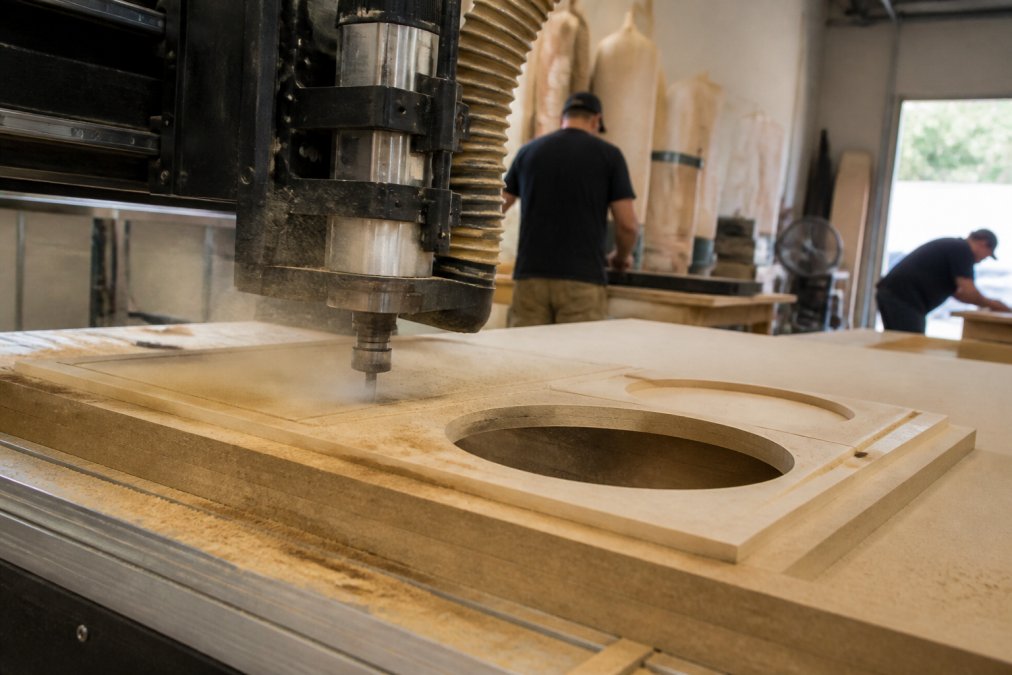
The advantages stack up quickly:
- Dimensional accuracy. Panel edges meet cleanly, so joints seal without filler.
- Consistent port geometry. Ports cut to spec keep tuning predictable.
- Repeatable results. The tenth box performs like the first.
- Vehicle-specific fit. Designs built around a particular cab drop in without fabrication.
Hand-building isn't worthless. Plenty of hobbyists build excellent boxes. But the outcome depends on the builder, and it varies. CNC machining removes that variable. Audio Intensity cuts its Proline X enclosures in-house, which is how a direct-fit design stays direct-fit across production runs.
Impact of Enclosure Material on Bass Response
Enclosure material on bass response matters because the cabinet is part of the acoustic system, not just a container.
Three properties do the work:
Panel Resonance and the Passband
Material Choice and Long-Term Stability
The Sustainability Angle
Acoustic Physics vs. Mechanical Precision: Where They Meet
Frequently Asked Questions
How does enclosure tolerance affect subwoofer performance?
Even a few millimeters of variation in panel fit can create air leaks that rob your subwoofer of output and introduce unwanted noise. Precision engineering keeps internal air volume consistent with the design spec, so the driver loads correctly and produces the frequency response it was built for. Loose tolerances also let panels flex under pressure, which smears transient response and muddies bass.
What is the role of CNC manufacturing in audio equipment?
CNC machining cuts each panel to the same dimensions every time, which matters when you are building a subwoofer enclosure where internal air volume and port geometry directly affect tuning. The benefits of CNC-cut subwoofer boxes include repeatable accuracy, tighter joints, and consistent baffle thickness. That consistency is what separates a box that hits the target frequency from one that sounds boomy or thin.
Why does air leakage ruin subwoofer sound quality?
A sealed enclosure depends on an airtight chamber to act as an air spring against the driver. Any leak, whether from a poor panel joint or a loose terminal cup, lets that pressure escape. The result is reduced low-frequency output, chuffing noise at high excursion, and a frequency response that rolls off earlier than designed. Precision engineering closes those gaps before they become a problem.
How does material density impact audio resonance?
Dense, rigid materials resist flexing when the subwoofer pushes air inside the box. When panels vibrate, they add their own resonance to the sound, which colors the bass and reduces clarity. The impact of enclosure material on bass response comes down to how well the material absorbs or rejects that energy. Thicker, denser panels keep the enclosure neutral so you hear the driver, not the box.


