
Proline X
Fi Car Audio Alpha 15 Box: Sealed 15" Wedge Enclosure
SKU: PO 15-S W FI ALPHA BB
- Best For: Fi Car Audio Alpha 15 Trunk-Fit Builds
- Net Volume: 2.54 cu ft (2.69 cu ft Gross)
- Driver Match: Fi Car Audio Alpha 15 (S1, S2 or S4)
- Construction: Rear-Firing Wedge | V-Groove/Dado | Double 1.5" Baffle | Threaded Insert Kit


 Financing available. Choose Shop Pay Installments at checkout.

Fi Car Audio Alpha 15 Box: Sealed 15" Wedge Enclosure
More enclosures cut for Fi Car Audio subwoofers: Fi Car Audio Subwoofer Boxes
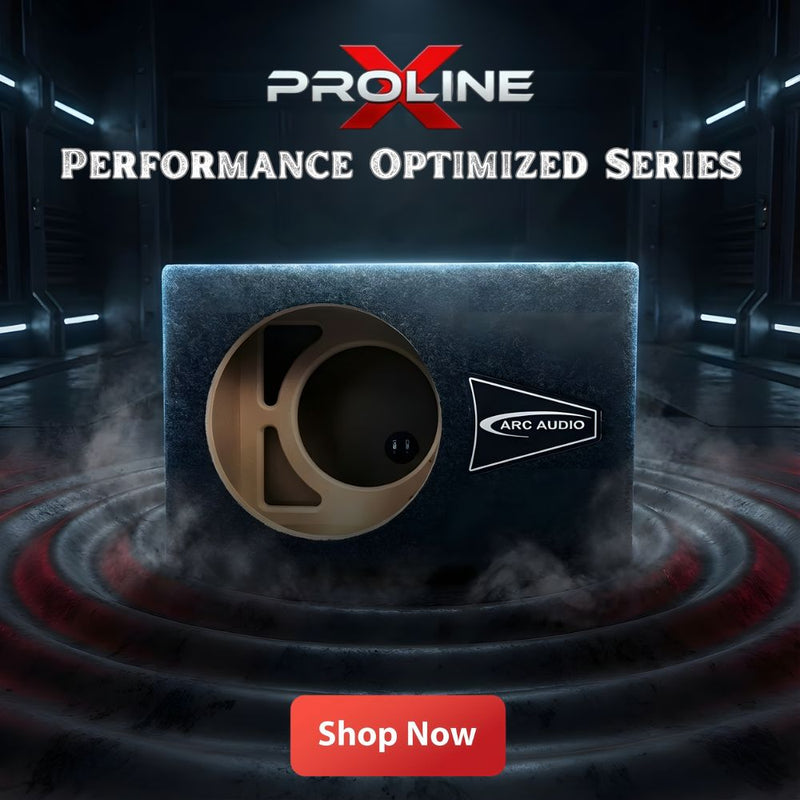
Performance Optimized Wedge | Fi Car Audio Alpha 15
15" Sealed Wedge Enclosure | Rear-Firing Trunk-Load Design
The Fi Car Audio Alpha 15 in a Sealed Wedge
The Alpha 15 is the 15 inch from Fi Car Audio's Alpha v1 line: 1000 watts RMS, 17 mm of one-way excursion on 810 square centimeters of cone, and 7.375 inches of mounting depth. Every figure comes from the Thiele-Small and technical tables Fi prints on its Alpha Series product page, including the 0.14 cubic foot driver displacement, and the parameters check against each other: the printed Qts reproduces from Qes and Qms, and Fi's moving mass agrees with its Fs, Vas and cone area.
2.54 cubic feet net is the Butterworth volume, inside Fi's recommended 1.8 to 3.0 cubic feet. On Fi's figures, Fs 34.7 Hz, Qts 0.52 and Vas 61.00 liters, that is Qtc 0.707 with half power at 47.2 Hz. Fi publishes one parameter set for the Alpha 15 that covers the S1, S2 and S4 single coil versions, so one alignment serves all three. Fi's own recommended sealed range for the Alpha 15 is 1.8 to 3 cubic feet, which reads Qtc 0.77 to 0.68.
Trunk-Load Wedge Design Explained
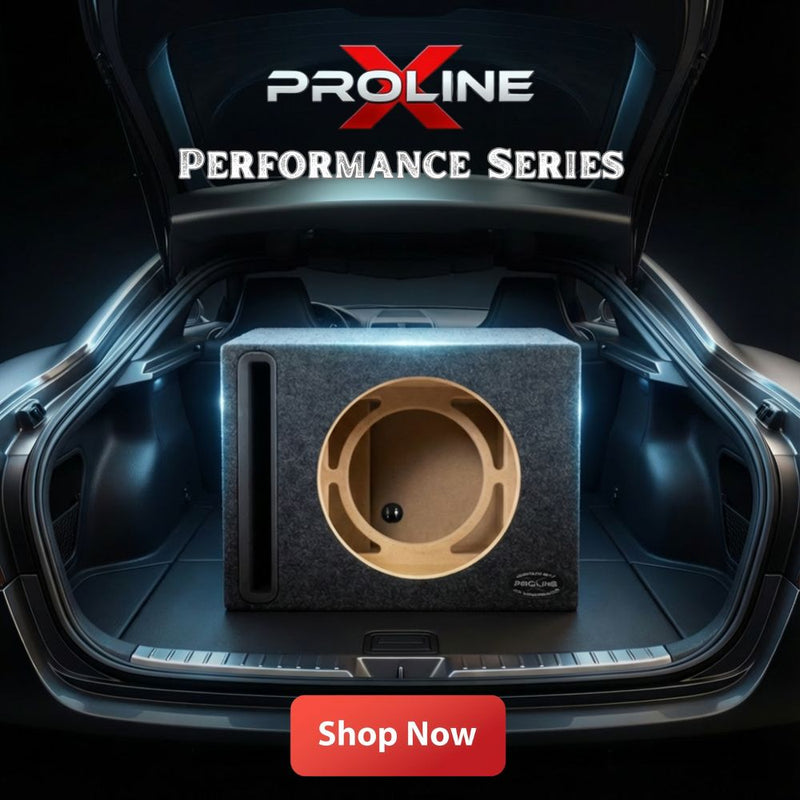
The driver mounts on the vertical trunk-lid-side face and fires rearward into the trunk cavity.
Seat-Side Face Matches Seat Lean
Angled face matches the roughly 20 degree factory seat lean.
Trunk-Lid-Side Face Fires the Woofer
Vertical baffle, cone firing rearward into the trunk cavity.
Trunk Cavity Loading
The trunk acts as an acoustic extension for a smoother presentation.
Preserves Trunk Cargo Space
The wedge tucks against the seat back and the space in front stays usable.
Engineered for the Fi Car Audio Alpha 15
Half power lands at 47.2 Hz anechoic, before any cabin gain. At Qtc 0.71 the response is maximally flat into the rolloff, so F3 and fc coincide. Fi publishes the driver displacement, 0.14 cubic feet, and it is taken out of the net figure.
Alignment Numbers
| Driver | System Qtc | fc | F3 |
|---|---|---|---|
| Alpha 15 S1, S2 or S4 | Qtc 0.707 | 47.2 Hz | 47.2 Hz |
Mounting Geometry
The baffle is cut to 13.875 in, Fi's published cutout, under the 15.5 in frame. The rear panel rakes 20 degrees, so the cavity deepens from 10.17 in at the top to 16.72 in at the base, and the 7.375 in motor clears it with 2.68 in to spare. Fi prints no bolt circle for the Alpha 15, so the baffle ships undrilled with a threaded insert kit and stainless machine screws: set the driver in the recess, mark its holes, drill, press the inserts and bolt it down.
What the Numbers Rest On
Langboard Elite MDF
Premium 3/4 in MDF throughout.
V-Groove and Dado Joinery
CNC cut V-grooves at every panel intersection, sides and brace seated in dados.
Double-Layer 1.5" Front Baffle
Two bonded 3/4 in MDF sheets at the driver face, the outer layer machined as a flush recess.
Fi's Published Parameters
Fs 34.7 Hz, Qts 0.52, Qes 0.56, Qms 8.10, Vas 61.00 L, Sd 810 cm2, Cms 0.0663 mm/N, Mms 326 g, Bl 10.0 / 14.1 / 20.2 N/A (S1 / S2 / S4), Re 0.8 / 1.6 / 3.3 ohms, sensitivity 88.5 dB 1W/1m.
Wiring the Fi Car Audio Alpha 15 to Your Amplifier
The single coil comes as S1, S2 or S4: 1, 2 or 4 ohms, wired straight to the amplifier. Confirm the final load against your amplifier's minimum stable impedance before powering the system.
Power handling is 1000 watts RMS per driver. Aim for roughly 700 to 1000 watts at the impedance you wire.
Built in Tennessee, Backed by Audio Intensity
Cut and assembled in Tullahoma, Tennessee on our own CNC equipment. Finished in plush black carpet with the gloss black acrylic baffle insert, one pre-wired terminal cup, 12 gauge OFC to the driver position. Polyfill wall lining installed. Threaded insert kit and stainless machine screws in the box. 1 year limited warranty. Enclosure only, the driver is purchased separately. Call or text 931-563-5151.
Fi Car Audio Alpha 15: Cut for the Driver
2.54 cubic feet net at Qtc 0.707, F3 47.2 Hz, cut direct fit and built to order in Tennessee.
| Specification | Value |
|---|---|
| Series | Proline X Performance Optimized Wedge |
| Compatible Driver | Fi Car Audio Alpha 15 S1, S2 or S4, quantity 1. Direct fit |
| Configuration | Single 15 inch, single chamber sealed wedge |
| Mounting Position | Trunk or cargo area, tall face against the rear seat back |
| Firing Direction | Rearward into the trunk. Not a down fire design, no feet included |
| External Width | 29.50 in |
| External Height | 18 in at the seat face |
| External Depth | 16.72 in at the base, tapering to 10.17 in at the top |
| Internal Volume, Gross | 2.69 cu ft |
| Internal Volume, Net Acoustic | 2.54 cu ft after the brace and Fi's published 0.14 cu ft displacement |
| Driver Mounting Depth | 7.375 in required; 2.68 in clearance above the motor against the raked rear panel |
| Alignment | Qtc 0.707, fc 47.2 Hz, F3 47.2 Hz anechoic |
| Fi Recommended Sealed | 1.8 to 3 cu ft (Qtc 0.77 to 0.68) |
| Woofer Opening | 13.875 in, Fi's published cutout |
| Frame Outer Diameter | 15.5 in, Fi's published figure |
| Bolt Circle | Not printed by Fi; threaded insert kit included |
| Driver Displacement | 0.14 cu ft, Fi's published figure |
| Fs / Qts / Qes / Qms / Vas | 34.7 Hz / 0.52 / 0.56 / 8.10 / 61.00 L |
| Driver Sd | 810 cm2, published by Fi |
| Xmax | 17 mm one way, Fi spec |
| Driver Power Handling | 1000 W RMS, Fi spec |
| Wiring Options | The single coil comes as S1, S2 or S4: 1, 2 or 4 ohms, wired straight to the amplifier. |
| Parameter Source | ficaraudio.com Alpha Series product page, Thiele-Small and Technical Specifications tables |
| Material | Langboard Elite MDF |
| Construction | CNC cut, V-groove and dado joinery |
| Panel Thickness | 0.75 in |
| Front Baffle | 1.5 in double baffle, outer layer machined as a flush recess |
| Internal Bracing | Windowed brace, dadoed to the shell |
| Driver Mounting | Threaded insert kit included, NOT pre-installed: Fi prints no bolt circle |
| Terminal Cups | One Proline X ABS and carbon fiber composite, side mounted, pre wired 12 gauge OFC |
| Acrylic Insert | Gloss black acrylic baffle insert standard; None variant minus $20 |
| Damping | Light polyfill wall lining, does not alter acoustic volume |
| Carpet | Plush black |
| Shipping Weight | 59 lb |
| Warranty | 1 Year Limited |
| Built In | Tullahoma, Tennessee |
01Is it a sealed driver?
Efficiency bandwidth product places the motor before anything else is decided.
02What the box does to it
2.54 cu ft against a 61.0 L Vas.
03The watts that reach Xmax (in this enclosure)
Travel scales with the square root of power, so there is one wattage that puts the cone exactly on 17.0 mm — and a bigger one once a subsonic filter stops it wasting travel below the passband.
| Param | Value | Unit | Note |
|---|---|---|---|
| Fs | 34.70 | Hz | free-air resonance |
| Qts | 0.520 | single 1, 2 or 4 ohm | |
| Vas | 61.00 | L | equivalent compliance |
| Sd | 810.0 | cm² | effective piston area |
| Xmax | 17 | mm | one-way linear travel |
| Pe | 1000 | W | continuous RMS |
| SPL | 88.4 | dB | 1 W / 1 m, derived from T/S |
Driver parameters as published by Fi Car Audio Alpha 15 product page. Curves computed against this enclosure’s actual net airspace.
Built From a Spec Sheet, Not a Sales Sheet
Every Proline X Performance Series enclosure is CNC-cut from Langboard Elite MDF, 3/4" (18mm) panels produced to published mill specifications. Most enclosure manufacturers source generic MDF without published data. We can tell you the internal bond rating, the modulus of elasticity, the modulus of rupture, and the face and edge screw holding strength for every panel in this enclosure, because we chose the material based on those numbers, not on price or availability.
Langboard Elite is produced in the United States. The specifications below are pulled directly from Langboard's published mill data and are verifiable. This is the same panel stock used in our full Proline X lineup.
Langboard Elite MDF: Published Mill Data
| Property | Value | Why It Matters |
|---|---|---|
| Panel Stock | Langboard Elite MDF | Named, verifiable panel source, not generic "high-density MDF" |
| Thickness | 3/4" (18mm) | Industry standard for subwoofer enclosures; panels below this flex under pressure |
| Density | 48.5 lbs/ft³ | Higher density = less porosity, better screw retention, reduced resonance |
| Internal Bond | 200 psi | Measures resistance to delamination under sustained internal pressure. The most enclosure-relevant spec on this sheet |
| Modulus of Rupture (MOR) | 4,200 psi | Bending strength before the panel breaks, relevant for larger unsupported baffle spans |
| Modulus of Elasticity (MOE) | 410,000 psi | Stiffness under load; higher MOE means less panel flex under bass pressure, less resonance |
| Face Screw Holding | 325 lbs | How firmly the panel surface holds a screw; critical for baffle joint integrity over time |
| Edge Screw Holding | 250 lbs | Panel edge retention, relevant for every joint that isn't face-to-face |
200 psi: The Number That Actually Matters for Enclosures
The internal bond rating measures how well the MDF panel resists delamination under sustained pressure applied perpendicular to the face. In a subwoofer enclosure, every bass transient generates a pressure pulse that pushes outward on every panel simultaneously. A panel that begins to delaminate internally loses stiffness gradually. The symptoms are slow: a box that starts to sound softer, less defined, less punchy over months of use. 200 psi internal bond is the spec that determines how long this enclosure holds its acoustic integrity under daily use at real power levels.
410,000 psi MOE: Less Flex, Less Resonance
The modulus of elasticity measures panel stiffness, its resistance to bending under load. A stiffer panel flexes less under the pressure generated by a high-excursion driver at volume. Panel flex is a source of acoustic coloration: the panel itself begins to radiate sound at its own resonant frequency, adding distortion to the output. 410,000 psi stiffness combined with V-groove and dado joinery means the panels stay rigid and the bracing controls resonance at the structure level, not the panel level. The bass you hear comes from the driver, not the box.
325 lb Face / 250 lb Edge: Joints That Stay Locked
Screw holding strength determines how firmly the panel grips a fastener at the face and at the edge. This matters most at the baffle joint, where the front panel meets the side panels and where the driver is mounted. A panel with low screw holding strength allows fasteners to loosen over time under vibration, leading to air gaps at the joint and loss of acoustic seal. 325 lb face screw holding strength means the baffle hardware stays put. Combined with dado joinery and adhesive, the front panel on a Proline X Performance Series enclosure is not going anywhere.
Named Panel Stock: Not "Premium MDF"
The phrase "premium MDF" or "high-density MDF" appears on marketing copy for enclosures across every price point, from $40 to $400. It is not a specification. It is a description with no defined standard. Langboard Elite is a named, sourced, mill-documented product with published data. We name it in our copy because naming it holds us accountable to the spec. You can look up Langboard Elite independently, verify the numbers on this page, and confirm you are getting what we say you are getting. That is the point.
Why Proline X?
Most enclosures are built to a price point. Proline X is built to a spec. Every box starts with published-data MDF, gets CNC-cut to exact internal volume, and is assembled by hand in our Tennessee facility. The difference shows up in the measurements, and in how the box holds up two years into daily use.

CNC-Cut to Spec
Panels are machine-cut on ShopSabre CNC routers and joined with V-groove and dado joinery. Consistent geometry, no hand-cut variance, no gaps at the joints.

Handcrafted in USA
Hand-assembled at our facility in Tullahoma, TN. Every enclosure is inspected before it ships.

Tuned to the Build
Internal volume and port geometry are calculated to spec and CNC-cut to exact dimensions. The box performs the same way every time.
Shop By Series