

Audio Dynamics
Audio Dynamics 2000 Series 5.25″ Coaxial Set – CX524
SKU: ADCX524


Audio Dynamics 2000 Series 5.25″ Coaxial Set – CX524
Closeout, remaining stock
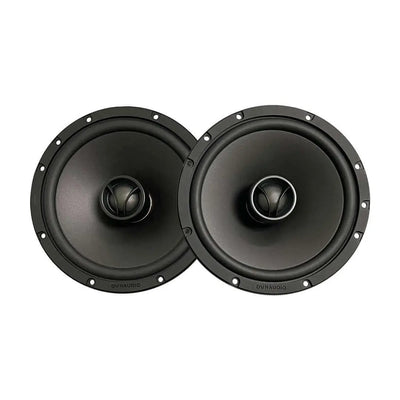
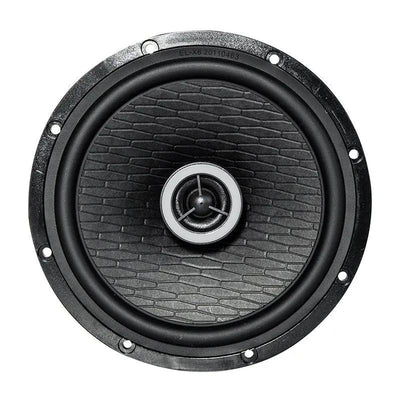
Audio Dynamics 2000 Series CX524 5.25 Inch Coaxial Set
Same wool pulp woofer as the CS524 component set, with a 13mm polymer film tweeter mounted at the centre. 100W RMS, 90.85dB, 4 Ohm, 54mm depth, no external crossover.
- Closeout
- Coaxial
- Final sale
What You Are Buying
A two-way 5.25 inch coaxial pair. One hole, one pair of wires, no crossover box to hide.
The interesting part is that the woofer is the same wool pulp driver Audio Dynamics used in the CS524 component set. The difference between the two products is the tweeter and the crossover, not the cone.
Read the power rating before you set your gains
The 100W RMS figure is conditional. Audio Dynamics rates it with an electronic high-pass filter in circuit at 80Hz at 24dB/octave, 100Hz at 18dB/octave, or 120Hz at 12dB/octave. The integrated crossover inside the speaker protects the tweeter only. It does nothing for the woofer, so you still need to high-pass the channel.
CX524 or CS524
Both use the same wool pulp woofer, the same 25mm voice coil, the same 119mm cutout and the same 54mm depth. Here is what actually differs.
| CX524 coaxial | CS524 component | |
|---|---|---|
| Tweeter | 13mm polymer film | 20mm transparent silk dome, neodymium |
| Crossover | Integrated, fixed | External, with 0dB / minus 2dB tweeter attenuation |
| Sensitivity | 90.85dB | 89.98dB |
| Tweeter placement | Fixed at the woofer centre | Wherever you can mount it |
| Install time | One hole per side | Woofer, tweeter and crossover per side |
Choose the coaxial if the tweeter is going to end up in the door either way, or if this is rear fill behind a component front stage. Choose the component set if you have somewhere to put a tweeter at ear height and you care about where the sound appears to come from.
Reading the Specification
90.85dB sensitivity
Nearly a decibel higher than the component version, which is what usually happens when a smaller, less loaded tweeter replaces a bigger one. It is enough sensitivity to work off a head unit at 25 to 35W, which the CS524 really is not.
Wool pulp cone
Self-damping paper-family material with no hard breakup peak in the upper midrange. It is the reason to buy this speaker over a generic polypropylene coaxial in the same size.
13mm polymer film tweeter
Small, and smaller than the 20mm silk dome in the component set. A 13mm dome disperses widely, which helps in a door where nothing is aimed at you, but it will not have the reach or the ease of the larger unit. It protrudes 10mm, which matters for grille clearance.
Fitment
- 119mm / 4 11/16 inch mounting diameter. Check this, not the nominal 5.25 inch.
- 54mm / 2 1/8 inch mounting depth.
- 10mm tweeter protrusion. Check clearance behind the factory grille before you close the panel.
- 4 Ohm nominal.
Matched rear fill
If you are running CS524 components up front, these use the identical woofer, so the rear tonal character matches. That is worth more than it sounds: mismatched rear fill is the usual reason a rear stage has to be turned down to nothing.
Who This Suits
Buy these if
- You want a straight factory replacement in a 5.25 inch location.
- You are running head unit power or a modest amplifier.
- You need rear fill that matches a CS524 front stage.
- You accept a final sale on closeout stock.
Look elsewhere if
- Imaging is the point. The tweeter is in the door and stays there.
- You cannot high-pass the channel.
- You want midbass. A 5.25 needs a subwoofer behind it.
- You want a large, refined tweeter; the CS524 has it.
Installation
- Set the high-pass, then set the gain.
- Test-fit dry with the window up and down before wiring.
- Wire straight from the head unit or amplifier. No external crossover.
- Seal the inner door skin. A 5.25 inch cone has little area and a leaky door wastes what it has.
Condition and sale terms
Closeout stock, sold as a final sale with no returns and no exchanges. Packaging may show shelf wear from storage. Specifications are as published by Audio Dynamics, including the power rating's dependence on external high-pass filtering. Once remaining stock is gone this listing will be removed.
Questions on fitment or amplifier matching: contact us.
| Type | 2-way coaxial |
|---|---|
| Woofer size | 5.25 inch / 130mm |
| Woofer cone | Wool pulp, same driver as the CS524 component set |
| Woofer voice coil | 25mm / 1 inch |
| Tweeter | 13mm / 0.5 inch polymer film dome, centre mounted |
| Frame | Steel |
| Impedance | 4 Ohm |
| Series | 2000 Series |
| Condition | Closeout |
| RMS power | 100W with high-pass filtering, see note |
|---|---|
| Works on head unit power | Yes, 25 to 35W RMS per channel |
| Recommended amplifier | 50 to 100W RMS per channel |
| Sensitivity | 90.85 dB (1W/1m) |
|---|
| Mounting diameter | 119mm / 4 11/16 inch |
|---|---|
| Mounting depth | 54mm / 2 1/8 inch |
| Tweeter protrusion | 10mm / 3/8 inch |
| External crossover | None required, integrated |
The 100W RMS rating is measured with an electronic high-pass filter in circuit at 80Hz / 24dB per octave, 100Hz / 18dB per octave, or 120Hz / 12dB per octave. The passive crossover inside the speaker protects the tweeter only.