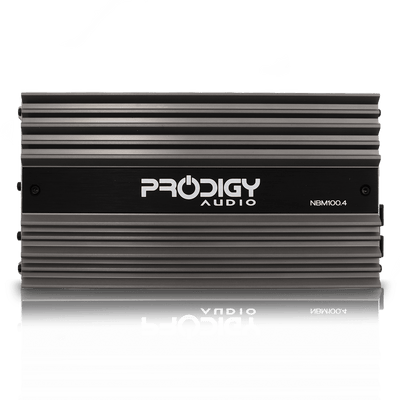
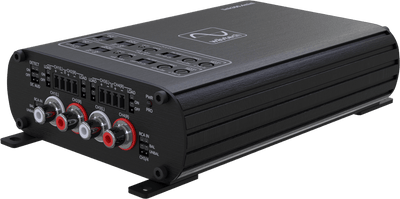
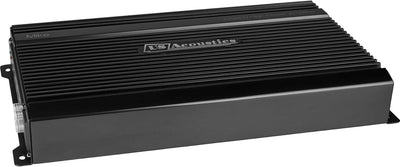
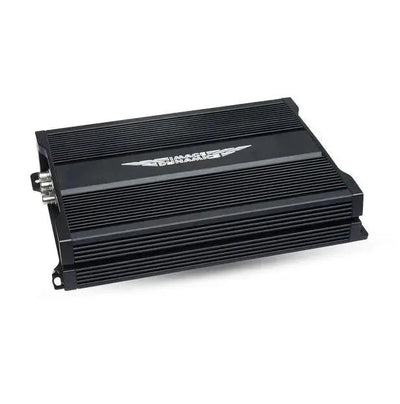
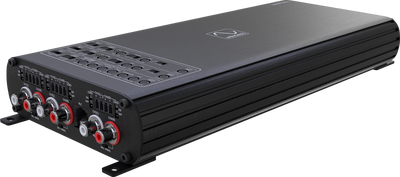
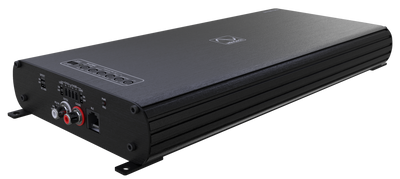
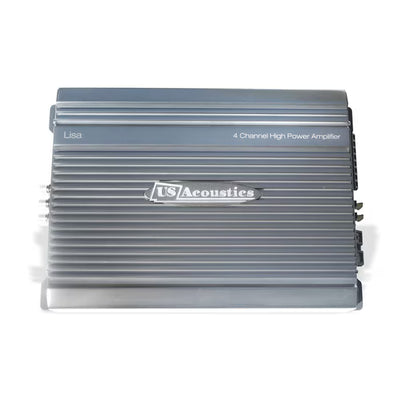
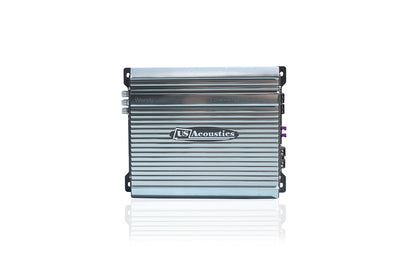
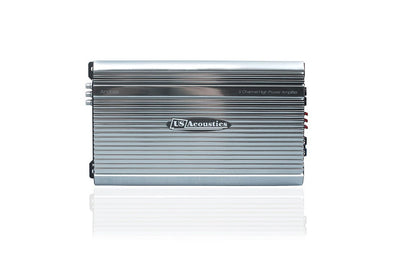
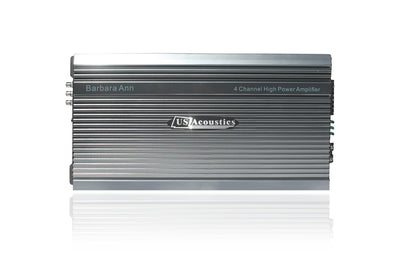
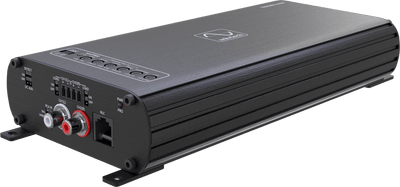
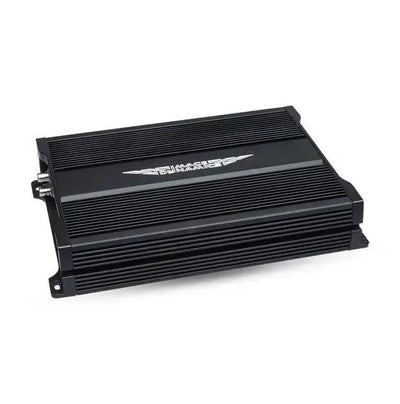
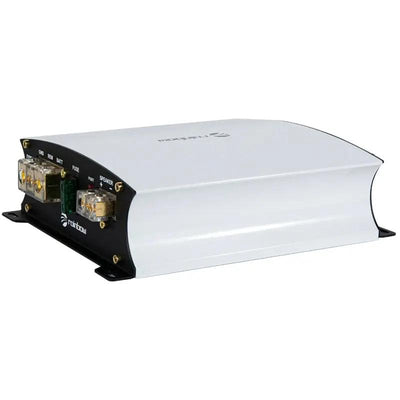
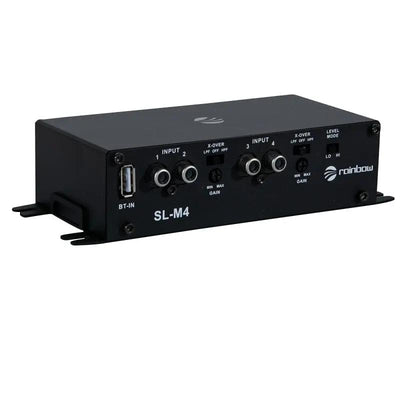
Class D amplifiers covering monoblock subwoofer duty and multi-channel full-range builds in compact, high-efficiency chassis designs.
Class D amplifiers have become the dominant topology in car audio for one straightforward reason: they deliver serious output power in a fraction of the physical space and electrical draw that equivalent Class AB designs require. Operating at efficiencies of 80-90%, a Class D amplifier converts most of its input power into audio signal output rather than heat, which means smaller heatsinks, smaller enclosures, and less strain on your vehicle's charging system.
The efficiency advantage translates directly into installation flexibility. A Class D monoblock rated at 1000W RMS can fit under a front seat where a Class AB design of equivalent output power physically couldn't. For modern vehicles where available mounting space is shrinking and factory electrical systems are already loaded, that compact footprint isn't a compromise. It's the enabling factor for builds that wouldn't otherwise be possible.
Audio Intensity stocks Class D amplifiers across every channel count and output tier, from compact monoblocks for subwoofer duty to high-output multi-channel designs for full system builds. Catalog brands include Wavtech, Crescendo, US Acoustics, Prodigy, and Image Dynamics, covering daily-use performance through full competition-grade output.
Need help matching a Class D amplifier to your speakers or subwoofer? Send us your build specs and we'll confirm the right fit before you buy.
Authorized Dealer
Every amplifier is brand new with the full manufacturer warranty.
Power Matching
Send us your subwoofer or speaker specs. We'll recommend the right amplifier at the right impedance before you buy.
Hands-On Expertise
Direct support from staff who designs, builds, and competes with these systems. Honest recommendations, not upsells.
Fast Shipping from TN
In-stock orders ship within 1-2 business days from our Tullahoma, Tennessee warehouse.
A Class D car amplifier operates on a fundamentally different principle than Class A or Class AB designs. Rather than using output transistors that remain partially or fully on throughout the audio signal cycle, a Class D amplifier switches its output transistors rapidly between fully on and fully off states, typically at frequencies between 300kHz and 600kHz, well above the audible range. The audio signal is encoded in the width of these switching pulses (pulse-width modulation), then reconstructed by a low-pass output filter that strips the high-frequency switching carrier and recovers the audio signal for delivery to the speaker.
The efficiency advantage comes from the switching behavior itself. A transistor that's fully on or fully off dissipates almost no power. Power dissipation in a transistor occurs primarily when it's in a partially conducting state, which is exactly where Class A and Class AB output stages operate. By eliminating that partially conducting state, Class D designs achieve efficiencies that Class AB designs can't approach, regardless of how well they're engineered.
The practical result for car audio is an amplifier that produces its rated output power while drawing significantly less current from the vehicle's electrical system and generating significantly less heat than a Class AB design at equivalent output. A well-engineered 500W RMS Class D monoblock draws roughly 50 amps at full output. An equivalent Class AB design would draw 80-100 amps and require a much larger heatsink to manage the thermal load.
Class D Sound Quality: Separating Fact from Audiophile Mythology
Modern Class D amplifier designs from quality manufacturers have closed the sonic gap with Class AB to the point where the difference is either inaudible or irrelevant in any real-world car audio context. Output filter designs have improved dramatically. Switching frequencies have increased to push artifacts further above the audible range. Feedback topologies have been refined to reduce distortion figures to levels that compete directly with Class AB designs.
The Wavtech Link series and Crescendo Revolution line are both Class D designs that measure and sound at a level that would have required Class AB technology a generation ago. For subwoofer amplification specifically, Class D is universally the right choice. For full-range speaker amplification, modern Class D from a quality manufacturer is entirely appropriate for demanding builds.
Where Class AB retains a genuine advantage is at the absolute reference level of sound quality competition. For that application, Tru Technology's Tungsten series and Audio Wave's Excel and Aspire Pro lineup remain in our catalog as Class AB alternatives. For the vast majority of builds, Class D is the correct choice.
Output Power and Impedance: Reading the Spec Sheet
Class D amplifier specifications are among the most abused in the consumer electronics industry. Power ratings are frequently inflated, measured at impedances that don't reflect real-world use, or derived under test conditions that don't translate to sustained output.
When evaluating a Class D amplifier's output power, focus on RMS power at the impedance your system will present. A monoblock rated at 1000W RMS at 1 ohm may only produce 500W RMS at 2 ohms, which matters if your subwoofer wiring configuration presents a 2 ohm load. Every amplifier in this collection is rated honestly at usable impedances and tested for sustained output, not burst performance.
Minimum stable impedance is equally important. Class D amplifiers that are rated stable at 1 ohm can handle low-impedance subwoofer wiring configurations that 2 ohm-stable designs can't. If you're running a dual voice coil subwoofer wired in parallel, confirm the amplifier's minimum stable impedance before purchasing. Running a 2 ohm-stable amplifier into a 1 ohm load will either engage protection circuitry or damage the output stage.
Electrical System Considerations for High-Output Class D
The efficiency of Class D amplifiers doesn't eliminate electrical system planning for high-powered builds. It reduces the scale of the problem. A 2000W RMS Class D monoblock at 90% efficiency still draws roughly 185 amps at full output, which exceeds the capacity of virtually every factory alternator.
For builds over 1000W RMS total system power, Big 3 wiring upgrades are the baseline. Replacing the factory ground cables and alternator positive cable with heavier gauge wire reduces resistance and voltage drop under load. For serious builds over 2000W, a high-output alternator and supplemental battery capacity become necessary to maintain stable voltage under sustained high-output operation.
Voltage drop is the enemy of Class D performance. Most Class D amplifiers regulate their output power relative to supply voltage. At 12V supply, output is rated power. At 11V due to voltage drop under load, output drops proportionally and the amplifier may engage protection. Building the electrical system correctly isn't optional for high-powered Class D builds. It's what allows the amplifier to deliver its rated performance reliably.
Catalog by Tier
Compact 4-Channel Class D ($225 to $499)
Prodigy NBM100.4 (600W, 4-channel, $225.99 on sale): Value-tier Class D for compact 4-channel installs. Last one available.
Wavtech link300.4mini (compact 4-channel, $329.99): Compact-chassis Class D where physical size matters as much as power.
Prodigy NB300.4 (1200W, 4-channel, $416.99 on sale): Higher-power 4-channel Class D at strong price-to-power ratio. Last one available.
Wavtech link500.4mini (4-channel, $449.99 on sale): Wavtech's higher-output compact 4-channel.
Image Dynamics SQ Class D
Image Dynamics SQ800.4 (800W full-range, 4-channel, $469.99): SQ-tuned Class D engineered specifically for Image Dynamics components.
Compact Class D Monoblocks ($329 to $699)
US Acoustics Mike (1500W monoblock, $329.99): The accessible Class D monoblock at value pricing.
Wavtech Link1500.1plus (1500W compact monoblock, $699.99): Compact-chassis 1500W Class D for installs where size matters as much as power.
5-Channel Class D
Prodigy NBM1000.5 (1000W 5-channel, $387.99 on sale): The accessible 5-channel Class D for complete one-amp full-system builds.
Wavtech link1000.5plus (1000W 5-channel, $649.99 on sale): Compact 5-channel for space-constrained full-system installs.
High-Output Class D Monoblocks ($527 to $569)
Prodigy NB2800.1 (2800W monoblock, $527.99 on sale): High-output Class D for serious sub builds. Last one available.
Crescendo REVOLUTION 3A1 (1-channel, $569.99): SQ-focused Class D monoblock from Crescendo's competition-heritage lineup.
Frequently Asked Class D Amplifier Questions
What is a Class D amplifier?
A Class D amplifier uses switching topology (pulse-width modulation) where the output transistors rapidly switch fully on or fully off at frequencies above the audible range, rather than operating in linear modes like Class A or Class AB. The signal is reconstructed by a low-pass output filter. The result is amplification with 80-90% efficiency, dramatically less heat output, and compact chassis sizes compared to linear amplifier topologies.
Is Class D sound quality good enough for SQ-focused builds?
For most builds, yes. Modern Class D designs from quality manufacturers (Wavtech Link series, Crescendo Revolution, Image Dynamics SQ-tuned designs) have closed the sonic gap with Class AB to the point where the difference is either inaudible or irrelevant in real-world car audio contexts. For subwoofer amplification specifically, Class D is universally the right choice. For full-range speaker amplification, modern Class D is appropriate for most demanding builds. Only at the absolute reference tier of sound quality competition does Class AB retain a genuine advantage.
What's the difference between Class D and Class AB?
Class D uses switching topology for 80-90% efficiency with compact chassis sizes and significantly less heat output. Class AB uses linear topology with continuous bias current for 50-60% efficiency, larger chassis, and more heat output. Class AB has historically been preferred for full-range speaker amplification because of smoother high-frequency reproduction; modern Class D has largely closed this gap. For subwoofer duty Class D is universally preferred; for reference-tier SQ builds Class AB is still the working standard.
How much power do I need from a Class D amp?
For subwoofer amplification, match the monoblock's RMS power output to your subwoofer's RMS rating, ideally 100 to 150% of the sub's RMS. For full-range speaker amplification, match the per-channel RMS power to your speaker's RMS rating at 75 to 150% of the speaker's RMS.
Will I need electrical system upgrades for a high-power Class D amp?
For builds over 1000W RMS total system power, Big 3 wiring upgrades are the baseline (replacing factory ground cables and alternator positive cable with heavier gauge wire). For builds over 2000W, a high-output alternator and supplemental battery capacity become necessary. Class D's efficiency advantage reduces electrical system demands compared to Class AB but doesn't eliminate them for serious power output.
What's the minimum stable impedance and why does it matter?
Minimum stable impedance is the lowest speaker or subwoofer load the amplifier can drive without engaging protection or damaging the output stage. Class D amplifiers stable at 1 ohm can handle low-impedance wiring configurations (dual voice coil subs wired in parallel) that 2 ohm-stable designs can't. Always confirm the amplifier's minimum stable impedance matches your subwoofer or speaker wiring before purchase.
Are these new with manufacturer warranty?
Yes. Every amplifier in this collection is brand new, sold by an authorized dealer, and carries the full manufacturer warranty. We handle warranty claims directly with the brand.
Related Collections
Pairs Well With This Collection
Browse curated picks that work with the products above.