Amplifier Subsonic Filter: Everything You Need to Know
Subsonic filters are an essential component in audio, protecting speakers from damage caused by l...
Read Article →6-channel amplifiers for active 3-way front stage builds with dedicated amplification per driver tier (tweeter, midrange, woofer).
Authorized Dealer
Every amplifier is brand new with the full manufacturer warranty.
Power Matching
Send us your subwoofer or speaker specs. We'll recommend the right amplifier at the right impedance before you buy.
Hands-On Expertise
Direct support from staff who designs, builds, and competes with these systems. Honest recommendations, not upsells.
Fast Shipping from TN
In-stock orders ship within 1-2 business days from our Tullahoma, Tennessee warehouse.
All products loaded
Pick a multichannel amp by what it has to drive, not by the watt number on the box. Channel count decides your tuning options for the life of the system, and it is the one spec you cannot change later without buying a different amp.
Four full-range channels plus a dedicated subwoofer channel. This is the one-amp answer for a factory-replacement build: front stage, rear fill, and bass off a single chassis. It runs a passive front stage, so the crossover between tweeter and midbass is fixed by the speaker maker, not by you. If you want a complete system on one amp and you are not going active, this is it.
Six full-range channels, which is an active three-way front stage: two channels each to the tweeters, the midrange, and the midbass, with no passive crossover in the signal path. Every driver pair gets its own amplified channel and its own crossover point, set in a DSP rather than by the speaker. This is the SQ build. The subwoofer goes on a separate monoblock.
Active three-way plus rear fill, or active three-way plus a bridged pair for the sub. Every driver on its own channel, nothing sharing. This is the competition-car or full-active answer, where you want as little bridged and as little passive as the build can manage.
The real decision underneath the channel count. One chassis does the whole job. Separate amps do each stage properly. Neither is wrong; they cost different things.
| One Multichannel Amp | Separate Amps | |
|---|---|---|
| Chassis in the build | 1 | 2 to 4 |
| Wiring and install time | Less | More |
| Per-stage tuning | Shared power supply and one chassis of crossovers | Independent per amp |
| Front stage isolation | Shared with the rest of the amp | Its own supply, ground and thermal load |
| Upgrade path | Replace the whole amp | Swap one stage at a time |
| Pick it when | Space, budget or a clean single-amp install decides it | Each stage deserves its own amp and you have the room |
If you are splitting the job, the front stage lives in 2-channel or 4-channel amps and the sub on a monoblock. Everything is in the full amplifier lineup.
5 channel. The Prodigy NBM1000.5 at $387.99 is 1000W of Class D and the value way into a complete one-amp system. The Wavtech link1000.5plus at $649.99 is the compact-chassis option when mounting space is the constraint. See Prodigy amplifiers and Wavtech.
6 channel. The US Acoustics Lanna at $695.00 is 6 x 150W Class AB, and it is the one we reach for on a straightforward active three-way. The Audio Wave Aspire Pro 6 Channel is the other end of the catalog entirely: a previous demo at $21,999.99 against a $29,999.99 compare price, last one, and it is here because we carry the full line, not because most builds need it. See US Acoustics and Audio Wave.
8 channel. The Wavtech link1400.8plus at $999.99 puts 1400W across eight Class D channels, which is a full active build on one chassis with nothing bridged that does not need to be.
The channels are only half of it. The drivers they feed are in component sets and the bass in car subwoofers, the crossover work belongs to a DSP on any active build, and gain is what protects the whole chain: how we set amplifier gain.
Four speakers plus a subwoofer, off one chassis. Four full-range channels drive the front and rear pairs, and a fifth dedicated channel drives the sub. It is the complete one-amp answer for a factory-replacement build running a passive front stage. If you want your whole system on a single amplifier and you are not going active, a 5 channel is the amp.
Yes. An active three-way is tweeter, midrange and midbass, left and right, which is six amplified channels with no way around it. A four-channel amp forces one driver pair to share a channel or stay passive, which gives back the reason you went active. Six channels lets a DSP set the crossover point, slope and level of every driver independently. The subwoofer then goes on its own monoblock.
An active three-way plus something extra: rear fill on the last two channels, or a bridged pair driving a subwoofer. Every driver gets its own channel, so nothing shares and as little as possible stays passive or bridged. It is the full-active and competition answer, and it consolidates what would otherwise be two or three separate amps onto one chassis.
Yes, that is the point of the fifth channel. It is a dedicated subwoofer channel, separate from the four full-range channels driving your speakers, so one amp handles the whole system. If you want more sub power than the fifth channel provides, run the four channels on your speakers and add a dedicated monoblock for the sub instead.
A 5 channel is four full-range channels plus a dedicated subwoofer channel. A 6 channel is six full-range channels. Five channels is built for a passive front stage plus a sub on one amp. Six channels is built for an active three-way front stage, with the sub on a separate amp. Five is the complete-system amp; six is the SQ amp.
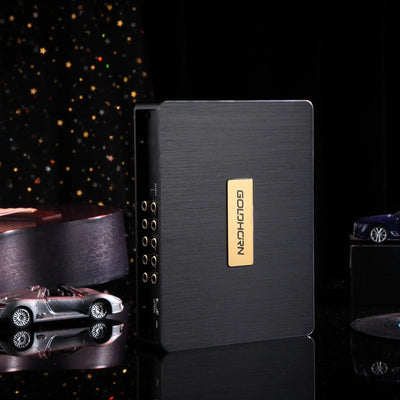
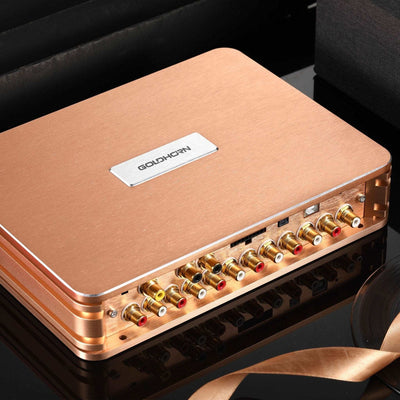
The amps on this page do not, so an active build pairs them with a standalone DSP in the signal chain. If you want the amplifier and the processor in one box, look at the Goldhorn DSP amplifiers, which combine channel count and onboard processing on a single chassis.
Yes, unless the listing says otherwise. We are an authorized dealer for every brand on this page and every new unit carries the full manufacturer warranty. Demo and previous-display units are described as such on the product page.
Related Collections
Browse curated picks that work with the products above.
US Acoustics
$ 159.99
US Acoustics
$ 159.99

Rainbow
$ 197.50 $ 399.99

Rainbow
$ 199.99 $ 549.99
DSP for Tuning Control
A DSP gives you crossovers, EQ, time alignment, and signal routing in a single unit. The amplifier delivers the power; the DSP makes the system actually sound right.
Related Collections
Browse curated picks that work with the products above.

US Acoustics
$ 159.99

Prodigy
$ 225.99 $ 270.99

Wavtech
$ 329.99

US Acoustics
$ 399.99