 Complete Hub Guide
Subwoofer Enclosure Design Guide
The enclosure is not an afterthought. It's half the subwoofer system. The same 12-inch driver that sounds muddy and undefined in the wrong box can sound tight, deep, and powerful in the right one. Sealed boxes roll off at 12 dB/octave below resonance; ported boxes roll off at 24 dB/octave but deliver 3–6 dB more output in the target band (SVS, 2022). That difference isn't subtle — it's the difference between needing 250 watts or 700 watts to hit the same sound pressure level.
This hub covers every enclosure type used in car audio, the Thiele-Small parameters that determine which type fits your driver, construction material selection, and how your vehicle's cabin acoustics interact with all of it. Use the topic links below to jump to any depth guide, or read straight through for the complete overview.
- Ported enclosures produce 3–6 dB more output than sealed with the same driver and amp — equal to doubling or quadrupling amplifier power (SVS, 2022)
- Your driver's Qts determines the box type: below 0.4 = ported; 0.4–0.7 = sealed; above 0.7 = infinite baffle (MONACOR, 2020)
- Car cabin acoustics boost bass at roughly 12 dB/octave below 70–90 Hz — meaning a sealed box in a car often performs like a ported box in a living room (CarAudioHelp.com, 2015)
- Use 3/4-inch (19mm) MDF minimum; birch plywood is over 2× stiffer at the same thickness for demanding builds (MDPI Forests, 2025)
What Does a Subwoofer Enclosure Actually Do?
A subwoofer driver radiates sound from both sides of its cone. The front face pushes air forward; the rear face pushes air backward, 180 degrees out of phase. Without an enclosure, these two wavefronts cancel each other at low frequencies — a phenomenon called acoustic short-circuit — and bass output collapses. The enclosure's primary job is to isolate the rear wave so that cancellation can't occur (Wikipedia, 2025).
The enclosure does more than separate the two wave faces, though. It loads the rear of the driver with air pressure, which controls the driver's suspension behavior and modifies its frequency response. The volume of that air, whether it's sealed or vented, and how any ports are tuned all determine where the bass extends, how steeply it rolls off, and how efficiently the system converts amplifier watts into acoustic output. Change the box, change the entire sound.
In a car, the enclosure interacts with a third factor: the vehicle's cabin. Below roughly 70–90 Hz, the interior of a car behaves less like a listening room and more like a pressure vessel (CarAudioHelp.com, 2015). This cabin gain adds significant bass output that you wouldn't get from the same enclosure in an open room — and it changes the optimal enclosure strategy compared to home audio design.
What Are the Four Main Subwoofer Enclosure Types?
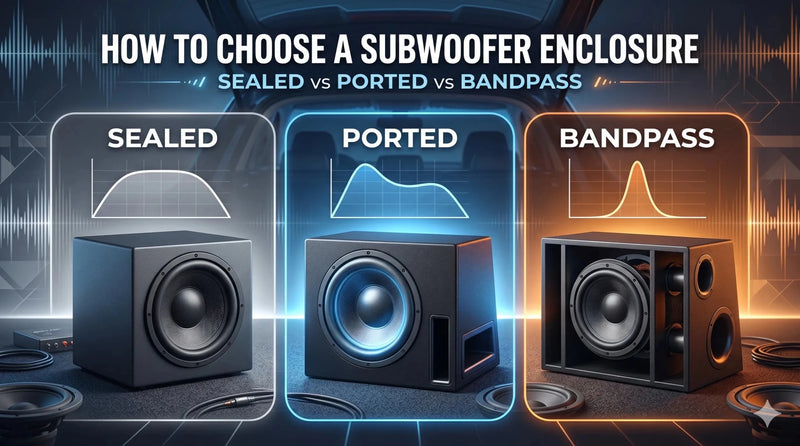
Car audio uses four primary enclosure architectures, each with a distinct frequency response shape and efficiency profile. Sealed enclosures roll off bass at 12 dB/octave below the system resonance frequency — a gentle, predictable slope that DSPs and equalizers handle well. Ported enclosures extend deeper and then fall off twice as steeply at 24 dB/octave below the port tuning frequency (KICKER, 2017). Bandpass designs push only the ported output through the box aperture, creating a narrow high-efficiency band. Isobaric and infinite baffle designs address space constraints that the other three can't solve.
Frequency Response by Enclosure Type
Source: KICKER Tech Paper (2017); SVS (2022); Audio Judgement (2021)
The chart above shows why enclosure type is a fundamental design decision, not a preference. A sealed box gives you graceful extension and predictable response. A ported box pushes more output but clips off sharply below tuning. Bandpass concentrates its energy in a target band. Choosing wrong doesn't just limit output — it can stress your driver, distort at high power, or produce bass that doesn't integrate with the rest of the system.
How Do Thiele-Small Parameters Tell You Which Box to Build?
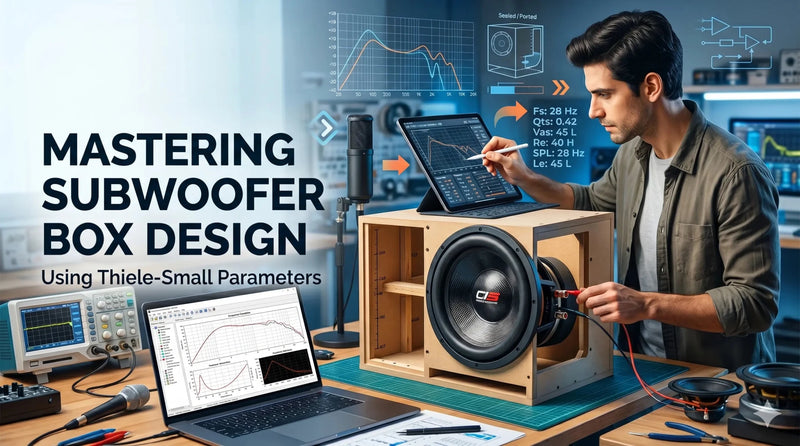
Three Thiele-Small parameters decide your box: Qts (total damping), Vas (compliance volume), and Fs (free-air resonance). The decision rule: Qts below 0.4 = build ported; Qts 0.4–0.7 = build sealed; Qts above 0.7 = infinite baffle. Vas sets the box size, Fs sets the minimum port tuning.
Thiele-Small parameters quantify a driver's physical and acoustic behavior in numbers you can plug directly into enclosure design formulas. The three most important for enclosure selection are Qts (total damping), Vas (equivalent compliance volume), and Fs (free-air resonance). Qts alone tells you the recommended enclosure type: values below 0.4 suit ported designs; 0.4–0.7 work in sealed enclosures; above 0.7 points toward infinite baffle or free-air mounting (MONACOR, 2020).
Qts Enclosure Selection Guide
Source: MONACOR (2020); Wikipedia — Thiele/Small Parameters (2025)
The Efficiency Bandwidth Product (EBP) gives you a second confirmation. Calculate it by dividing Fs by Qes: values above 100 suit ported designs; below 50 suit sealed; between 50 and 100, either works (Wikipedia, 2025). When Qts and EBP point in opposite directions, trust EBP for efficiency prediction and Qts for damping behavior — most experienced builders weight both.
Vas — the equivalent compliance volume — tells you how large your enclosure needs to be relative to the driver. It represents the volume of air that has the same acoustic compliance as the driver's suspension. A driver with a large Vas (say, 80 liters) needs a big box to breathe; one with a small Vas (15 liters) can work in compact enclosures. One caution: manufacturer Vas specs carry ±20–30% tolerance (Wikipedia, 2025), so always verify with actual measurements when the box design is critical.
Sealed Enclosure Design: Precision, Accuracy, and Tight Bass
A sealed enclosure traps a fixed volume of air behind the driver, which acts as an additional spring in the driver's suspension system. This raises the effective resonance frequency and stiffens the cone's movement — producing tighter, more controlled bass compared to a ported design. The frequency response rolls off smoothly at 12 dB/octave below the system resonance, which is predictable, equalization-friendly, and forgiving of imprecise tuning (Audio Judgement, 2020).
The key design parameter is the system Q (Qtc). Target Qtc = 0.707 for the flattest possible frequency response — this is the Butterworth alignment, which acousticians call "maximally flat." A Qtc of 0.5 sounds overdamped: deep, accurate, but quieter. Push Qtc above 0.9 and the response develops a hump at the resonance peak — more "punch" in the upper bass but muddy below it. Above 1.2, single-note bass dominates and the system loses its coherence (Audio Judgement, 2020).
Sealed Box Qtc: How It Shapes the Sound
One practical trick for sealed boxes: acoustic stuffing (polyfill or long-fiber wool) packed inside the enclosure makes the driver "think" the box is larger. This can increase the perceived internal volume by 15–25% (Audio Judgement, 2020). If your calculations call for a box volume you can't fit in your trunk, try filling a smaller box with polyfill and measuring the result — you'll often get within acceptable tolerance.
In IASCA Sound Quality competition, judges score bass on accuracy, not loudness. Sealed boxes with Qtc near 0.707 consistently outperform ported builds in SQ events because the 12 dB/octave rolloff sounds "natural" to trained ears — it mimics how bass decays in real acoustic spaces. For daily drivers and SPL events, the calculus flips completely.

Proline X IDMAX 12 V4 Sealed Enclosure
Driver-matched internal volume, double-stack baffle, heavy internal bracing. Built to handle the pressure a 1000W+ RMS competition driver generates. Langboard Elite MDF, CNC-cut in Tullahoma TN.
Shop the IDMAX 12 sealed →Ported Enclosure Design: Maximum Output and Deep Extension
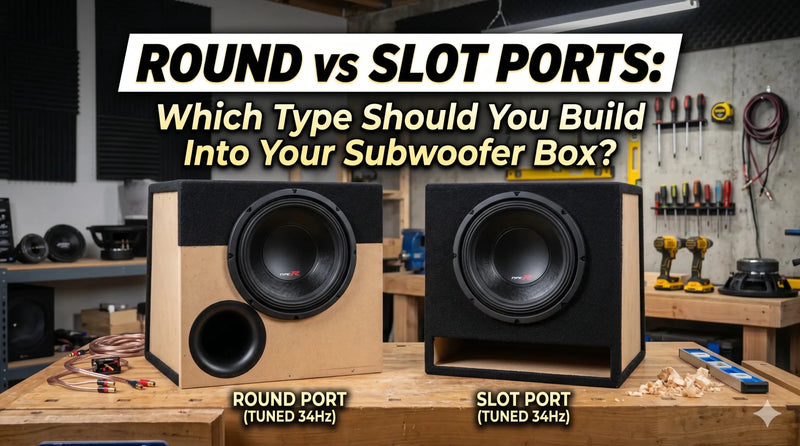
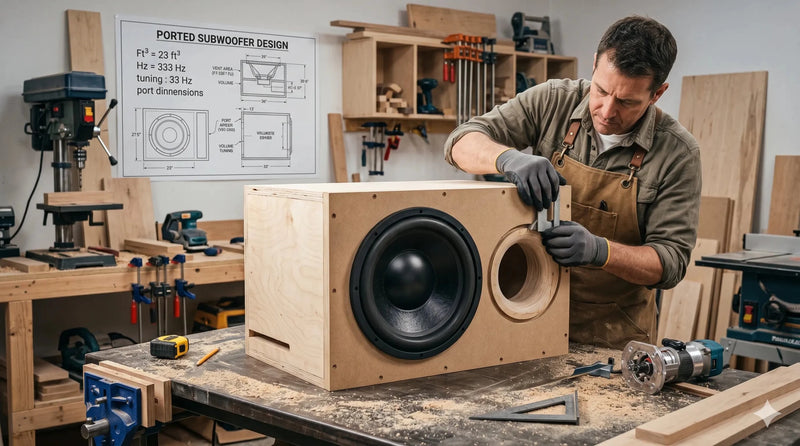
Ported enclosures add a tuned port — a tube or slot with a specific length and cross-section — that resonates at a target frequency (Fb). At Fb, the port itself produces most of the bass output while the driver's cone movement is actually minimal. This gives the driver a moment of mechanical relief right where output is greatest, which is why ported designs can play louder at low frequencies without overheating the driver. The result: 3–6 dB more output than a sealed enclosure using the same driver and amplifier (SVS, 2022) — equivalent to doubling amplifier power.
For car audio, the sweet spot for port tuning is 30–35 Hz. This balances deep extension with driver control. Tuning lower (25 Hz) stretches extension for audiophile-level sound quality. Tuning higher (40–45+ Hz) shifts the efficiency peak upward — useful for SPL competition where scoring bands typically sit between 40–63 Hz (Wooster Audio, 2022). Never tune below your driver's Fs. Below that point, the port loses its restoring force on the driver, and the cone can travel beyond its mechanical limits.
The tradeoff is the sharp rolloff below Fb. While a sealed box falls off gradually at 12 dB/octave, a ported box rolls off at 24 dB/octave once it drops below the port tuning frequency — twice as fast (Audio Judgement, 2020). Bass content below Fb reaches the driver unloaded. This matters for music that contains subsonic content: a 20 Hz tone on a 35 Hz-tuned ported box will stress the driver significantly more than the same tone through a sealed enclosure.
SPL Output: Sealed vs Ported (Same Driver, Same Power)
Source: SVS Sound (2022)
When we build ported enclosures for MECA competition vehicles, we measure port air velocity at actual competition listening levels — not at the driver's rated maximum. Port turbulence (chuffing) starts around 17 m/s of air velocity in the port tube. Most competition builds run 12–14 m/s at peak SPL to stay clean under the meter.

Proline X JL Audio 13W7AE Single Ported
Spec-tuned for the JL 13W7AE in the 30–35 Hz window. CNC-cut port geometry, Langboard Elite MDF, internal port velocity verified to stay under chuffing threshold at peak SPL.
Shop the JL 13W7AE ported →Bandpass Enclosures: High Efficiency in a Narrow Band
A 4th-order bandpass enclosure seals the driver inside a split chamber — one sealed rear chamber, one ported front chamber — so that sound can only exit through the port. This creates an acoustic bandpass filter: only frequencies between the lower and upper cutoff frequencies pass through at full volume. A real-world example using a JL 10TW3-D4: the passband runs from 38 Hz to 88 Hz with +5 dB sensitivity in that band (Audio Judgement, 2021). Below 38 Hz and above 88 Hz, output drops sharply at 24 dB/octave.
The efficiency advantage is real but narrow. Where a ported box gains 3–6 dB across its tuning range, a bandpass box concentrates its gain in an even smaller window — useful for SPL competition where judges score a specific frequency, but problematic for music listening where bass spans 20–80+ Hz. Narrowing the bandwidth increases peak efficiency; widening it reduces it and approaches ported behavior. Bandpass enclosures also can't be tuned by ear easily — they require simulation software (WinISD or BassBox Pro) because any mistake is hidden inside the box where you can't hear the driver.

Proline X Dual 8" Enclosure for Kicker Solo-X
Built specifically for the Kicker Solo-X 8 platform. Dual-driver loading for SPL-leaning installs where output ceiling matters more than space. CNC-cut Langboard Elite MDF, stainless hardware throughout.
Shop the X Series Dual 8 →Isobaric and Infinite Baffle: Solving Space and Excursion Problems
Isobaric loading pairs two identical drivers in the same enclosure — one pushing, one pulling in tandem — which effectively doubles the acoustic compliance of the system. The practical result: you can use half the box volume for the same low-frequency extension. A driver that needs a 30-liter sealed box can work in a 15-liter isobaric enclosure. The catch is that two drivers are required to do what one driver does in a normal box, and efficiency drops by 3 dB compared to a single driver in a full-size box. Isobaric makes sense in vehicles where space is severely limited — think under-seat placements in pickups or tight rear deck installs.
Infinite baffle mounting eliminates the enclosure entirely by using the vehicle's trunk as an unenclosed rear cavity. It only works with drivers that have a Qts above 0.7 — these are specifically designed to operate in large or unconfined spaces. The trunk must be fully sealed from the cabin, or the rear wave reaches the cabin and partial cancellation occurs. Done right, infinite baffle produces exceptionally clean, fast bass because the driver is mechanically free — but you sacrifice the boundary loading that an enclosure provides, and output-per-watt is lower than any enclosed design.

Proline X Micro Series M10-S WAV Sealed
When isobaric and infinite baffle aren't options, shallow-mount is. 0.4 ft³ sealed enclosure spec-matched to the Wavtech thinPRO 10 — 750W RMS rating from a 2.9-inch mounting depth. Under-seat and tight-trunk installs.
Shop the Micro Series M10-S →What Materials Make the Best Subwoofer Enclosure?
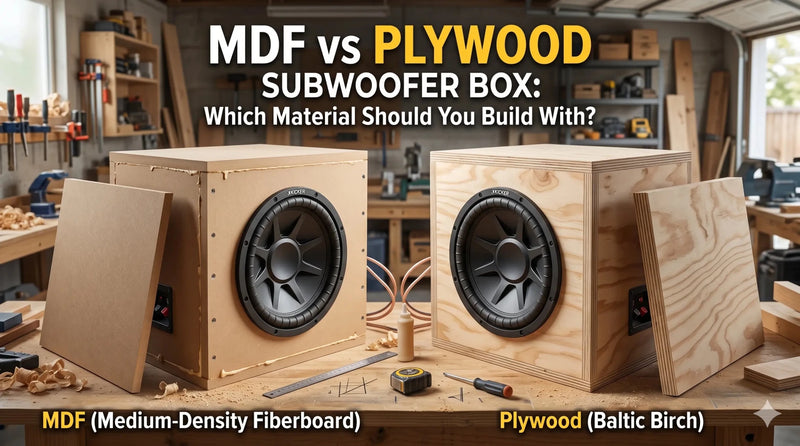
MDF (medium-density fiberboard) is the default choice for a reason. Its density of approximately 749 kg/m³ gives it excellent mass-per-dollar, its uniform internal structure takes router cuts and screw holes cleanly, and its damping characteristics reduce panel resonance without expensive bracing (TREBLAB, 2023). A 2025 peer-reviewed study found that acoustic filling reduces sub-bass peaks by up to 10 dB and smooths dips by 4 dB in MDF enclosures compared to unfilled versions — making MDF plus polyfill a surprisingly high-performance combination (MDPI Forests, 2025).
Birch plywood offers a different tradeoff. It's over 2× stiffer than MDF at the same panel thickness (MDPI Forests, 2025), which matters for large enclosures and high-excursion drivers where panel flex is a real problem. Birch also handles moisture better than MDF — an important consideration in vehicles where temperature cycling and humidity fluctuate. The downside: it costs more, doesn't machine as cleanly at cut edges, and the laminar structure means you must be careful about screw placement near edges.
| Material | Density | Stiffness | Machinability | Best For |
|---|---|---|---|---|
| MDF (3/4") | ~749 kg/m³ | Moderate | Excellent | Compact sealed, standard ported, most builds |
| Birch Plywood (3/4") | ~630 kg/m³ | High (2× MDF) | Good | Large enclosures, high-excursion drivers, competition |
| HDF / Void-free Ply | Varies | High | Good | Premium builds, show vehicles |
Regardless of material, use 3/4-inch (19mm) panels as your minimum for any subwoofer enclosure. Double-up the front baffle to 1.5 inches for heavy drivers — the baffle sees the most stress from driver movement and benefits most from added mass (Crutchfield). Seal all internal joints with silicone or PL Premium construction adhesive; a single small air leak eliminates the acoustic loading that the enclosure provides.
How Do Car Cabin Acoustics Change Your Enclosure Choice?
A car interior behaves very differently from a room. Below approximately 70–90 Hz — the exact frequency depends on the vehicle's interior volume — the wavelength of bass becomes longer than the car's interior dimensions. At that point, the cabin stops behaving like a room and starts behaving like a pressure vessel: the subwoofer pressurizes the entire interior rather than radiating as a sound source. This creates cabin gain: a rising bass response of roughly 12 dB/octave below the pressurization threshold (CarAudioHelp.com, 2015).
The practical implication: a sealed subwoofer enclosure in a car produces far more bass than the same box in a room, especially below 60 Hz. Many experienced builders deliberately use sealed designs — or even undersized ported boxes — because cabin gain fills in the low end that the box's rolloff leaves behind. The result can be nearly flat response from 20 Hz to 80 Hz when the cabin gain curve naturally compensates for the enclosure's rolloff. This is one reason why "books say use a bigger box" often conflicts with real-world in-car performance.
Hatchbacks and SUVs with open rear cargo areas couple even more of this gain to the passenger space — the subwoofer pressurizes a larger combined volume that includes both the cargo area and the cabin (Sonic Electronix, 2023). Sealed sedans with separated trunks lose some of this coupling through the rear seat — which is why a sedan often sounds thinner than an equivalent SUV build, all else equal.
Does Subwoofer Placement and Orientation Actually Matter?
Placement matters more than most builders expect. Rockford Fosgate's testing found that a trunk-mounted subwoofer facing rearward and positioned within one foot of the rear wall delivers the best output — the rear wall reinforces the driver's output through boundary loading (Rockford Fosgate, 2021). Forward-facing placement in the middle of the trunk delivered the worst measured output in the same study, because the driver's output has to travel farther through multiple reflections before reaching the cabin.
Corner loading amplifies this effect further. When a subwoofer is placed in the corner of a trunk — touching two walls and a floor — it gains output from each boundary. Each hard surface within a quarter-wavelength of the driver can add up to 3 dB of output through acoustic coupling. A corner-loaded subwoofer at 40 Hz can gain 6–9 dB over a center-trunk placement of the same box, essentially for free.
Down-firing designs — with the driver aimed at the floor — use floor coupling systematically. The floor acts as a reflective surface at every bass frequency, providing consistent loading regardless of trunk geometry.
Vehicle fitment matters. For trucks like the F-150, a behind-seat enclosure has to work within very specific cabin geometry. Audio Intensity builds Ford F-150 direct-fit enclosures CNC-cut to drop into the factory behind-seat space without modification.
Ready to Build? Browse the Full Proline X Lineup
Sealed, ported, vehicle-specific, and shallow-mount enclosures — every Proline X SKU CNC-cut from Langboard Elite MDF in Tullahoma, TN, driver-matched to real Thiele-Small specs.
Shop All Proline X Enclosures →Frequently Asked Questions
What is the best subwoofer enclosure type for car audio?
It depends on your goals. Ported enclosures deliver 3–6 dB more output than sealed with the same driver and amplifier (SVS, 2022) — making them best for daily drivers wanting deep bass. Sealed offers tighter, more accurate transients. Check your driver's Qts: below 0.4 favors ported; 0.4–0.7 works in sealed. For competition SQ, sealed at Qtc 0.707 almost always wins on judge scores.
How do I know what size subwoofer box to build?
Start with Thiele-Small parameters. For sealed: Vb = Vas ÷ [(Qtc ÷ Qts)² − 1], targeting Qtc = 0.707. For ported: start at 1.25–1.5× the manufacturer's recommended sealed volume, then tune the port. Keep in mind that Vas carries ±20–30% tolerance (Wikipedia, 2025) — manufacturer recommendations are your most reliable calibration point.
Is MDF or plywood better for a subwoofer box?
Both work well for different reasons. MDF (~749 kg/m³) machines cleanly, holds screws tightly, and acoustic filling reduces bass peaks by up to 10 dB (MDPI Forests, 2025). Birch plywood is over 2× stiffer at the same thickness — better for large, high-excursion builds. Use 3/4-inch (19mm) minimum for either material, and double the front baffle for heavy drivers.
What tuning frequency should I use for a ported subwoofer box?
For car audio, tune between 30–35 Hz for the best balance of deep extension and driver control (Wooster Audio, 2022). Sound quality listening: tune down to 25 Hz. SPL competition: tune up to 45+ Hz. Never tune below your driver's Fs — doing so removes the port's restoring effect on the cone and risks mechanical damage at high power.
Does subwoofer placement in a car affect bass output?
Yes — significantly. Rockford Fosgate's testing found rearward-facing, wall-adjacent trunk placement delivers the best output (Rockford Fosgate, 2021). Below 70–90 Hz, the car cabin pressurizes at roughly 12 dB/octave (CarAudioHelp.com, 2015) — hatchbacks and SUVs couple even more of this gain to the listening space than sealed sedans.
The Bottom Line on Enclosure Design
Enclosure design isn't a single decision — it's a chain of decisions that starts with your driver's Thiele-Small parameters and ends with the acoustic environment of your specific vehicle. The physics are consistent: ported delivers more output, sealed delivers more accuracy, bandpass concentrates efficiency, and your car's cabin gain reshapes all of it. Use the Qts and EBP values to identify the right box type first, then size it correctly, build it from 3/4-inch material with sealed joints, and place it where boundary loading can work in your favor. EPB Calculator
Every enclosure referenced in this guide is part of the Proline X lineup — CNC-cut from Langboard Elite MDF in Tullahoma, Tennessee, driver-matched internal volume, and spec'd to the acoustic principles described above.
Use the depth guides below to go further on any topic — the Thiele-Small formula guide and the ported volume calculator are the most commonly used next steps.