
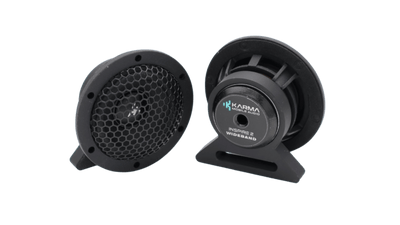
Karma Mobile Audio Inspire 2 | 2" Wideband - Pair
$ 425.00
Out of stock


Two flagship widebands. One coherent front stage. Choose the right one for your install.
Authorized Dealer
Full warranty, 2 years with pro install
Aspect, Allure, Inspire
Value sets to flagship widebands
SQ-Judge Support
Real techs answer your install questions
Shipped from Tullahoma, TN
Fast support from a working SQ shop
All products loaded
A wideband driver covers the midrange and the highs from one cone. That removes the crossover and the tweeter from the most sensitive part of the music, which is why a good wideband front stage sounds so coherent and natural. Both Inspire drivers share the same design language: a coated paper cone, a one-piece butyl surround, a magnesium dustcap, a titanium voice coil former, a pure copper voice coil, an integrated copper shorting ring, and a neodymium motor in a cast aluminum basket. They sit above the Allure series at the top of the Karma line, and each is sold as a matched pair.
The two drivers are not a good and better version of the same thing. They are tuned for different installs, and the right choice depends mostly on where you can mount them and how you want to cross them over. The sections below give you the real numbers.
| Spec | Inspire 2 | Inspire 3 |
|---|---|---|
| Size | 2 inch wideband | 3 inch wideband |
| Sensitivity | 85 dB (1W/1m) | 85.5 dB (1W/1m) |
| Power handling (with crossover) | 75W @ 350Hz to 100W @ 400Hz | 125W @ 250Hz |
| Excursion (Xmax) | 2mm one-way | 5mm one-way |
| Minimum high-pass | 300 Hz, 24 dB/oct (350 Hz in the pod) | 150 to 200 Hz, 24 dB/oct |
| Top-end extension | To 20 kHz, wide off-axis | To 20 kHz on-axis, narrows off-axis |
| Best mounting | Factory dash, off-axis, tight spaces | On-axis pods and pillars |
| Enclosure | Small sealed or free-air | Free-air preferred |
| Included pods | Yes, angled ABS pods | No |
| Flange / cutout / depth | 77.5mm / 66mm / 44.7mm bare | 91mm / 73mm / 45mm |
| Sold as | Matched pair | Matched pair |
This is the single most important thing to understand about these two drivers, because their power handling is not one fixed number. It depends on where you cross them over. Every speaker has two separate limits. One is thermal, set by the voice coil and rated in watts. The other is excursion, set by how far the cone can travel, and it changes with frequency. As you go lower in frequency, the cone has to move much farther to make the same output, so the excursion limit drops fast. Whichever limit you hit first is the one that matters. The numbers below are the usable power behind the recommended high-pass, which is how these drivers are actually installed.
The Inspire 2 has 2mm of excursion. That is a small amount of cone travel, so it runs into its excursion limit at a fairly high frequency. Crossed at 300 Hz it is at its safe minimum; crossed higher it can use more power before the cone bottoms out. Behind a 350 Hz high-pass it handles about 75 watts of clean power, and behind a 400 Hz high-pass about 100 watts. That is the excursion principle in action: a higher crossover gives the cone more room and raises usable power. The crossover, not the amplifier, is what protects this driver, so 300 Hz is the floor and 350 Hz is the floor in the included pod.
The Inspire 3 has 5mm of excursion, more than double the Inspire 2, on a larger cone. That long throw changes everything. It can be high-passed as low as 150 to 200 Hz and still play cleanly, taking over more of the midrange and overlapping a midbass instead of leaning on it. And behind a 250 Hz high-pass it handles about 125 watts of clean power, more than the Inspire 2 and with excursion headroom well beyond that. This is why the flagship is the more capable driver: it crosses lower and takes more power at the same time.
The short version: the Inspire 2's power handling rises as you cross it higher, from about 75 watts at 350 Hz to 100 watts at 400 Hz, with 300 Hz the lowest safe point. The Inspire 3's long excursion lets it cross as low as 150 Hz and still handle about 125 watts behind a 250 Hz high-pass. If you need to cross below 300 Hz, the Inspire 3 is the only one of the two that can do it, and it is the stronger driver overall.
Every power number on this page assumes clean, low-distortion power. These are usable figures behind the recommended crossover with a clean signal. The moment an amplifier clips or the signal distorts, the driver sees energy it was never rated for, and a small wideband will fail almost instantly. Distortion is what destroys these drivers, not wattage. Do not feed them a cheap or underpowered amplifier driven into clipping. Buy a clean amplifier with real power and headroom, set the gains right, and these drivers last for years. In normal use a wideband only draws 10 to 20 watts to play loud. This is exactly why we build the Inspire system around an honest, low-distortion amplifier rather than the biggest number on the box.
Both Inspire drivers are efficient, and in the role they are built for, a front stage handed a midbass and a subwoofer below them, they play louder than most people expect from a small driver. Because both are thermally limited across their passband rather than excursion limited, their output is essentially flat across the range, and clean power plus correct crossover matters far more than amplifier size.
A single Inspire 2 produces roughly 96 dB at one meter on its rated power, and a single Inspire 3 about 97 dB, with the 3 holding more dynamic headroom because it is nowhere near its excursion limit. As a front-stage pair, one driver per dash corner with the driver-side unit delayed and trimmed slightly to center the image, the realistic level at the listening position lands around 100 to 103 dB for the Inspire 2 and 102 to 105 dB for the Inspire 3, accounting for how close the dash corners sit to your ears. Those are strong, fully engaging listening levels with headroom to spare, comfortably louder than most people ever turn it up.
The Inspire 3 plays roughly 2 to 3 dB louder than the Inspire 2 and holds more headroom, because its long excursion keeps it far from its mechanical limit. Both are plenty loud for serious listening. Neither is a substitute for a midbass and a subwoofer, which carry everything below the wideband's crossover. These figures are estimates from the rated power, the published parameters, and typical cabin gain, so treat them as a realistic range rather than a guaranteed number.
Both drivers reach 20 kHz, but they get there differently. The smaller Inspire 2 cone holds its high-frequency output across a wider range of angles, so it keeps its top end even when it is firing off-axis, which is exactly what a flat factory dash location does as it fires across the car. The larger Inspire 3 cone plays the full top octave to 20 kHz aimed at the listener, but its output up top narrows as you move past about 30 to 45 degrees off-axis. The manufacturer rates the Inspire 3 to 10 kHz because that is the frequency where its output holds at every angle, including steep ones. Aimed at the seats, it gives you everything to 20 kHz with no tweeter.
This is the practical reason the Inspire 2 suits flat factory locations and the Inspire 3 wants to be aimed. In a steep off-axis dash location where you cannot aim the driver, the Inspire 3 can give up some of its very top end to the far seat, and that is the one case where a small super-tweeter above 10 kHz is worth considering.
You are working with factory dash or pillar wideband locations that fire across the car, you want the simplest possible install with the widest off-axis top end, or space is tight. Its smaller size, included angled ABS pods, and 300 Hz crossover make it the easy, forgiving choice for most dash installs and for anyone who wants a true tweeterless front stage that holds its highs from any angle.
You can aim the driver on-axis from a pillar or a custom pod, you want the most output and the lowest reach, or you want to cross low and let the wideband carry more of the midrange. Its 5mm excursion, low 150 to 200 Hz crossover capability, and extra output make it the choice for a more involved, higher-performance build where placement and aiming are under your control.
A wideband front stage does not need a rack of amplifiers. It needs one good one. Pair either Inspire driver with a set of Karma Mobile Audio Aspect 6.9 midbass and a single US Acoustics Lanna 6-channel amplifier, run everything active off a DSP, and you have a fully active two-way front stage with competition-level topology at a price that does not look like one.
The Lanna is a direct-input Class AB amplifier with no onboard crossover, which is exactly what you want under a DSP. Every filter, slope, and time alignment lives in the processor, and the amp just delivers clean power. The wiring is simple:
| Channels | Drives | Crossover |
|---|---|---|
| 1 & 2 (stereo) | Inspire widebands, left and right | High-pass 350 Hz (Inspire 2) or 250 Hz (Inspire 3), 24 dB/oct |
| 3 & 4 (bridged) | Aspect 6.9 midbass, one side | Band-pass: high-pass above the sub, low-pass to the wideband |
| 5 & 6 (bridged) | Aspect 6.9 midbass, other side | Band-pass: high-pass above the sub, low-pass to the wideband |
Add a subwoofer on its own amplifier for the bottom, and the front stage is complete on one chassis.
Three things make it work: headroom, purity, and the right amplifier class. The Lanna delivers 150 watts to each wideband channel, and a wideband draws only 10 to 20 watts to play loud, so those channels coast with enormous reserve and never strain. Each Aspect 6.9 gets a full bridged channel pair, 500 watts into a midbass that is happy on a fraction of it, so the bass stays effortless and controlled no matter how hard you push the system. Nothing in this build is ever working near its limit, and that reserve is exactly what you hear as ease, dynamics, and a stage that does not collapse when the music gets demanding.
The purity comes from running it all active. There is not a single passive crossover in the signal path. The wideband carries the midrange and highs with no crossover in the critical band at all, the 6.9 handles the midbass on its own bridged channels, and the DSP sets every crossover point, slope, and delay digitally. That is the same topology used on the competition lanes, a clean source, a transparent direct-input amplifier, and a processor doing all the work.
The amplifier class is the part people overlook. The Lanna is Class AB, and on a wideband front stage that matters more than usual. A wideband reproduces the entire midrange and treble from one cone with no crossover in front of it, so there is nothing between the amplifier and your ears to mask the amplifier's own character. Class AB output devices conduct linearly, with none of the high-frequency switching artifacts a Class D stage introduces, so what reaches the driver is the low-level detail, the natural decay, and the clean top end that a sound quality system lives for. Measured, the Lanna holds total harmonic distortion below 0.01 percent and a signal-to-noise ratio above 103 dB. Put that linear, low-distortion power on a driver that hides nothing, and you hear exactly why this pairing punches so far above its price. Efficient widebands, an affordable 6x9 midbass, and one honest Class AB six-channel amplifier put a real competition-grade front stage within reach of a normal budget. If you want to go deeper on why amplifier class matters, read our guide on Class AB versus Class D amplifiers.
This is why we crossed the widebands a little high, 350 Hz for the Inspire 2 and 250 Hz for the Inspire 3 rather than their absolute minimums. With this much amplifier on tap, raising the crossover slightly keeps the widebands well inside their excursion limit under real power, so the whole system has headroom to spare and stays clean at any level you will actually run.
Not Sure Which Inspire Fits Your Build?
Talk to an SQ-judge tech directly. Tell us your vehicle, your mounting locations, and your midbass and we will tell you which Inspire driver fits, where to cross it, and how to tune it.
931-563-5151|contact@audiointensity.com
The Inspire 2 is a 2 inch wideband with 2mm of excursion that must be crossed at 300 Hz or higher, fits tight factory locations, includes angled ABS pods, and holds its top end wide off-axis. The Inspire 3 is a 3 inch wideband with 5mm of excursion that can be crossed as low as 150 Hz, plays louder and lower, and reaches full 20 kHz extension aimed on-axis. The 2 is the forgiving factory-location choice, the 3 is the higher-output choice for aimed installs.
Crossover frequency is limited by cone travel. The Inspire 3 has 5mm of excursion versus 2mm on the Inspire 2, so it has the travel to play down to 150 to 200 Hz cleanly without reaching its mechanical limit. The Inspire 2 reaches the end of its shorter travel by about 300 Hz, so that is its floor, and 350 Hz in the included pod.
The Inspire 2 handles about 75 watts behind a 350 Hz high-pass and up to 100 watts behind a 400 Hz high-pass. The Inspire 3 handles about 125 watts behind a 250 Hz high-pass, and it plays roughly 2 to 3 dB louder with more headroom because its longer excursion keeps it well clear of its mechanical limit. Both figures assume clean, low-distortion power; a clipping amplifier will destroy either driver almost instantly regardless of wattage. In normal use a wideband only draws 10 to 20 watts to play loud. As a front-stage pair both are comfortably loud for serious listening, on the order of 100 dB or more at the seat. Neither replaces a midbass and subwoofer, which carry everything below the wideband crossover.
No. Both Inspire drivers reach 20 kHz and are designed to run with no tweeter. The Inspire 2 holds its top end across wide angles, so it suits flat factory locations. The Inspire 3 plays to 20 kHz aimed on-axis, and only a steep off-axis location would make a small super-tweeter worth considering.
Pair either Inspire wideband with a set of Karma Mobile Audio Aspect 6.9 midbass and a US Acoustics Lanna 6-channel amplifier, run fully active off a DSP, and add a subwoofer on its own amp. The widebands run on channels 1 and 2, and each 6.9 gets a bridged channel pair for 500 watts. It is a competition-grade active topology with enormous headroom and clean Class AB power, at a real-world price.
Yes. The Inspire drivers carry the midrange and the highs, which is most of the music, but they are crossed out of the low end to protect them. Pair them with a midbass below, such as the Karma Mobile Audio Allure 6 Midbass or Aspect 6.9, and a subwoofer for the bottom, for a complete and surprisingly loud system built around one clean driver per side.
Yes. You are buying from a working SQ judge and competitor. Tell us your vehicle, your mounting locations, and your midbass, and we will tell you which Inspire driver fits, exactly where to set the crossover and slope, and how to delay and level the drivers so the stage centers correctly.
Browse both Inspire drivers below, and see the rest of the line on the Karma Mobile Audio collection.
Related Collections
Browse curated picks that work with the products above.
Goldhorn
$ 249.99 $ 279.99
Goldhorn
$ 599.99 $ 679.99
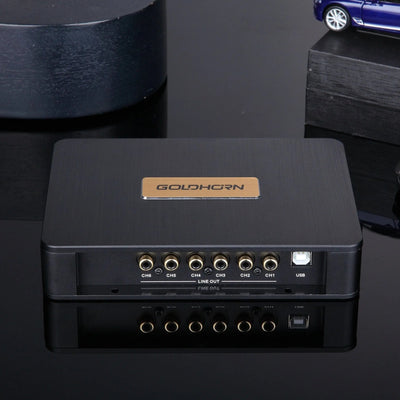
Goldhorn
$ 399.99 $ 449.99
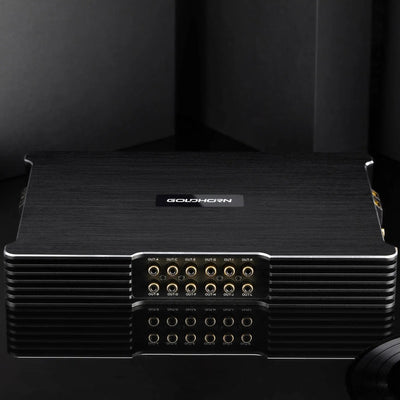
Goldhorn
$ 1,399.99 $ 1,799.99


