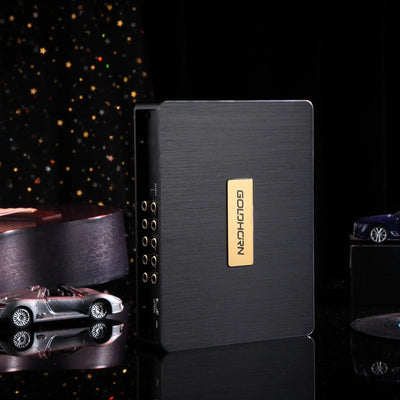
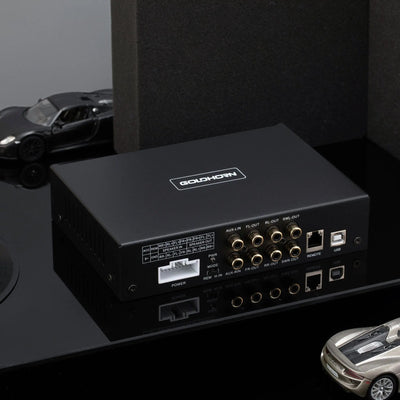
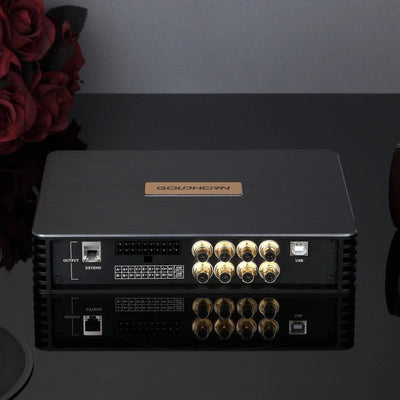
Goldhorn DSPA 206 | 6 Channel DSP / 4 x 50w Amplifier
$ 349.99
$ 399.99
12% OFF
In stock and ready to ship!


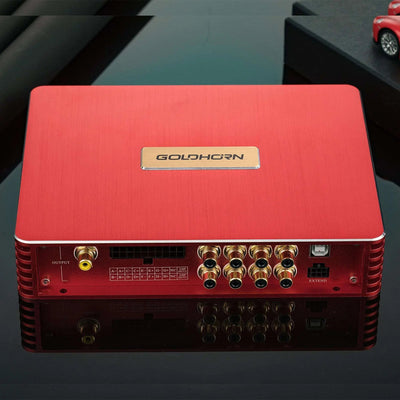
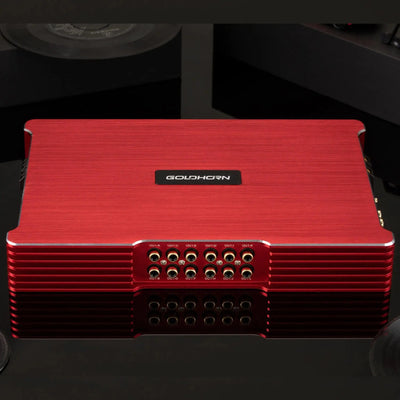
DSP amplifiers combining signal processing and multi-channel amplification in one chassis. From 6 channels to 36 channels.
Original US Importer
We brought Goldhorn to the US market. Direct factory relationship with the deepest product knowledge in the country.
Manufacturer Warranty
Every Goldhorn product carries full coverage. We handle warranty claims directly with the factory.
DSP Tuning Expertise
Factory-trained on DSD playback, channel configuration, and complex crossover setup. Real technical guidance, not sales scripts.
Fast Shipping from TN
In-stock orders ship within 1-2 business days from our Tullahoma, Tennessee warehouse.
Decision Shortcut
Curated picks matched to common build goals
Best DSP Amp Entry
Goldhorn
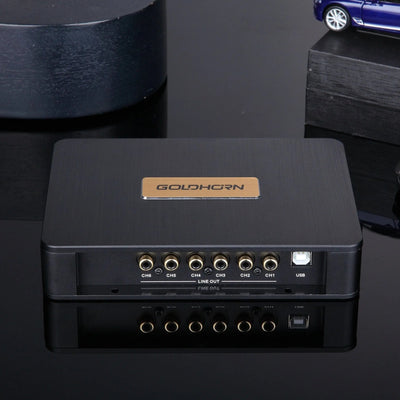
6-channel DSPA with 4x50W Class AB. The accessible entry into integrated DSP and amplification at $349.99.
$ 349.99 $ 399.99
View DetailsBest for Sub-Heavy Systems
Goldhorn
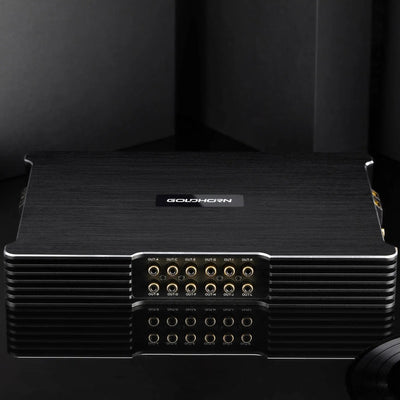
20-channel DSPA with 8x80W plus 2x150W. Dedicated sub amplification (940W total) in the same chassis.
$ 1,399.99 $ 1,799.99
View DetailsBest Competition Grade
Goldhorn
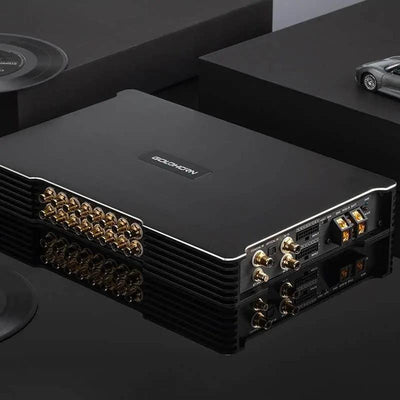
24-channel DSPA with 8x80W plus 4x150W (1240W total). Competition-grade processing and amplification.
$ 1,699.99 $ 1,999.99
View DetailsBest Flagship
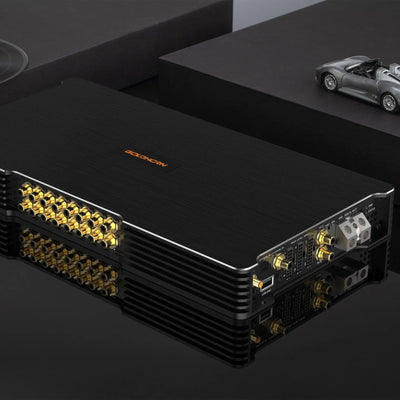
Goldhorn
36-channel flagship DSPA with 20x80W plus 4x150W (2200W total). The absolute top of the integrated lineup.
$ 2,599.99 $ 2,999.99
View DetailsFeatured Goldhorn products spanning entry through flagship tiers. Browse the full lineup by sub-collection below.
All products loaded
The choice between a DSP amplifier (all-in-one) and a standalone DSP plus separate amplifier stack comes down to three factors: complexity tolerance, amplifier flexibility, and physical space.
Choose a DSP amplifier if you want:
One chassis for the entire processing-and-power stack. Simpler wiring (one power cable, one ground, one set of speaker outputs). Less physical space consumed in the install location. A complete system from a single component. Lower total cost compared to buying a quality DSP plus quality amplifiers separately.
Choose a standalone DSP plus separate amps if you want:
Amplifier-side flexibility (mixing Class A, AB, and D for different frequency ranges or driver tiers). The ability to keep existing high-quality amplification you already own. Easier amplifier-side upgrades over time without replacing the DSP. Reference-tier amplifier brands not available in integrated DSPA form.
For most car audio buyers (including most SQ-focused builds), the all-in-one DSPA is the practical choice. The wiring simplification and chassis consolidation outweigh the amplifier-flexibility argument for the majority of systems.
DSP amplifier specs combine two independent dimensions: processing channels (the number of independent signals the DSP can route) and amplifier channels (the number of speakers the unit can drive directly).
Entry-tier units for upgrading a factory audio system. 6 channels of DSP processing, 4 channels of amplification. The DSPA 206 (4x50W, $349.99) and DSPA 406 (4x65W, $399.99) cover this segment. Right for stock-or-near-stock speaker upgrades where you want DSP tuning without rebuilding the amplifier stack.
The practical SQ-build segment. 10-16 channels of DSP processing, 8 channels of amplification. The DSPA 816 Pro (8x80W, 16 channels, $999.99) handles active 2-way and active 3-way front stage builds with passive rear and sub. The right channel count for the majority of SQ-focused builds.
Advanced builds with dedicated subwoofer amplification. 20-24 channels of DSP processing, 10-12 channels of amplification with hybrid power tiers. The DSPA 1012 Plus (8x80W plus 2x150W, 940W total, 20 channels, $1,399.99), DSPA 1216 Plus (8x80W plus 4x150W, 1240W total, 24 channels, $1,699.99), and DSPA 1616 Ultra (12x80W plus 4x150W, 24 channels, $1,899.99) cover this tier.
Competition-grade flagship. The DSPA 2416 Ultra (20x80W plus 4x150W, 2200W total, 36 channels, $2,599.99) addresses competition systems and reference home-audio-in-car installations with no channel-count compromise.
The P series pairs the same amplification with a native DSD player stage, so a DSD or high-resolution file plays without passing through a separate source unit. The P1 DSPA (10 channels, 4x65W Class AB, $799.99) is the entry point. The P2 DSPA Pro (16 channels, 8x80W, $1,699.99) and P3 DSPA Plus (20 channels, 8x80W plus 150W subwoofer channels, $1,999.99) carry the same channel counts as the Pro and Plus DSPA units with the player stage added. Choose a P series unit if the source is a file library rather than a head unit. Choose a standard DSPA if a head unit or streaming source is already in the build.
DSP amplifier power output is specified per channel at a stated impedance (4 ohm or 2 ohm) and as total system output. Match the amplifier rating to your speaker requirements:
Component speakers: Typically need 50-100W per channel for clean output. The DSPA 206 (50W) and DSPA 406 (65W) handle most factory and stock-replacement component speakers. Higher-end components (Image Dynamics CTX, IDQ series) benefit from 80W per channel from the Pro and Ultra series.
Coaxial speakers: 50-65W per channel covers most coaxials. The entry DSPA models are well-matched.
Subwoofers: Require dedicated high-power channels. The DSPA 1012 Plus and higher units include 150W channels specifically engineered for sub-amplifier duty. For larger or multiple subwoofers, an external monoblock amplifier paired with a smaller DSPA unit often makes more sense.
Modern DSP amplifiers accept multiple input types: high-level (speaker-level) inputs from factory head units, RCA line-level inputs from aftermarket source units, and digital inputs (optical TOSLINK and coaxial SPDIF) for buyers who want full digital signal path. This input flexibility makes a DSPA suitable for both OEM integration (keep the factory radio) and full aftermarket builds.
For BMW, Mercedes, and other vehicles using the A2B digital bus protocol, dedicated A2B DSP amplifier models address OEM integration with native bus compatibility. The Goldhorn AB212 and AB218 are coming soon to this collection.
A DSP amplifier (DSPA) combines DSP processing and multi-channel amplification in one chassis. A standalone DSP is pure signal processing without integrated amplification, requiring you to supply separate amplifiers downstream. DSPA is the right choice for most buyers (simpler wiring, lower cost, complete system in one box). Standalone DSP is the right choice for reference SQ builds that need amplifier-side flexibility.
Channel count is determined by your speaker topology. A factory upgrade with replacement coax or component speakers and a single sub needs 6 channels. An active 2-way front plus passive rear plus sub needs 8-10 channels. An active 3-way front plus rear plus sub needs 14-16 channels. Competition builds with active 3-way plus active rear plus dual subs can reach 20-24 channels. The DSPA 2416 Ultra at 36 channels addresses competition systems with no realistic channel-count compromise.
Yes. DSP amplifiers in this collection accept high-level (speaker-level) input from factory head units in addition to RCA line input and digital input. This makes them suitable for OEM integration where the factory head unit stays in place. For BMW, Mercedes, and other vehicles using the A2B protocol, dedicated A2B DSP amplifier models are coming soon.
Match the amplifier's per-channel power rating to your speakers' recommended power range. Most component and coaxial speakers in the aftermarket require 50-100W per channel for clean output. The entry DSPA 206 (50W) and DSPA 406 (65W) handle most factory and stock-replacement speakers. The Pro and Ultra series (80W per channel) handle higher-end components without strain.
Yes. Every product in this collection is brand new, sold by an authorized dealer, and carries the full manufacturer warranty. We handle warranty claims directly with the brand.
Pro series (DSPA 816 Pro, P2 DSPA Pro) uses ADAU1450 DSP architecture in a refined implementation suited to serious audiophile builds. Ultra series (DSPA 1616 Ultra, DSPA 2416 Ultra) uses ADAU1463 DSP with flagship DAC implementations, engineered for competition-grade SQ builds. Plus series (DSPA 1012 Plus, DSPA 1216 Plus) sits between Pro and Ultra with hybrid power tiers including 150W channels for subwoofer duty.
Related Collections
Browse curated picks that work with the products above.
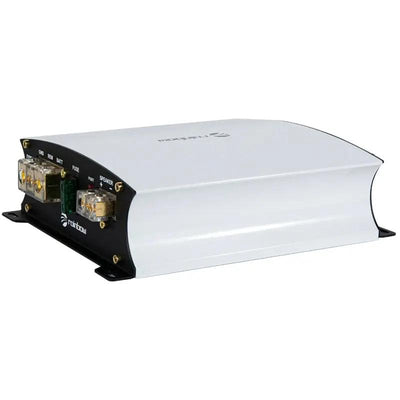
Amplifiers the DSP Can Drive
Multi-channel and monoblock amplifiers spec'd to receive a processed DSP signal. Clean input stage, configurable gain, and full compatibility with line-level outputs.
Rainbow
$ 89.99 $ 399.99
Rainbow
$ 98.99 $ 549.99
US Acoustics
$ 159.99
US Acoustics
$ 159.99