
Key Highlights
-
The choice between a round and a slot port impacts airflow, resonance, and overall sound quality in a ported subwoofer enclosure.
-
Slot ports provide greater control over port area and placement, making them ideal for daily driver systems seeking wide bass response.
-
Round ports, or aero ports, are effective in compact setups and higher-tuned SPL builds due to their simple design and flared ends.
-
Proper subwoofer port design is critical to prevent port noise or "chuffing," which is caused by turbulent air velocity.
-
The ideal port type depends on your woofer's excursion, enclosure space, and specific tuning goals for your car audio system.
-
Bandwidth, or the range of clean, usable bass frequencies, is a more important goal for sound quality than just peak SPL.
Introduction
When designing a custom subwoofer enclosure, one of the most debated choices is the type of port to use. The decision between a round port and a slot port directly influences the enclosure design and, ultimately, the final sound quality. This isn't just about aesthetics; each port type interacts with air differently, shaping the bass your system produces. Understanding the engineering behind each option will help you make an informed choice that aligns with your car audio goals, whether you're chasing SPL numbers or a smooth, musical low end.
Round Port Vs. Slot Port?
When comparing round ports to slot ports, audio performance can vary. Round ports generally offer smoother airflow and reduced turbulence, resulting in clearer sound. However, slot ports can be more space-efficient. Ultimately, the choice depends on your specific design needs and personal sound preferences. Both have their unique advantages.
Engineering Principles Behind Speaker Box Ports
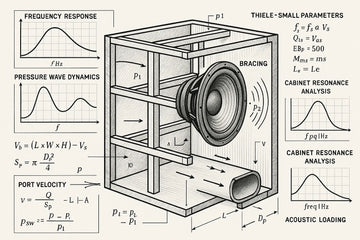
A ported enclosure, also known as a bass-reflex box, uses a vent or port to reinforce low-frequency output. This port acts as a resonator, using the air movement from the back of the woofer cone to produce sound at a specific tuning frequency. This design increases efficiency, allowing for more bass output with the same amount of amplifier power.
The core principle is to tune the enclosure volume and port dimensions to work with the subwoofer's parameters. At the tuning frequency, the port does most of the work, reducing the woofer's cone movement. This controlled resonance is what makes a bass reflex system so powerful. We'll now look at how the port's shape affects this process.
How Round and Slot Ports Shape Airflow Dynamics
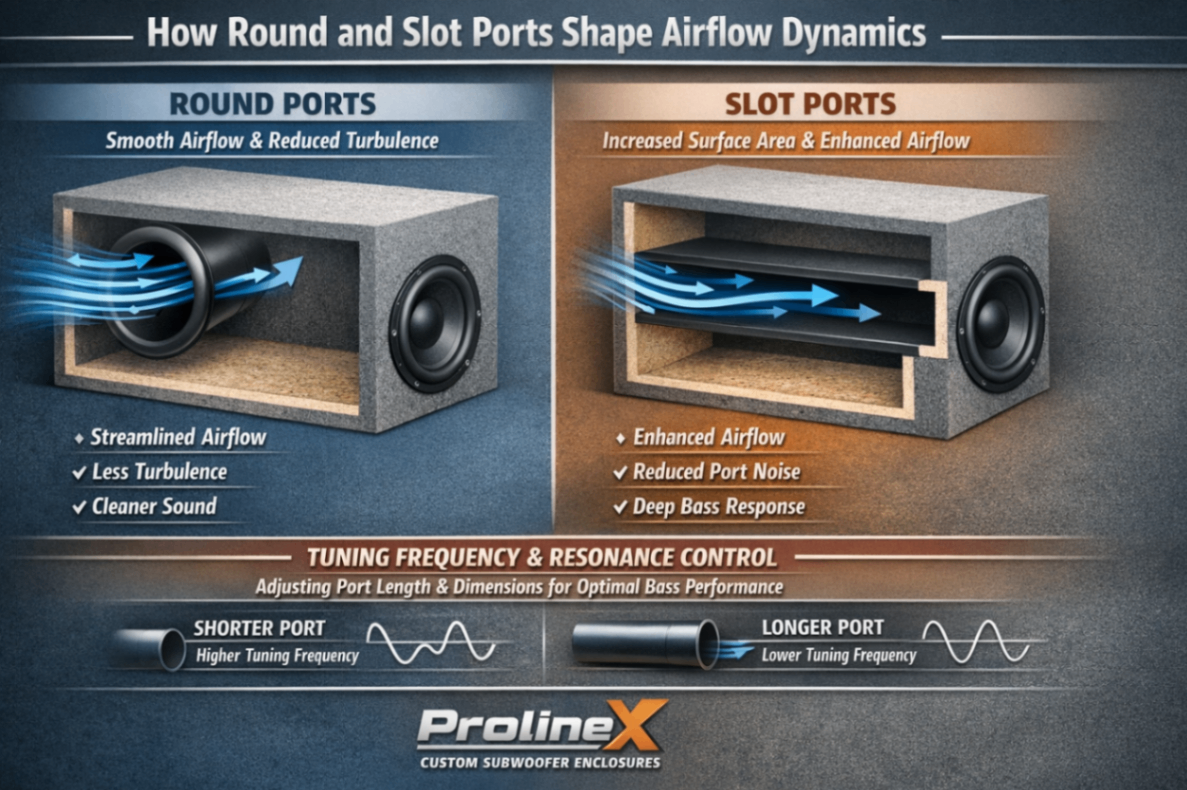
Airflow dynamics significantly influence the performance of subwoofer port designs. Round ports provide a streamlined path for air, reducing turbulence and improving sound quality, especially at high volumes. Conversely, slot ports can capitalize on their larger surface area to enhance airflow, which can lower port noise in specific configurations of ported subwoofer enclosures. The tuning frequency also plays a vital role; adjusting the port length or dimensions allows for more precise resonance control, enhancing the overall impact of the bass response in custom subwoofer enclosures by Proline X.
Acoustic Loading and Resonance Control in Ported Enclosures
Acoustic loading significantly influences how sound propagates from ported enclosures. In a well-designed slot port subwoofer box, the chosen geometry shapes airflow dynamics, altering resonance at various frequencies. This control is vital for ensuring consistent output and minimizing distortion, as it enhances the system's ability to reach its tuning frequency. Proper port design mitigates unwanted port noise, refining the overall sound quality. For a tailored experience, a CNC subwoofer box from Proline X can optimize these characteristics, ensuring both peak performance and fidelity.
Comparing Sound Quality: Round Ports vs. Slot Ports
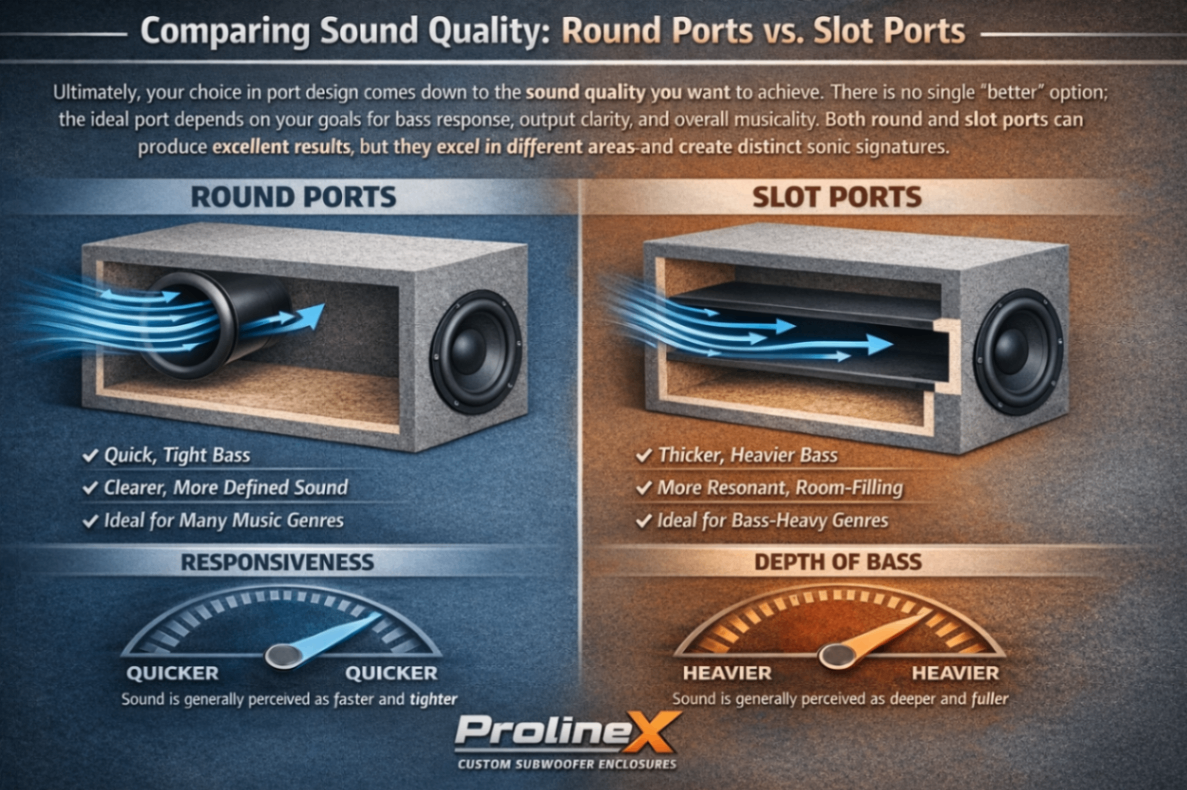
Ultimately, your choice in port design comes down to the sound quality you want to achieve. There is no single "better" option; the ideal port depends on your goals for bass response, output clarity, and overall musicality. Both round and slot ports can produce excellent results, but they excel in different areas and create distinct sonic signatures.
A common perception is that slot ports produce a "thicker" or "heavier" low end, while round ports can sound "quicker." These characterizations are tied to differences in how each port handles air mass and couples with the vehicle's interior. Let's examine the detailed differences in their performance.
Detailed Differences in Bass Response and Output Clarity
Different port shapes affect the way air moves within ported subwoofer enclosures. Round ports tend to provide a smoother airflow, which can enhance bass response and minimize port noise, resulting in clearer output. Slot port designs, with their larger surface area, allow for a greater volume of air to escape, leading to increased low-end punch. However, they can introduce more turbulence at higher volumes if not properly tuned. Understanding these dynamics is key for optimizing any custom subwoofer enclosure, particularly with Proline X's precise CNC-cut designs.
Real-World Listening Impressions in Car Audio Setups
On paper, the differences between round and slot ports are engineering abstractions — cross-sectional area, port velocity, resonance behavior. In a vehicle, those abstractions become audible.
The most consistent real-world observation from builders who have run both is that slot-ported enclosures tend to produce tighter, more controlled bass at high output levels. When a round port starts to approach its velocity limit, the chuffing that develops isn't just noise — it's a sign that the port is no longer loading the driver cleanly. The bass becomes less defined, and the low end starts to sound more like pressure than music. A slot port with adequate cross-sectional area stays clean through that same output range, and the bass retains its punch and articulation even when you're pushing the system hard.
At moderate power levels — a single 12" running 400 to 600 watts in a daily driver — most listeners wouldn't identify a meaningful difference between a well-designed round port and a well-designed slot port. Both load the driver correctly, both produce clean output, and both can be tuned to the same frequency. The divergence becomes apparent when output demands climb. In truck builds, SUV installs, and anything running over 1,000 watts, the slot port's airflow advantage translates directly into audible performance that stays composed where a round port would start to break up.
Practical Considerations for Building and Installing Ports
Beyond theoretical performance, the practical aspects of construction and installation play a large part in choosing a port. The complexity of the build and the port's impact on the internal enclosure volume are two major factors that can steer your decision. Your skill level, available tools, and the physical constraints of your vehicle will all influence which port type is more feasible for your project.
Whether you are a DIY builder or commissioning a custom enclosure, understanding these practical differences is important. A perfectly designed port on paper is useless if it cannot be built correctly or if it compromises the enclosure's structural integrity.
Construction Complexity and Precision (Round vs. Slot)
Crafting a slot port subwoofer box involves unique complexities compared to a round port design. Slot ports generally require precise alignment to optimize airflow, enhancing performance while reducing potential port noise. CNC technology, like that used by Proline X, allows for meticulous construction, ensuring accurate dimensions that influence tuning frequency and resonance behavior. A well-executed slot design can amplify low-end sound quality and improve clarity, while round ports may be simpler to produce but might not achieve the same airflow dynamics as their slot counterparts.
Impact on Internal Box Space and Enclosure Tuning
The design of a slot port subwoofer box significantly influences how the internal volume interacts with airflow and sound quality. In a ported subwoofer enclosure, the geometry of the port affects the tuning frequency and overall resonance. Slot ports provide a larger surface area compared to round ports, allowing for improved air velocity and reduced port noise, enhancing sound clarity. Additionally, the precise placement of ports in a custom subwoofer enclosure, like those made with CNC technology by Proline X, optimizes the use of internal space for maximum bass output.
Addressing Port Noise and High SPL Performance
When pushing a ported system hard, port noise, also known as "chuffing," can become a significant issue. This sound is the result of air turbulence at the port's entrance and exit. It not only creates audible distortion but also indicates that the port is no longer functioning efficiently, which limits your system's clean output and power handling.
Proper port design is the key to mitigating noise and achieving high SPL performance without compromising sound quality. The port's geometry, area, and the smoothness of its surfaces all play a role in keeping airflow laminar, even at high excursion levels. Let's explore the causes of port noise and how to choose the right port for maximum output.
Port Chuffing: Causes, Mitigation, and Port Geometry
Port chuffing occurs when the air velocity within a subwoofer box exceeds a certain limit, causing turbulence that sounds like unwanted noise during playback. This phenomenon often arises in badly designed ported subwoofer enclosures, particularly if the port diameter or length does not align with the tuning frequency. To mitigate chuffing, consider optimizing the subwoofer port design, ensuring sufficient surface area and appropriate geometry. Investing in a CNC subwoofer box from Proline X can enhance airflow and reduce distortion, achieving clearer bass response.
Choosing the Right Port for Maximum Output and Low Distortion
Understanding the proper port for your subwoofer enclosure greatly influences output and distortion levels. A slot port subwoofer box often provides a more efficient airflow compared to round ports, which enhances sound clarity and reduces port noise. Proper alignment of the port tuning frequency with the resonant frequency of the driver maximizes performance. Custom subwoofer enclosures, especially those designed with CNC precision, can further optimize port dimensions to complement the woofer’s specifications, ensuring high SPL and minimized distortion throughout the bass spectrum.
Conclusion
In conclusion, the choice between round and slot ports hinges on various engineering principles that affect sound quality and performance. Round ports typically offer smoother airflow and reduced turbulence, enhancing bass response and clarity. Conversely, slot ports can provide a more robust design with greater tuning flexibility, albeit at the cost of potential port noise. Ultimately, the decision should align with your specific audio goals and installation constraints. As you build or modify your enclosure, consider these dynamics carefully to optimize your listening experience. For those serious about their car audio setups, Proline X provides precision-engineered CNC-cut subwoofer enclosures tailored for both round and slot port configurations. Embrace the nuances of your audio journey and elevate your sound system to new heights.
Frequently Asked Questions
Does a Slot Port or a Round Port Use More Internal Box Volume?
This is one of the most practical questions in enclosure design, and the answer matters because internal volume directly affects tuning and driver performance. A slot port, being integrated into the enclosure structure, displaces internal volume based on its cross-sectional area multiplied by its length — the same calculation used for round ports. However, because a slot port runs along an interior wall rather than protruding into the box from the baffle, it often uses that volume more efficiently in terms of usable space versus acoustic performance. A large-diameter round port extended into the enclosure interior can displace a significant chunk of net volume, particularly in compact truck-specific boxes where every cubic inch matters. Slot ports in those applications allow builders to maximize net volume within a tight external footprint, which is one reason they're the preferred choice for behind-seat and under-seat truck enclosures.
Which Port Type Is Better for High SPL or Competition Systems?
For high SPL and competition applications, slot ports are the clear choice. The reason comes back to port velocity — the speed at which air moves through the port at a given output level. Competition systems running multiple kilowatts of power are displacing enormous volumes of air with every bass note, and a round port simply cannot provide enough cross-sectional area to handle that airflow without exceeding the velocity threshold where turbulence and port noise begin. A slot port built to the full width of the enclosure can provide two to three times the cross-sectional area of a comparable round port setup, keeping air velocity within acceptable limits even at extreme output levels. This is why virtually every serious competition enclosure — whether built for SPL events or high-output SQL — uses slot port geometry. It is not a preference; it is an engineering requirement at those power levels.
Is It Easier to Build a Round or a Slot Port for a DIY Project?
For a DIY builder working with basic tools, a round port is significantly easier to execute correctly. Pre-made flared port tubes are available in standard diameters and lengths, they install with a hole saw and some silicone, and port modeling software can calculate the correct length for a target tuning frequency in minutes. There is very little room for error in the construction process itself. A slot port, by contrast, requires precise internal panel cuts, accurate port dimensions, and ideally chamfered or rounded edges at the port opening to reduce turbulence. Done well on a CNC router with proper modeling, a slot port is superior. Done imprecisely by hand, it can introduce more problems than it solves. For DIY builders without access to precision tooling, a quality flared round port is the more reliable path to a clean result. For builders ordering a custom enclosure from a shop running CNC equipment — where the slot port dimensions are calculated and cut to spec — the round port's simplicity advantage disappears entirely.