

Key Takeaways
- Sub size is constrained by enclosure airspace first, cabin gain second, and personal preference last. A 10 in a Civic and dual 12s in a Tahoe can both be the right call.
- A single 12 sealed in 0.85 to 1.25 ft³ is the highest-fit-rate aftermarket build across sedans, crossovers, and crew-cab trucks, per Crutchfield's published vehicle fit data.
- Smaller cabins (compact cars, crew-cab trucks) generate more cabin gain at low frequencies, which means a smaller driver hits harder than its size suggests (BestCarAudio.com).
- Pickup truck installs are decided by cab configuration: regular cab uses shallow under-seat 8s and 10s, extended cab uses shallow 10s and 12s behind the seat, crew cab fits standard-depth 12s.
- Two smaller drivers almost always out-displace one larger driver at the same cone-area total, when the airspace and amp power are there to support them.
The right car subwoofer size for your vehicle is decided by enclosure airspace and cabin acoustics, not by personal preference. A 10 in a Civic and a 15 in a Tahoe can both be correct answers; a 15 in a Civic almost never is. Once you know the size, the subwoofer box range is filtered by driver diameter. This guide is the size-by-vehicle decision tree we use at Audio Intensity before we cut a single board.
The global car subwoofer market reached $629.66M in 2025 and is projected to grow at 9.15% CAGR through 2033, according to Global Growth Insights (2025), with the truck and SUV segment driving most of that growth. More buyers spending more money on subs has not stopped the most common mistake we see in the shop: the wrong size driver for the vehicle it goes into. An oversized sub in a small trunk costs you usable cargo space and rarely sounds better. An undersized sub in a full-size SUV runs out of cone area before it runs out of amp.
What follows is the fit-and-output answer for compact cars, sedans, coupes, hatchbacks, wagons, crossovers, SUVs, and pickup trucks across cab configurations. Every range cited is published or measurable. The big-picture framework on enclosure type, wiring, and amp matching lives in our complete car subwoofer guide; this article is the vehicle-by-vehicle layer that sits on top of it.
Why does vehicle airspace decide sub size before you do?
Subwoofer sizing starts with a number you cannot negotiate: the published enclosure volume the driver's manufacturer specifies. A standard 12 wants 0.8 to 1.25 ft³ sealed or 1.5 to 2.25 ft³ ported. A standard 10 wants 0.6 to 0.85 ft³ sealed or 1.0 to 1.5 ft³ ported. A standard 15 wants 1.5 to 2.5 ft³ sealed or 3.0 to 5.0 ft³ ported. Per Crutchfield's buying guide and individual driver published specs, those are the working ranges. The driver does not move that target. Your vehicle does.
The second constraint is cabin gain. The smaller your acoustic cabin, the more low-frequency reinforcement you get for free, and the less cone area you have to throw at extension below 40 Hz (BestCarAudio.com; Car Audio Help). A pickup crew cab is small and sealed enough that a single 10 can hit at 30 Hz the way a 12 hits in a station wagon. The sub size that fits is not always the sub size that hits hardest. Both decisions get made before you spec the amp.
What Size Subwoofer Fits a Compact Car or Sedan?
For a compact car (Civic, Corolla, Sentra, Elantra, Mazda3 sedan), a single 10 sealed in 0.6 to 0.85 ft³ is the highest-fit-rate build. A single 12 sealed in 0.85 to 1.0 ft³ is the next step up if you can give up corner trunk space. Mid-size sedans (Accord, Camry, Altima) hold the same single 12 cleanly and have the room for dual 12s if you want them. Compact-sedan trunk volumes typically run 12 to 15 ft³ before any enclosure, per Crutchfield's per-vehicle fit data, which sets the realistic ceiling.
The 11th-gen Civic sedan trunk is roughly 14.8 ft³ published. A sealed 0.85 ft³ box for a 12 occupies about 1.2 ft³ once you account for 3/4-inch wall thickness and driver displacement. Wedged into a rear corner with the cone firing toward the trunk lid, it takes corner reinforcement, leaves the spare tire well clear, and keeps the rear-seat pass-through usable. Dual 12s in that same trunk need 1.7 to 2.0 ft³ total enclosure, which fits, but you give up the pass-through and most of the floor.
If you want tested model-by-model picks at this size, we keep a current list in our best 12-inch subwoofers for 2026, tested roundup. For compact sedans specifically, prioritize drivers with published sealed-box recommendations under 1.0 ft³ and Xmax of 14 mm or higher; that combination gives you the cleanest excursion at low frequencies in the smaller airspace.
What Works in a Coupe, Hatchback, or Wagon?
Coupes have narrow trunks and small pass-throughs. Hatchbacks and wagons have one shared acoustic space with the cabin, which boosts cabin gain but means the enclosure has to be physically secured. A Mustang or Camaro coupe handles a single 12 sealed or a slim-ported 10. A Golf GTI or Mazda3 hatchback handles a single 12 down-firing or a pair of 10s. A Subaru Outback or Volvo wagon handles dual 12s without complaint.
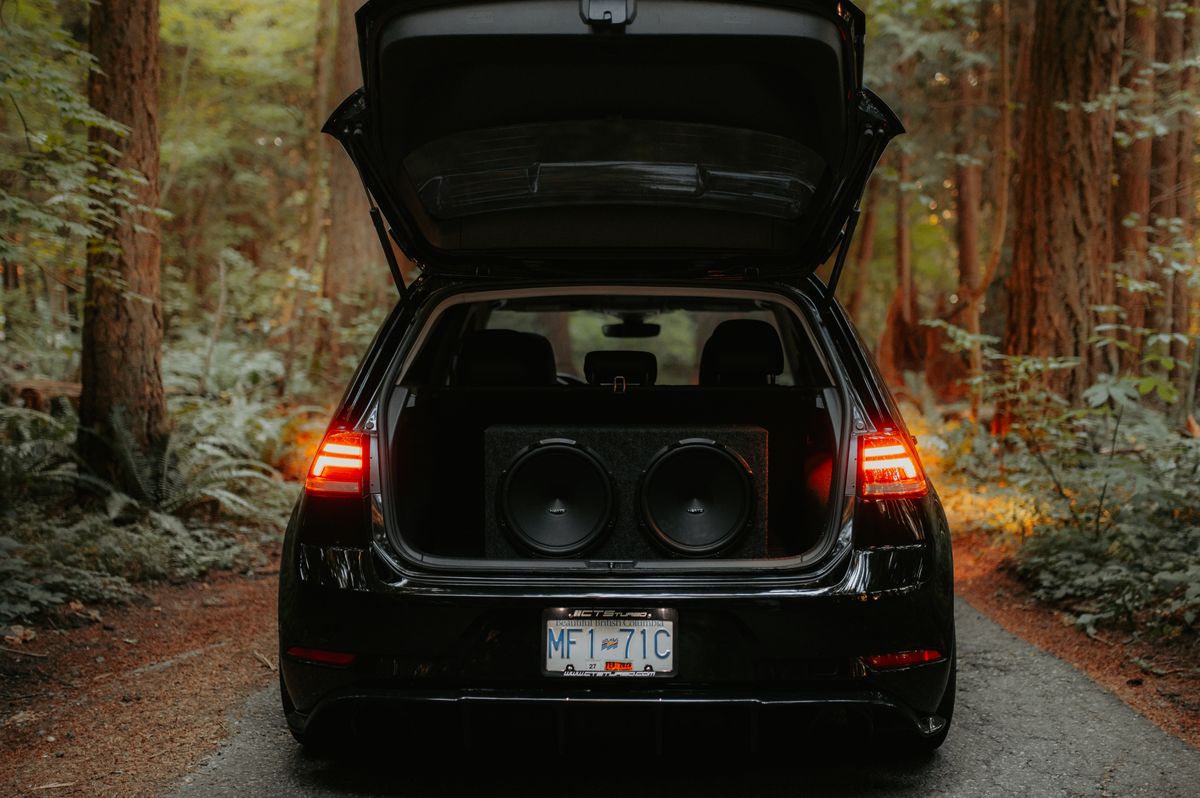
The Mustang trunk pass-through is roughly 8 inches tall on most years through the S550 platform. That rules out tall ported enclosures for any driver larger than a 10. The fix is either a shallow-mount 12 in a custom slim sealed enclosure or accepting that the box ships in two pieces and gets assembled in the trunk. The Camaro is worse on visibility but slightly better on pass-through depth. Either way, measure before you build.
Hatchbacks reward down-firing or front-firing enclosures because the cabin is the box's acoustic load. A 50-pound enclosure behind the rear seat in a Golf is loaded directly into the same space your ears occupy, which means cabin gain works in your favor and you do not pay a transfer-function penalty going through a closed trunk. It also means an unsecured box becomes a projectile in any hard stop. Bolt the enclosure to the cargo floor or strap it to the tie-down anchors. We have replaced two windshields for customers who learned this the wrong way.
Wagons split the difference between sedans and SUVs. More cargo length than a sedan, more sealed acoustic feel than a hatchback. Dual 12s sealed or a single 15 both work in an Outback-class wagon; the Volvo V60 and Audi Allroad have less floor length but enough vertical clearance for taller boxes.
What Size Subwoofer Belongs in a Crossover or SUV?
Crossovers and SUVs have more cargo volume than sedans and less cabin gain than trucks. For a compact crossover (RAV4, CR-V, Tucson, Sportage, Forester), a single 12 sealed in 1.0 ft³ is the default. For a mid-size SUV (Highlander, Pilot, Telluride, Grand Cherokee), dual 12s or a single 15 sealed becomes realistic. For a full-size SUV (Tahoe, Suburban, Expedition, Yukon), the enclosure stops being the constraint and the driver's Xmax becomes the limit.
A RAV4 has roughly 37.6 ft³ of cargo behind the second row. A Tahoe has roughly 25.5 ft³ behind the third row or 72.6 ft³ with the third row folded. That is more usable enclosure space than any single sub configuration requires. The decision shifts from "what fits" to "how much cargo are you willing to give up" and "how much amp can your electrical system feed."
Output expectations matter here. Cabin gain in a full-size SUV is weaker than in a sedan or truck because the acoustic volume is larger and the leakage to the cargo area is greater. To match the on-axis SPL at 30 Hz that a single 12 gives you in a compact crossover, you typically need dual 12s or a single 15 in the Tahoe-class vehicle. Two drivers also share excursion load and run cooler than a single driver fighting for the same SPL, which is why dual 12s in a Tahoe will typically out-last a single 15 at the same total power.
Why does truck cab configuration change everything?
Pickup truck subwoofer fitment depends entirely on cab configuration. Regular cab gives you under-seat space (typically 3 to 4 inches deep). Extended cab gives you a narrow behind-seat band (typically 3 to 5 inches deep). Crew cab gives you behind-seat space deep enough for a standard driver (typically 5 to 8 inches). The same model year truck with three different cab options is three different installs with three different drivers. That depth band is where a wedge box earns its shape, with the taper following the seat back. Our truck box guide lays out the box options by truck cab type, from under-seat in a regular cab to behind-seat in a crew cab.
Regular Cab
Most regular cabs (two-door, single-row trucks like the F-150 Regular Cab or Silverado Regular Cab) have minimal behind-seat space. The install location is under-seat or on top of the rear floor. Shallow-mount 8s and 10s with 3 to 3.5 inch mounting depth are the realistic options. A single 10 shallow in a low-profile sealed enclosure under the passenger seat gives you usable bass without sacrificing legroom or daily-use cargo on the bench.
Extended Cab
Extended cabs (SuperCab, Double Cab, Access Cab) typically have a fold-up rear bench with shallow behind-seat space. Mounting depth is the limit. A pair of shallow 10s or a single shallow 12 in a vehicle-specific enclosure fits where a standard-depth driver will not. Our direct-fit Proline X truck boxes are Ford-only: the F-150, F-250/F-350 Super Duty and Maverick (see Ford truck subwoofer enclosures for your cab and year). For a Ram, Silverado, Sierra, Tundra or other truck, measure the space and choose a universal shallow-mount box.
Crew Cab
Crew cabs (SuperCrew, Crew Cab, CrewMax) have the most behind-seat depth, typically 5 to 8 inches. That is enough for a standard-depth 10 or 12 in a behind-seat enclosure. A single 12 sealed in 0.85 to 1.0 ft³ is the most common high-output crew-cab install we build. Dual 10s sealed behind the seat is the SQ alternative; you give up some peak output for tighter transient response and a flatter cabin curve. For the placement specifics by cab style, see subwoofer placement for max bass.
How does cabin gain change the math on sub size?
Cabin gain adds roughly 12 dB per octave of low-frequency reinforcement below the cabin's transfer frequency, which sits around 70 to 90 Hz in a typical vehicle (BestCarAudio.com; Car Audio Help). The smaller the cabin, the higher that transfer frequency, and the more gain stacks on at the bottom of the octave. A sealed 10 in a Civic can produce more pressure at 30 Hz than the same sealed 10 in a Suburban because the smaller cabin amplifies the low end further before the driver runs out of stroke.
This is the part most articles get backwards. Larger vehicles do not automatically need larger subs for the same low-end response. They often need more cone area total because cabin gain is doing less work for them at 30 Hz. A 15 in a Suburban is doing the job that a 10 in a Civic gets for free from the room itself. Once you understand that the cabin is part of the system, you stop sizing the sub by personal taste and start sizing it by what the vehicle gives back.
The practical takeaway: if you drive a compact car, a regular-cab truck, or a crew-cab truck, a single high-Xmax 10 or 12 may give you everything you want and leave your usable space intact. If you drive a full-size SUV or a van, dual 12s start to make sense not because the vehicle is bigger but because the cabin gain helps you less.
When should you run multiple smaller subs vs one larger sub?
Two smaller subs almost always out-displace one larger sub at the same total cone area, because excursion divides between the drivers and thermal load divides with it. Two 10s give you 156 in² of cone area; one 12 gives you 113 in². Two 12s give you 226 in²; one 15 gives you 177 in². The pair wins on raw displacement and on thermal headroom every time, when the box and the amp can support them both.

Single drivers are the right answer when the enclosure airspace only supports one box, when the amp is single-channel and you want to avoid wiring two drivers into one output, or when the install priority is simplicity. A single 12 sealed is the most-installed aftermarket configuration because it balances output, fit, and complexity (Crutchfield). For a daily-driver music system, that single 12 is almost never the wrong call.
Pairs earn their place when you have the airspace and the amp power, especially in larger vehicles where cabin gain is weaker. Two 12s wired to a 1-ohm load on a 2000W monoblock is a common high-output truck or SUV configuration. Wiring math to remember: two 2-ohm SVC drivers in parallel present a 1-ohm load; two 4-ohm SVC drivers in parallel present 2 ohms; two 2-ohm SVC drivers in series present 4 ohms. Verify your amp's minimum stable impedance before you wire.
If you do not have time to spec your specific vehicle right now, the table below is the working starting point we use at the shop. It is free to copy, share, and embed; we just ask for a credit link back to this page when you republish or embed it. Once the table points you at a size, the car subwoofers we stock can be filtered to it directly.


