

Key Takeaways
- The Goldhorn DSP 10 is a 10-channel standalone processor at $699.99: 31-band parametric EQ per output channel, 0.02ms time alignment resolution, 108dB SNR, into your existing amplifiers via 6V RCA outputs.
- The Goldhorn DSPA 1216 Plus combines 24 channels of DSP processing with a 12-channel Class D amplifier (8×80W + 4×150W at 4Ω, 1,100W total) plus 16 unamplified RCA outputs, at $1,599.99.
- Both units accept high-level (speaker-level) inputs for OEM integration, run Bluetooth 5.0 with aptX HD, and step time alignment in 0.02ms increments, equivalent to roughly 6.9mm of distance correction per step.
- Audio Intensity is the original US importer of Goldhorn DSP. We stock, install, and tune these units and can answer build-specific questions before you order.
Picking a DSP audio processor comes down to one question before anything else: do you already have amplifiers you want to keep, or are you starting fresh? That answer determines whether a standalone processor like the Goldhorn DSP 10 makes sense, or whether the DSPA 1216 Plus all-in-one approach fits better. Both units run the same processing core, 31-band parametric EQ per output channel, Butterworth/Bessel/Linkwitz-Riley crossovers, and 0.02ms time alignment steps. Where they split is in amplification, channel count, and tuning software.
We're the original US importer of Goldhorn DSP. We run these processors in our own builds and tune them on installs daily. This post covers what the specs mean in practice, what each unit is designed for, and how to decide between them.
What Specs Actually Matter When Choosing a DSP Processor
Most DSP spec sheets lead with channel count and bury the numbers that separate competent units from frustrating ones. Here's what to look at first.
Output Channel Count
Count every speaker in your active system, including subwoofers. A front 3-way (tweeter, midrange, midbass per side) is 6 channels before you add a sub. Add rear fill and a second sub and you're at 9. Plan for where the build is going, not just where it is today. The DSP 10 tops out at 10 output channels via RCA. The DSPA 1216 Plus runs 12 amplified channels and 16 RCA pre-outs simultaneously, which covers the largest active builds without requiring a second DSP chassis.
EQ Depth and Resolution
Both Goldhorn units run 31 bands of parametric EQ per output channel with 0.1dB gain steps and Q adjustable from 0.5 to 15. That's meaningful. A unit with 15 bands per channel forces broader corrections that can't address narrow resonance peaks without affecting frequencies on either side. In a car with a hard resonance at, say, 630Hz, a narrow Q of 8 or higher lets you notch just that frequency. Wider Q values at 1.5 to 3 are better for broad shelf corrections. Having 31 bands means you're not choosing between the two approaches.
Time Alignment Resolution
Sound travels 343 meters per second at 20°C. A 0.02ms time alignment step is roughly 6.9mm of distance correction. Both Goldhorn units offer 0.02ms steps across a 0 to 20ms range per output channel. For comparison, units with 0.1ms steps can only correct distance in 34mm increments, which introduces audible alignment errors at high frequencies where the wavelengths are short. The 0.02ms resolution matters if you're doing SQ work or trying to nail a precise staging image.
SNR and THD
Both units measure >108dB SNR (A-weighted) on the RCA outputs at 6V out, with THD+N below 0.002%. Those numbers are close to the floor of what analog interconnects can actually pass cleanly to an amplifier. At those measurements you're not losing resolution in the DSP stage. The DSPA 1216 Plus amplifier section measures 0.03% THD+N and >100dB SNR at the amplified outputs, which is competitive for a multi-channel Class D at this price point.
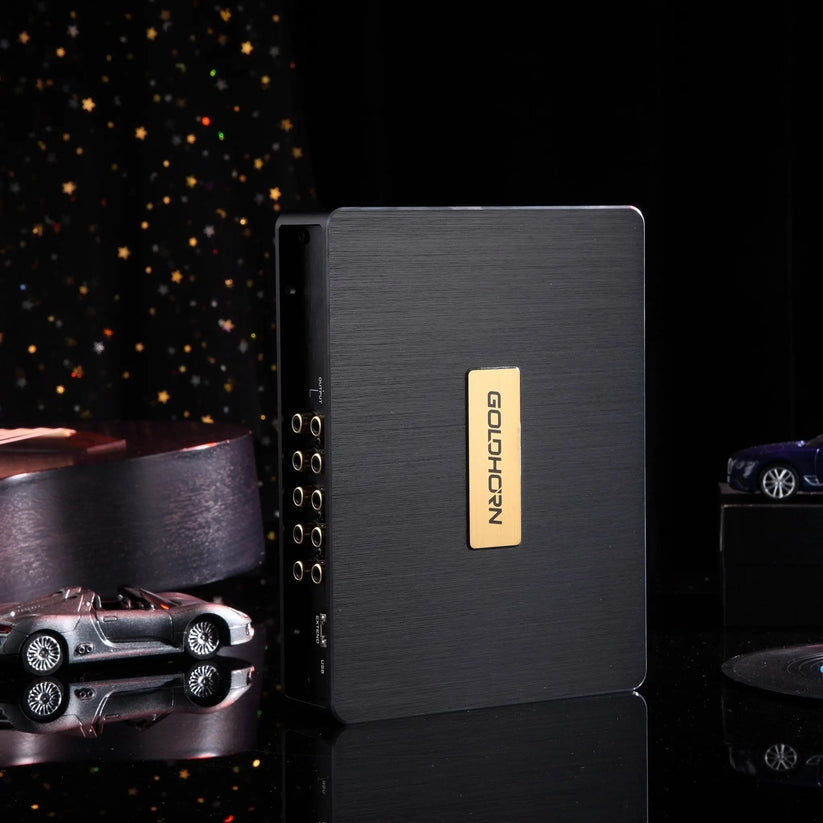
Goldhorn DSP 10: 10-Channel Standalone Processor
The DSP 10 is a standalone processor built around the Analog Devices ADAU1453 chip with a TI PCM1691 DAC and dual PCM1840 ADCs. It processes 10 independent output channels and hands the signal off to your existing amplifiers via 10 RCA outputs at 6Vrms. Frequency response is 20Hz to 40kHz (±0.5dB), SNR is >108dB A-weighted, and THD+N is <0.002% at full output. It's built into a 193 × 146 × 41mm black anodized aluminum chassis and draws under 2A.
Inputs
The DSP 10 takes signal eight ways: 8 high-level inputs (2V to 16V, 6Ω impedance) for OEM integration, one TOSLINK optical, one stereo RCA AUX, and Bluetooth 5.0 with aptX HD, aptX, AAC, and SBC. The 8-channel high-level input covers most factory speaker configurations directly. You tap the OEM wires, connect them to the high-level inputs, and the DSP flattens the factory EQ curve before reprocessing. No signal converter required.
Tuning Software
The DSP 10 uses Goldhorn's PC tuning software, connected via USB-B. The interface maps the 10 output channels directly so input routing, crossover points, time alignment, and per-channel EQ are all organized around the hardware layout. Connect, configure, and the settings store onboard. No laptop required once the tune is pushed. The software runs on Windows 7 through 11.
Additional Features
The DSP 10 includes navigation audio ducking (automatically reduces system volume when navigation prompts play), a noise gate, dynamic loudness control, 8 user-switchable presets, and Goldhorn SKYATOM surround processing. Auto turn-on works via DC offset detection or signal sensing, and it's compatible with start-stop ignition systems. The 12V remote output at 500mA handles most amplifier remote lines.
Goldhorn DSP 10
10-channel standalone DSP. 31-band parametric EQ per channel, 108dB SNR, Goldhorn PC software. Ships from Tullahoma, TN.
View the DSP 10 – $699.99Goldhorn DSPA 1216 Plus: Integrated DSP and 12-Channel Amplifier
The DSPA 1216 Plus puts 24 channels of DSP processing and a 12-channel Class D amplifier in a single 331 × 217 × 43mm chassis. Amplifier power is 8 channels at 80W RMS and 4 channels at 150W RMS, all at 4Ω, for 1,100W total system output. On the unamplified side, 16 RCA pre-outs at 6Vrms let you feed additional external amplifiers from the same DSP processing chain. At $1,599.99 it replaces a standalone DSP plus a multi-channel amplifier in a single rack slot.

Processing Core
The processing runs on an Analog Devices ADAU1463 with dual AKM AK4458VN 32-bit DACs and four TI PCM1840 ADCs. The 32-bit DACs give you 128dB dynamic range internally. For competition tuning where you stack 20 or more parametric filters per channel, the 32-bit headroom reduces rounding artifacts that accumulate when multiple operations run sequentially on the same signal. The RCA outputs measure >108dB SNR A-weighted and <0.002% THD+N at 6V out, matching the DSP 10 on unamplified output quality.
Inputs
12 high-level inputs (up to 16V) cover 6-channel OEM systems with channels to spare. Two RCA inputs (up to 3V), one TOSLINK optical (192kHz/24-bit), one coaxial S/PDIF (192kHz/24-bit), and Bluetooth 5.0 with aptX HD round out the input options. The 192kHz digital inputs are useful when you're feeding a lossless hi-res source and want the DSP's own DAC handling the conversion instead of an upstream unit.
Tuning Software
The DSPA 1216 Plus uses the same Goldhorn PC tuning software as the DSP 10, connected via USB-B. The 12 amplified channels and 16 RCA pre-outs are mapped directly in the interface, so channel assignment and routing are organized around the hardware rather than a generic signal flow. Settings store onboard once pushed. The software runs on 64-bit Windows 8, 8.1, 10, and 11.
Goldhorn DSPA 1216 Plus
12-channel Class D amp + 24 DSP channels. 8×80W + 4×150W at 4Ω, dual 32-bit AKM DACs, 16 RCA pre-outs. Ships from Tullahoma, TN.
View the DSPA 1216 Plus – $1,599.99Which Unit Fits Your Build?
Neither unit is universally better. The right choice depends on your existing hardware, channel count, and whether you're optimizing for install simplicity or tuning flexibility.
| Spec | DSP 10 | DSPA 1216 Plus |
|---|---|---|
| Output Channels | 10 RCA pre-outs | 12 amplified + 16 RCA pre-outs |
| Amplification | None (standalone) | 8×80W + 4×150W @ 4Ω (1,100W) |
| High-Level Inputs | 8 (2–16V) | 12 (up to 16V) |
| Digital Inputs | 1 × TOSLINK | TOSLINK + Coaxial S/PDIF (both 192kHz/24-bit) |
| DSP Chip | ADAU1453 | ADAU1463 |
| DAC | TI PCM1691 | Dual AKM AK4458VN (32-bit, 128dB DR) |
| RCA Output SNR | >108dB A-weighted | 108dB A-weighted |
| Tuning Software | Goldhorn PC tuning software | Goldhorn proprietary software |
| Dimensions | 193 × 146 × 41mm | 331 × 217 × 43mm |
| Price | $699.99 | $1,599.99 |
Go with the DSP 10 if: you already have amplifiers that work and you want to add DSP processing without replacing them. It also makes sense if you're running 10 channels or fewer or if you want to keep the install compact. At 193 × 146mm it fits behind most seat panels without issue.
Go with the DSPA 1216 Plus if: you're building a full active system from scratch and want to minimize box count and cabling. One unit handles the DSP processing and the amplification for up to 12 channels, with 16 additional RCA outputs available if you bolt on external amps later. The 32-bit dual AKM DAC architecture also makes it the better call for competition builds where you'll be stacking high filter counts per channel. If you're doing a full front 3-way active plus sub in a single install, this is where we'd start.
OEM Integration: High-Level Inputs Explained
Both units accept high-level speaker-level inputs, which is how you connect a DSP to a factory head unit without replacing it. The factory amp outputs an amplified signal, typically somewhere between 2V and 16V depending on the system. The DSP 10's high-level inputs handle that 2–16V range at 6Ω impedance. The DSPA 1216 Plus handles up to 16V on all 12 high-level inputs.
Most late-model OEM systems bake heavy equalization into the signal before it reaches the speaker output, often a heavy bass cut below 80Hz and a presence boost around 3kHz to compensate for cheap OEM tweeters. The DSP receives that pre-equalized signal and you then build an inverse EQ curve to flatten it before setting your own crossovers and time alignment. This is standard practice on OEM integration builds. It takes more time than starting with a clean line-level signal, but the end result is the same.
Crossover Slopes: Butterworth, Bessel, and Linkwitz-Riley
Both Goldhorn units offer three crossover filter families, each with different roll-off behavior at the crossover point. Understanding which one to use in a given situation saves time at the tune.
Butterworth filters are maximally flat in the passband and roll off at the specified slope: 6, 12, 18, 24, 30, 36, 42, or 48dB per octave. At the crossover frequency, high-pass and low-pass sum to +3dB. They're a good default for most crossover points and straightforward to implement.
Bessel filters prioritize phase linearity over a sharp roll-off. They're a better choice at the midbass-to-midrange crossover point where phase relationships affect imaging. The trade-off is a shallower effective slope at the corner frequency.
Linkwitz-Riley filters (12, 24, or 36dB/oct) are the standard for active speaker crossovers. At the crossover frequency, both filters are at −6dB and sum flat. Acoustic phase through the crossover region is 0 degrees at all orders. This makes Linkwitz-Riley the first choice for most woofer-to-midrange and midrange-to-tweeter crossovers in SQ builds where phase coherence through the crossover region is a priority.
Frequently Asked Questions
What is the difference between a standalone DSP and a DSP amplifier?
How many output channels do I need from a DSP?
What time alignment resolution do I actually need?
Can these units integrate with a factory OEM system?
What software do you use to tune the Goldhorn DSP 10 and DSPA 1216 Plus?
Where can I buy the Goldhorn DSP 10 and DSPA 1216 Plus in the US?
Scott Welch
Founder, Audio Intensity | SQ Competition Champion | Original US Importer, Goldhorn DSP
Scott runs the CNC shop and install bay at Audio Intensity in Tullahoma, Tennessee. He competes in SQ, builds the Proline X enclosure line, and installs and tunes Goldhorn DSP in his own builds. Audio Intensity is the original US importer of Goldhorn DSP processors.


