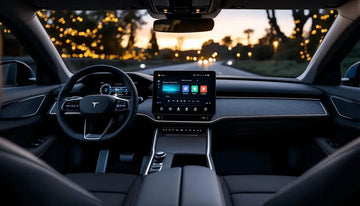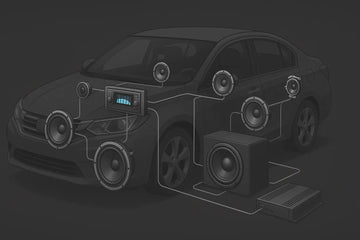

The best sound settings for car audio aren't found in a preset menu — they're built around one physical reality your head unit can't correct on its own: your car cabin distorts sound before it reaches your ears. Every vehicle interior generates cabin gain, adding approximately 12 dB per octave of bass boost below 70-90 Hz (CarAudioHelp.com). That means a completely flat EQ response inside your car isn't flat at all. It's heavily bass-boosted by physics.
Add highway road noise — which averages 66-70 dBA inside a moving vehicle (NCBI study, 2020) — and your system is working against two forces simultaneously. I've been tuning Sound Quality competition builds since 2014, and every install starts with the same two problems: too much bass that nobody asked for, and road noise masking the frequencies that make music actually sound like music. This guide covers the exact EQ, crossover, and DSP settings that account for both.
- Cabin gain adds ~12 dB/octave of bass boost below 70-90 Hz — a flat EQ produces bass-heavy sound in every car (CarAudioHelp.com)
- At 50 Hz, your ear needs 37.8 dB more SPL to sound as loud as 1 kHz — low frequencies need significant boost just to compete (ISO 226:2023)
- The THX 80 Hz crossover standard exists because humans can't localize sound below ~80 Hz — routing everything below there to your sub is acoustically correct (THX)
- A 2024 AES study found drivers consistently boost bass more when driving noise is present — static presets don't adapt to real-world conditions (AES Journal, 2024)
- FIR digital EQ scores 7.2/10 vs 6.9/10 for basic IIR EQ on subjective quality tests in real vehicle conditions (AES Paper 7575, 2008)
Video: Tuning Your Car Stereo: Head Unit EQ Process Explained by CarAudioFabrication. Step-by-step walkthrough of head-unit EQ tuning without a DSP.
Why Does Car Audio Need EQ Correction?
Your car cabin is an acoustic anomaly. When a subwoofer or woofer plays a frequency below roughly 70-90 Hz, the wavelength of that sound becomes larger than your car's interior dimensions. At that point, sound doesn't propagate the way it does in open air — it pressurizes the entire cabin instead. The result is cabin gain: a physics-driven bass boost of about 12 dB per octave below the cabin's resonance frequency (CarAudioHelp.com). It happens in every car, regardless of what equipment is installed.
The human ear compounds the problem from the other direction. ISO 226:2023 — the international standard for equal-loudness contours — establishes that hearing sensitivity varies dramatically across the frequency spectrum. At the 40-phon loudness level, a 50 Hz tone requires 77.78 dB SPL to sound as loud as a 1 kHz tone at just 40.01 dB SPL (Williams Sound Studio ISO 226 Calculator, 2023). That's a 37.77 dB gap before cabin acoustics even factor in. Your brain needs a lot of energy to perceive bass, and your car is already adding some — but not always in the right amounts.
Road noise makes the situation worse. A 2020 peer-reviewed study in MDPI's Sensors journal measured interior noise across multiple vehicles at highway speeds, finding consistent levels of 66-70 dBA (PMC/NCBI, 2020). That noise energy peaks in the 500 Hz-2 kHz range — the exact range where vocal intelligibility and instrumental clarity live. Without EQ compensation, your system fights a noise floor in the middle of the spectrum it was designed to reproduce clearly.
What Are the Best Universal EQ Settings for Car Audio?
Start with every EQ band at 0 dB, volume at 75% capacity, and use these adjustments as your foundation. They're calibrated to account for ISO 226 equal-loudness compensation, typical cabin gain, and road noise masking — not just for a flat frequency response in isolation:
| Frequency Band | Center Frequency | Adjustment | Reason |
|---|---|---|---|
| Bass | 60 Hz | +3 dB | ISO 226 sensitivity deficit at low frequencies |
| Mid-Bass | 250 Hz | +1 dB | Compensates for typical cabin nulls and road noise masking |
| Midrange | 1 kHz | 0 dB | ISO 226 and cabin gain roughly cancel here — leave it flat |
| Presence | 4 kHz | +2 dB | Adds clarity without harshness; uses ear's sensitivity peak |
| Treble | 8 kHz | +1 dB | Compensates for high-frequency absorption by seat materials |
The 0 dB midrange setting surprises a lot of people who expect more. Here's why it's correct: the cabin gain effect and the ISO 226 equal-loudness curve tend to offset each other in the 500 Hz-2 kHz range. The cabin adds energy in the bass; the ear is more sensitive in the mid-upper range. A flat midrange is the acoustically correct starting point in most vehicles, not a default or a lazy choice.
A 2024 AES study found something important about these starting points: 18 drivers in listening tests consistently applied higher bass amplification when driving noise was present, with strong individual variation (Rennies et al., Journal of the AES, Vol. 72, 2024). The implication is clear — these settings work as a starting point, but you should expect to fine-tune them based on your vehicle's noise floor and your own hearing.
From what I've seen across hundreds of installs, the +2 dB presence boost at 4 kHz consistently delivers the most noticeable improvement in perceived clarity — more than any other single adjustment. It's the range where cymbals become distinct, guitar attack becomes audible, and vocals stop feeling buried. Start there if you're limited to one adjustment.
How Do You Set the Right Crossover Points?
The THX standard uses 80 Hz for the subwoofer crossover — and not arbitrarily. Below approximately 80 Hz, the human auditory system loses the ability to localize sound directionally (THX Features Synopsis). You genuinely can't tell where bass is coming from below that frequency. That means routing everything below 80 Hz to the subwoofer — wherever it's mounted in the car — is both acoustically accurate and perceptually correct. Your brain won't register it as coming from the wrong place.
Here's the crossover setup I use on every build, from daily drivers to competition vehicles:
| Component | Crossover Point | Filter Type | Slope |
|---|---|---|---|
| Subwoofer | 80 Hz | Low-Pass | 24 dB/octave (4th-order Linkwitz-Riley) |
| Front Speakers | 80 Hz | High-Pass | 12 dB/octave |
| Tweeter | 3,500 Hz | High-Pass | 18 dB/octave |
The 24 dB/octave slope on the subwoofer channel is the same slope THX specifies in their reference home theater standard. It provides steep rejection of midrange frequencies that would make your subwoofer's location audible and introduce distortion. The shallower 12 dB/octave slope on the front speakers creates a gradual handoff with the subwoofer, producing a smoother transition through the 60-100 Hz overlap zone.
Set the tweeter crossover at 3,500 Hz minimum. Most tweeters physically can't handle sustained energy below 3 kHz without distorting or sustaining damage — and because the 2-5 kHz range is where your ear peaks in sensitivity (per ISO 226:2023), distortion in that band is the most audible distortion your system can produce. Give the tweeter a steep 18 dB/octave high-pass slope to protect it. For systems using a separate DSP amplifier, all three crossover slopes can be configured digitally with FIR filter accuracy rather than relying on the head unit's built-in analog crossover.
How Should You Tune EQ Settings for Different Music Genres?
Genre-specific tuning works as offsets from the universal starting point above — not as standalone presets. The physical difference between a hip-hop track and a classical recording isn't just taste; it's how frequency energy is distributed across the spectrum by the mixing engineer. Hip-hop deliberately concentrates energy in the 50-80 Hz sub-bass range. Classical recordings aim for flat reproduction with detailed midrange. Those different distributions require different EQ corrections on top of the cabin-gain baseline.
| Genre | 60 Hz (Bass) | 250 Hz (Mid-Bass) | 1 kHz (Midrange) | 4 kHz (Presence) | 8 kHz (Treble) |
|---|---|---|---|---|---|
| Hip-Hop / R&B | +6 dB | +2 dB | -1 dB | +2 dB | +1 dB |
| Rock | +3 dB | +1 dB | +1 dB | +4 dB | +3 dB |
| Classical / Acoustic | +2 dB | 0 dB | +2 dB | +2 dB | +3 dB |
| Pop | +4 dB | +1 dB | 0 dB | +3 dB | +2 dB |
| Jazz | +2 dB | +2 dB | +2 dB | +1 dB | +2 dB |
Values above are absolute recommended settings (not offsets from universal). Start here, then fine-tune by ear.
These genre presets come from tuning Sound Quality competition builds since 2014 across dozens of vehicle platforms. The hip-hop +6 dB bass setting gets pushback from people who've read that boosting more than 3-4 dB "damages speakers." That concern applies to excessive boost without proper crossover and gain staging — with an 80 Hz crossover in place and clean amplifier gain, +6 dB at 60 Hz is well within safe operating range for any properly rated subwoofer.
A 2024 AES study reinforces why treating these as fixed absolutes would be wrong: Rennies et al. found that 18 trained listeners showed strong individual variation in preferred EQ curves even within the same vehicle and the same driving conditions (Journal of the AES, Vol. 72, 2024). The takeaway isn't that presets don't work — it's that they work best as a launch pad, not a destination.
What Is Time Alignment and How Do You Calculate It?
Above 80 Hz — where localization becomes possible again — arrival timing is the primary cue for soundstage placement (THX). In a typical car interior, the dashboard tweeter sits 18-24 inches from your head while the trunk subwoofer sits 40-60 inches away. That distance gap means high-frequency sounds arrive at your ears milliseconds before the overlapping bass frequencies from the subwoofer. The soundstage collapses — vocals pull down to dashboard level, center image disappears.
Time alignment solves exactly this problem. It can't be fixed with EQ because EQ only adjusts volume, not timing. You need to delay the closer speaker so both sources arrive at your ears simultaneously.
The formula is straightforward:
(Distance difference in inches ÷ 1,130) × 1,000 = milliseconds of delayHere's a worked example. If your front tweeter is 20 inches from your ears and your subwoofer is 60 inches away, the distance difference is 40 inches. Divide 40 by 1,130 (the speed of sound in inches per second at room temperature): 0.0354. Multiply by 1,000 to convert to milliseconds: 35.4 ms of delay on the subwoofer channel.
Apply this delay to the closer speaker (the tweeter), not the farther one. You're holding back the closer source so it arrives at your ears at the same moment as the farther one. Most head units and DSP processors express time alignment in either milliseconds or distance (inches or centimeters) — use whichever unit your system accepts.
In my experience, time alignment delivers a more dramatic improvement to soundstage quality than any EQ adjustment. When it's dialed in correctly, the center vocal image locks in directly in front of the driver — not at the dashboard, not between the seats. I measure the distance from each driver to the listener's left ear as the reference point, which tends to produce better results than measuring to the center of the head.
How Do Advanced DSP Settings Improve Car Audio?
In a 2008 AES listening test conducted inside a Fiat Stilo, FIR-equalized car audio scored 7.2 out of 10 on a subjective quality scale vs. 6.9 out of 10 for standard IIR equalization — a statistically meaningful difference that listeners identified consistently (AES Convention Paper 7575, 2008). The gap widens at higher listening levels and with more complex source material. That 0.3-point improvement comes from one key distinction: FIR filters correct both amplitude and phase simultaneously, while basic EQ only corrects amplitude.
Digital Signal Processing corrects frequency response problems that EQ alone can't fix — specifically, the complex interaction between your car's cabin modes, speaker placement, and reflections off the windshield and side panels. A basic 5-band EQ adjusts amplitude at fixed frequencies. A DSP processor measures what the system actually outputs at your listening position and applies correction at every frequency simultaneously, including the phase correction that makes time alignment work properly across the full crossover range.

Professional 5-Step DSP Tuning Process
- Reset all EQ and crossovers to flat. Set crossovers first (subwoofer 80 Hz LP at 24 dB/oct, fronts 80 Hz HP at 12 dB/oct, tweeters 3.5 kHz HP at 18 dB/oct). Don't add EQ before crossovers are set — you're tuning the wrong signal.
- Set gain structure. Turn your head unit to 75-80% volume, then adjust amplifier gains until you hear clean sound just below clipping. Never set amp gains by ear at low volume — you'll clip the amplifier at normal listening levels.
- Apply time alignment. Measure distance from each driver to your listening position (driver's left ear as reference). Calculate delay in milliseconds and apply to each channel in your DSP.
- Apply starting EQ. Use the universal settings from the table above as a baseline, then run a measurement microphone (RTA/REW) if available. Correct only peaks over 6 dB — cutting peaks is more effective than boosting valleys.
- Fine-tune by ear with reference tracks. Use tracks you know well across multiple genres. Adjust in increments of 0.5-1 dB. Give each change a full song before deciding whether to keep it.
Video: Room EQ Wizard: Car Audio Tuning Step-by-Step Guide (2025). How to use free REW software to measure and correct your car audio system with data instead of guesswork.
Do You Need to Replace Factory Audio to Get Good Sound?
Not always — but factory system limitations are real and measurable. BestCarAudio.com tested an OEM Honda Civic speaker and found a -3 dB rolloff at 98 Hz under controlled conditions, with total harmonic distortion reaching approximately 10% THD at 80 Hz and 7% THD at 800 Hz at 25 watts (BestCarAudio.com). That 10% THD at 80 Hz is audible distortion — and it's a design constraint, not a manufacturing defect. OEM speakers are designed to fit the door panel and cost $8 wholesale, not to reproduce bass accurately.
The market reflects real demand for aftermarket quality. The global car audio market was valued at $11.10 billion in 2025 and is projected to reach $20.72 billion by 2034 at a 7.21% CAGR, with the aftermarket segment growing at 12.43% CAGR — nearly double the overall market rate (Fortune Business Insights, 2025). OEM systems held 69.12% of 2024 revenue, but the aftermarket's faster growth signals where consumer demand is moving.
The practical answer: EQ and DSP can extract surprisingly good performance from factory systems, especially premium OEM setups from Toyota, Honda, and Ford with dedicated amplifiers. What EQ can't fix is fundamental driver distortion (like that 10% THD at 80 Hz) or the physical inability to reproduce sub-50 Hz frequencies. If you want accurate bass below 60 Hz, you'll need an aftermarket subwoofer regardless of how well you tune the system. For everything above that, proper EQ and DSP tuning closes most of the gap.
Want to explore DSP amplifiers, aftermarket speakers, or subwoofers that work well alongside factory head units? All three product lines include options designed for OEM integration without a full system replacement.
Frequently Asked Questions
Start with: Bass (60 Hz) +3 dB, Mid-Bass (250 Hz) +1 dB, Midrange (1 kHz) 0 dB, Presence (4 kHz) +2 dB, Treble (8 kHz) +1 dB. These settings account for the ISO 226:2023 equal-loudness curve, which shows the human ear needs 37.8 dB more SPL at 50 Hz than at 1 kHz, and for typical cabin gain below 90 Hz. The flat midrange is intentional — cabin gain and ISO 226 sensitivity roughly cancel in the 500 Hz-2 kHz range. Fine-tune by ±1-2 dB based on your vehicle's specific acoustic characteristics and your hearing preference.
Use your car's EQ, not your phone's. If you apply EQ at both the source (Spotify, Apple Music, or a phone EQ app) and at the head unit, you're double-processing the signal. The two EQ curves stack on top of each other, creating unpredictable results that are difficult to diagnose. Set all streaming app EQ settings to flat (off) and apply all equalization through your head unit or DSP processor. The one exception: if your phone connects via Bluetooth and your head unit has no EQ, your phone's EQ is better than nothing — but replace it with a proper in-car solution when possible.
Yes, but only under specific conditions. Boosting frequencies below your crossover point drives the speaker into range it can't handle — for example, boosting bass on a tweeter without a proper high-pass crossover will destroy it. Within a properly crossed-over system, moderate boosts of 3-6 dB are safe provided your amplifier has clean headroom to deliver the extra signal without clipping. Clipped (distorted) amplifier output causes far more speaker damage than EQ boost alone. Set your amp gain structure correctly first, then apply EQ. Boost of +6 dB or more at any single band should be evaluated carefully — that's equivalent to doubling the power demand at that frequency.
Premium factory systems in 2025 vehicles — particularly Toyota's JBL systems, Ford's B&O setups, and Honda's premium audio options — are meaningfully better than budget factory audio from five years ago. They include dedicated amplification and tuning tailored to each vehicle. That said, they still face the same physical constraints: driver distortion at low frequencies (OEM Honda Civic speakers measured ~10% THD at 80 Hz in controlled tests per BestCarAudio.com), and limited sub-bass extension below 60 Hz. Aftermarket systems win decisively on dynamic range, distortion, and deep bass output — but good DSP tuning closes most of the perceptual gap for everyday listening.
A basic EQ adjusts volume at a small number of fixed frequency bands (typically 5-13). A DSP (Digital Signal Processor) does everything an EQ does, plus crossover management, time alignment, phase correction, and often room correction based on measurements from a microphone placed at your listening position. A 2008 AES study found DSP-based FIR equalization scored 7.2/10 on subjective quality tests vs. 6.9/10 for standard EQ — a difference listeners could identify consistently. For a stock system or a simple two-way setup, head-unit EQ is sufficient. For any system with a separate subwoofer, separate amplifier, or multiple crossover points, a dedicated DSP produces noticeably better results.